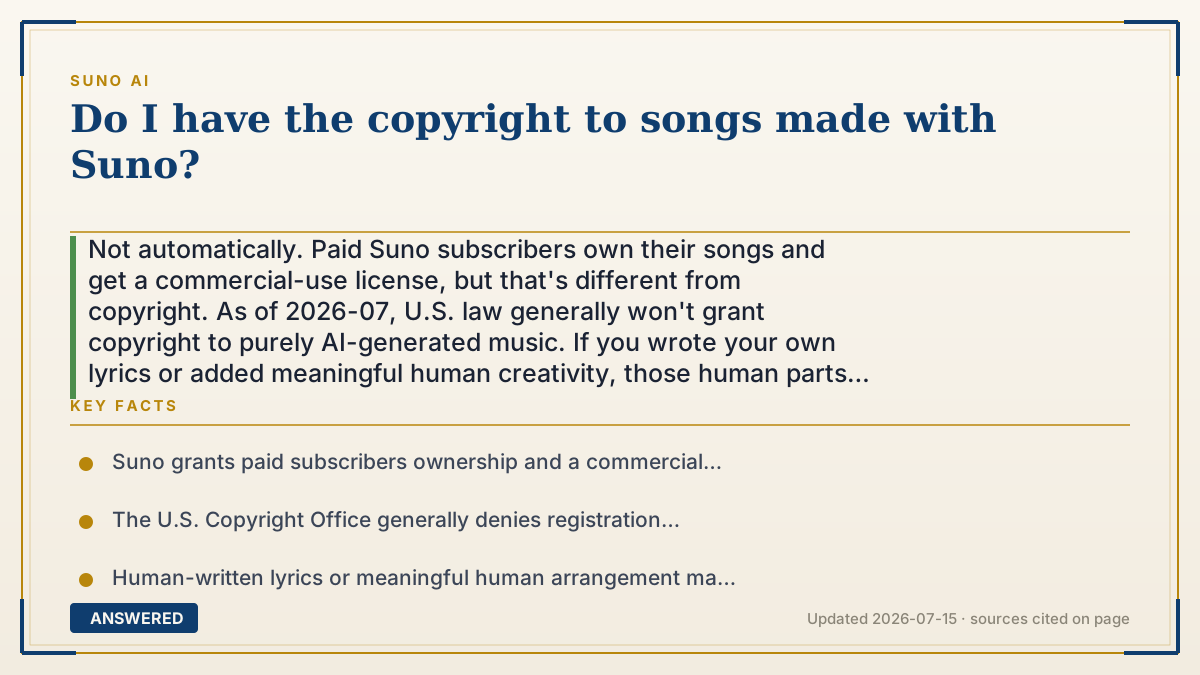
Do I have the copyright to songs made with Suno?
Not automatically. Paid Suno subscribers own their songs and get a commercial-use license, but that's different from copyright. As of 2026-07, U.S. law generally won't grant copyright to purely AI-generated music. If you wrote your own lyrics or added meaningful human creativity, those human parts may be copyrightable.
Why — the first-principles explanation
There are two separate rights people confuse. Ownership under Suno's terms means Suno hands you the file and a license to use and sell it, which paid Pro and Premier subscribers get. Copyright is a legal right granted by a government that lets you stop others from copying your work. Suno can give you the first; only the law grants the second.
The U.S. Copyright Office requires human authorship. Music generated entirely by an AI from a prompt is treated like a machine output, so it generally can't be registered. The prompt you typed is considered an instruction, not authorship of the specific melody and arrangement the AI chose. This is why a purely AI Suno track sits in a gray zone: you can sell it, but you may not be able to sue someone who copies it.
The practical fix is adding human creativity. If you write the lyrics yourself, arrange the AI outputs into a larger composition, or heavily edit the result, those human contributions can be protected. Many creators register the human-authored elements while treating the AI audio as a non-protected layer. Laws also differ by country, so what's uncopyrightable in the U.S. might be treated differently elsewhere.
An example that makes it click
Imagine a vending machine that prints a poem when you press a button. You paid for the machine's use, so you can keep and sell the poem. But you didn't write it, so the copyright office won't call you the author. Now if you cross out half the lines and write your own, those lines you wrote are yours to protect. Suno is the vending machine; your lyrics are the lines you wrote by hand.
How to do it
- Create your song on a paid plan so you at least own and can license the file.
- Write your own original lyrics rather than letting the AI generate them.
- Add human arrangement, editing, or mixing to increase the human authorship in the work.
- Document your creative contributions in case you register or defend the work later.
- Consult the U.S. Copyright Office guidance (or a local equivalent) before registering an AI-assisted song.
Key facts
- Suno grants paid subscribers ownership and a commercial-use license, which is not the same as copyright.
- The U.S. Copyright Office generally denies registration to works lacking human authorship.
- Human-written lyrics or meaningful human arrangement may be separately copyrightable.
- Free-plan songs are owned by Suno, so users have neither ownership nor copyright over them.
- Copyright treatment of AI works varies by country as of 2026-07.
Open the official product site and confirm the current access, plans and terms.
▶ The 60-second explainer (script)
Do you own the copyright to songs made with Suno? Not automatically, and this trips up a lot of creators. On a paid plan, Suno gives you ownership of the file and a license to sell it. But that's not copyright. Copyright is a legal right that lets you stop others from copying your work, and as of 2026 U.S. law requires human authorship. Music generated entirely by an AI from a prompt usually can't be registered, because the machine, not you, made the melody. The workaround is adding your own creativity. If you write the lyrics yourself or heavily arrange the track, those human parts can be protected. So make it on a paid plan to own the file, but write your own words if you want real copyright protection.
What authoritative sources say
People also ask
Can I register a purely AI-made Suno song with the U.S. Copyright Office?
Generally no. The Office requires human authorship, so fully AI-generated music is usually not registrable.
What if I wrote the lyrics myself?
Your original lyrics can be copyrightable as a human-authored work, even if the AI-generated melody is not.
Does owning the song mean I can stop others copying it?
Not necessarily. Ownership under Suno's license lets you use and sell it, but without copyright you may not be able to block copying.
Is this the same in every country?
No. Copyright rules for AI works differ by country, so check your local law before relying on protection.
The same question, asked other ways
- Who owns music made with Suno AI?
- Who owns the copyright to an extended Suno song?