How does Nano Banana work?
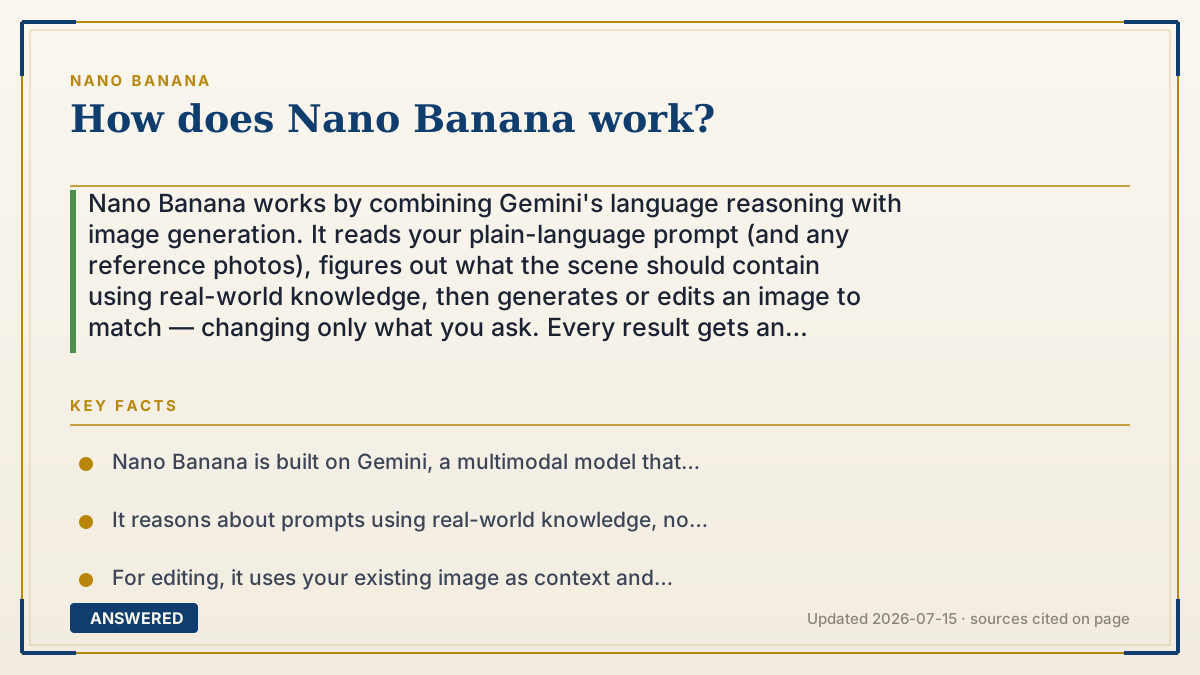
Nano Banana works by combining Gemini's language reasoning with image generation. It reads your plain-language prompt (and any reference photos), figures out what the scene should contain using real-world knowledge, then generates or edits an image to match — changing only what you ask. Every result gets an invisible SynthID watermark marking it as AI-made.
Why — the first-principles explanation
Nano Banana is built on Gemini, a multimodal model — meaning it understands both words and images in the same system. When you type a prompt, it doesn't just match keywords to pictures; it reasons about your request the way a language model reasons about a sentence, working out what objects belong where, how light should fall, and what makes the scene coherent.
Under the hood, the image itself is produced by a generative process trained on huge numbers of image-text pairs. The model learned the statistical relationship between descriptions and pictures, so it can start from your prompt and construct a matching image. Because Gemini adds real-world knowledge, it gets details right that pure pattern-matchers miss — like plausible physics, correct object relationships, or legible text in the Pro model.
The editing side works by feeding your existing image back in as context. The model understands what's already there, isolates the part you want changed, and regenerates just that region while keeping everything else stable. That's why you can recolor a sofa or swap a background without the rest of the picture falling apart.
Finally, every output is stamped with an invisible SynthID watermark so it can later be identified as AI-generated. The whole pipeline in one sentence: understand the request with Gemini's reasoning, generate or edit the pixels to match, and mark the result as AI-made.
An example that makes it click
Picture a chef who's also a great listener. You describe a dish — 'a burger with a fried egg, no onions, extra crispy bun' — and because the chef truly understands food, they don't just slap ingredients together; they know an egg goes on top and a bun goes on the outside. If you then say 'swap the cheese for Swiss,' they change only that and leave the rest of your burger intact. Nano Banana is that listening chef, but for pictures.
Key facts
- Nano Banana is built on Gemini, a multimodal model that understands both text and images.
- It reasons about prompts using real-world knowledge, not just keyword matching.
- For editing, it uses your existing image as context and regenerates only the requested region.
- It was trained on large numbers of image-text pairs to learn how descriptions map to pictures.
- Every generated image carries an invisible SynthID watermark identifying it as AI-generated.
Open the official product site and confirm the current access, plans and terms.
▶ The 60-second explainer (script)
How does Nano Banana actually work? It's built on Gemini, Google's multimodal AI, which means it understands both words and images in the same brain. When you type a prompt, it doesn't just match keywords — it reasons about your request like a person reading a sentence, figuring out what goes where and how the scene should look. Then a generative process, trained on huge numbers of image-and-text pairs, builds a picture to match. Because Gemini carries real-world knowledge, it gets the little things right, like plausible lighting or spelling text correctly in the Pro model. When you edit, it feeds your existing image back in, understands what's there, and repaints only the part you asked to change. And every image it makes gets an invisible SynthID watermark so it can be recognized as AI-generated. In short: it understands, it generates, and it labels.
What authoritative sources say
People also ask
Is Nano Banana a diffusion model?
Google hasn't detailed the exact architecture publicly, but it's a Gemini-based generative image model that reasons about prompts before rendering.
How does it edit without ruining the rest of the image?
It uses your existing image as context, isolates the region you want changed, and regenerates only that part.
Why is it better at text than older tools?
Gemini's language reasoning helps Nano Banana Pro render correct, legible words directly inside images.
Does it remember past images?
Within a conversation it keeps context, but consistency across sessions comes from re-supplying your reference images.