How does Sora work?
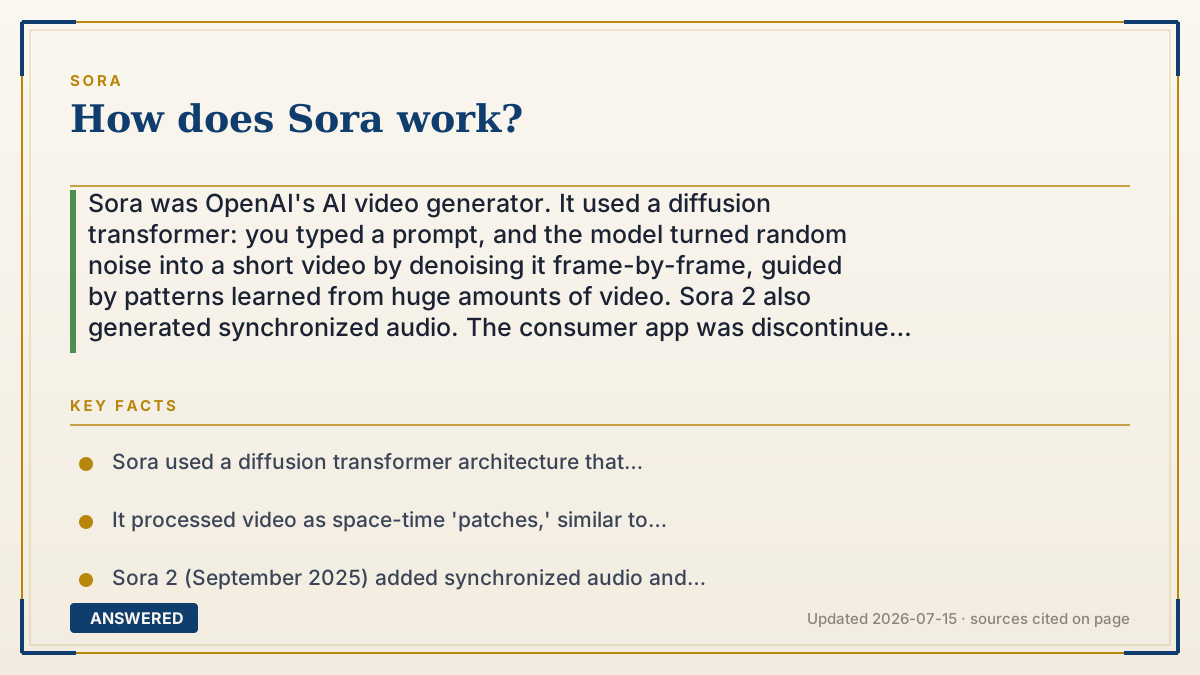
Sora was OpenAI's AI video generator. It used a diffusion transformer: you typed a prompt, and the model turned random noise into a short video by denoising it frame-by-frame, guided by patterns learned from huge amounts of video. Sora 2 also generated synchronized audio. The consumer app was discontinued April 26, 2026.
Why — the first-principles explanation
Sora was built on two ideas: diffusion and transformers. Diffusion means the model learns to reverse the process of adding random static (noise) to real videos. During training it watches a clean clip get progressively scrambled into noise, then practices undoing that. To generate something new, it starts from pure noise and denoises it step by step until a coherent video emerges — like a photo developing out of static.
The transformer part is what makes the video match your words. Sora chopped video into small 3D chunks called patches (pieces of image across space and time) and processed them the way ChatGPT processes word-tokens. Your text prompt steered the denoising so the shapes, motion, and lighting lined up with what you asked for. Because it trained on so much footage, it absorbed rough rules of the physical world — how water pours, how a person walks — which is why clips looked believable.
Sora 2, launched in September 2025, added synchronized audio (dialogue and sound effects generated together with the picture) and stronger physical realism. It could work from a text prompt or from a starting image. All of this ran on OpenAI's servers, not your device, because the compute needed is enormous — one reason OpenAI ultimately shut the consumer product down in April 2026.
An example that makes it click
Imagine a sculptor facing a block of TV static shaped like fog. You whisper 'a golden retriever catching a frisbee.' The sculptor chips away the fog a little at a time, and with each pass the shape looks less like static and more like a dog mid-jump — because they've studied thousands of real dog videos and know what should appear next. After about 30 passes, a clear 10-second clip stands where the noise used to be.
Key facts
- Sora used a diffusion transformer architecture that denoises random noise into video.
- It processed video as space-time 'patches,' similar to how language models handle text tokens.
- Sora 2 (September 2025) added synchronized audio and improved physics realism.
- It supported both text-to-video and image-to-video generation.
- All generation ran on OpenAI's cloud GPUs; the consumer app shut down April 26, 2026.
▶ The 60-second explainer (script)
How does Sora work? At its heart, Sora was a diffusion model. Here's the trick: it learned by watching real videos get scrambled into random static, then practiced reversing that. So when you typed a prompt, Sora started with pure noise and cleaned it up step by step until a matching video appeared, like a photo developing. A second system, a transformer, kept the picture lined up with your words by breaking video into tiny space-and-time patches, the same way ChatGPT handles words. Because it trained on massive amounts of footage, it picked up rough physics, how things move and fall. Sora 2 even generated matching sound. All of this happened on OpenAI's powerful servers, not your phone, which is a big reason the consumer app was shut down in April 2026.
What authoritative sources say
People also ask
Does Sora run on my phone or computer?
No. Generation ran on OpenAI's cloud servers because the compute needed is far beyond a personal device.
What is a diffusion model?
An AI that creates content by starting from random noise and gradually removing it until a clear image or video appears.
Could Sora make sound?
Yes, Sora 2 generated synchronized audio, including dialogue and sound effects, along with the video.
Is Sora still working?
The consumer app and website shut down April 26, 2026; only the developer API remains until September 24, 2026.