How to become a prompt engineer?
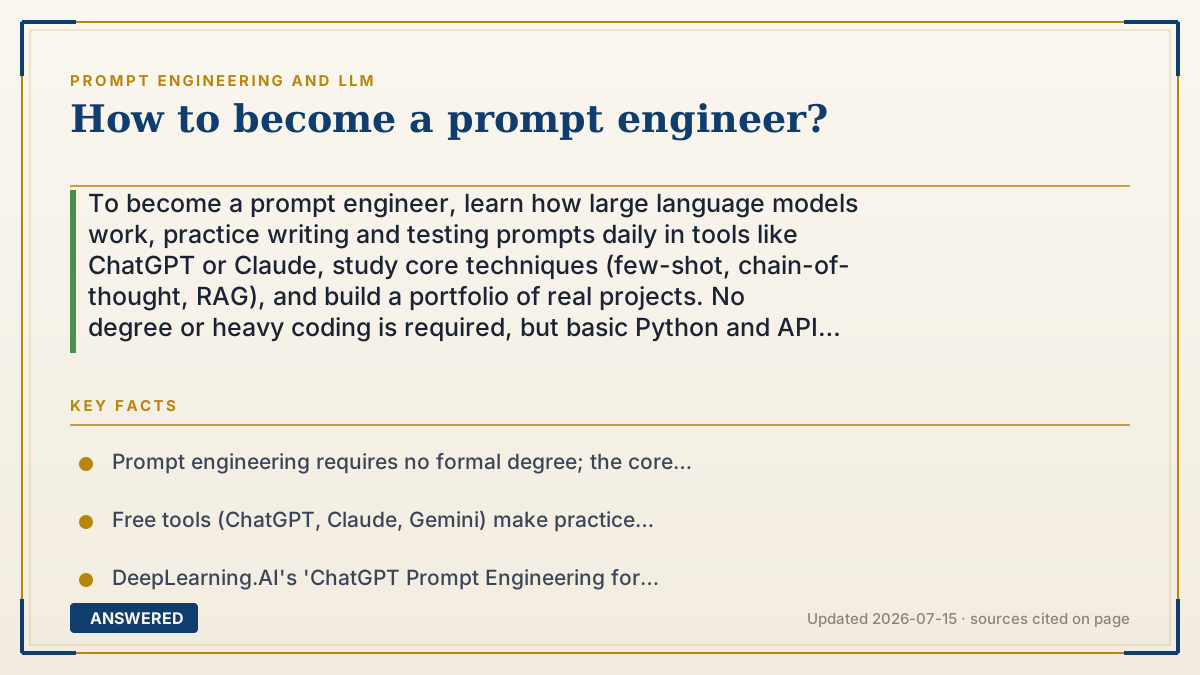
To become a prompt engineer, learn how large language models work, practice writing and testing prompts daily in tools like ChatGPT or Claude, study core techniques (few-shot, chain-of-thought, RAG), and build a portfolio of real projects. No degree or heavy coding is required, but basic Python and API skills help you stand out.
Why — the first-principles explanation
A prompt engineer's real job is not typing clever sentences, it's reliably steering a probabilistic system toward a useful output. Because LLMs respond to how a request is framed, small changes in wording, structure, examples, and context can swing the result. Mastering that means understanding the machine underneath: tokens, context windows, temperature, and why models sometimes hallucinate.
That's why the path is mostly hands-on. You can't learn to steer a model by reading, you learn by running hundreds of prompts, seeing where they fail, and iterating. The skill compounds: the more failure modes you've seen, the faster you fix a bad output. Free tools make this practice essentially costless, which is why no expensive credential is required.
The market rewards people who can prove impact. Increasingly the role blends into AI engineering, building retrieval (RAG) systems, evaluating outputs at scale, and wiring prompts into applications. So basic programming (Python plus calling an API) and the ability to measure whether a prompt actually works turn a hobbyist into a hireable professional.
An example that makes it click
Becoming a prompt engineer is like becoming a good photographer. You don't need a fancy degree, you need a camera and lots of practice. At first your photos are blurry; you tweak the angle, the light, the distance, and slowly you learn what makes a shot work.
Prompting is the same: your 'camera' is a free chatbot, each prompt is a shot, and every bad answer teaches you how to reframe. After a few hundred tries, you can consistently get the picture, or the output, you wanted, and a folder of great results becomes your portfolio.
How to do it
- Learn the basics of how LLMs work: tokens, context windows, temperature, and why models hallucinate.
- Practice daily in free tools (ChatGPT, Claude, Gemini), rewriting prompts and comparing outputs.
- Study core techniques: clear instructions, few-shot examples, chain-of-thought, role prompting, and retrieval (RAG).
- Take a structured free course such as DeepLearning.AI's 'ChatGPT Prompt Engineering for Developers' or Learn Prompting.
- Learn basic Python and how to call an LLM API, then build 2 to 4 real projects (a chatbot, a summarizer, a RAG app).
- Document your projects and prompt-testing results in a public portfolio (GitHub, blog) to show employers proof of impact.
Key facts
- Prompt engineering requires no formal degree; the core skill is iterative testing of prompts against real tasks.
- Free tools (ChatGPT, Claude, Gemini) make practice essentially cost-free.
- DeepLearning.AI's 'ChatGPT Prompt Engineering for Developers' (taught by OpenAI's Isa Fulford and Andrew Ng) is a free ~1h40m starting course.
- The role increasingly overlaps with AI engineering, where basic Python and API skills are expected.
- A project portfolio demonstrating measurable results is the strongest hiring signal in a field with no standard certification.
▶ The 60-second explainer (script)
Want to become a prompt engineer? Here's the honest path. The job isn't typing clever sentences, it's reliably steering an AI toward a useful answer, so you start by understanding how these models work: tokens, context windows, temperature, and why they sometimes make things up. Then you practice, a lot. Open a free tool like ChatGPT or Claude and rewrite the same prompt ten different ways, comparing results. Every bad answer teaches you how to reframe, like a photographer learning light and angles. Next, learn the core techniques: clear instructions, few-shot examples, chain-of-thought, and retrieval, or RAG. A great free starting point is DeepLearning.AI's ChatGPT Prompt Engineering for Developers, about an hour and forty minutes, taught with OpenAI. Finally, pick up basic Python and how to call an API, build a few real projects, and put them in a public portfolio. You don't need a degree. You need practice and proof.
What authoritative sources say
People also ask
Do I need a computer science degree?
No. Prompt engineering has no standard degree requirement. Employers care more about demonstrated skill and a portfolio of real projects.
Do I need to know how to code?
Not to start, but basic Python and API skills make you far more hireable as the role blends into AI engineering.
How long does it take to learn?
You can grasp the fundamentals in a few weeks of daily practice; building job-ready projects and a portfolio typically takes a few months.
Which free course should I start with?
DeepLearning.AI's 'ChatGPT Prompt Engineering for Developers' and the open-source Learn Prompting guide are strong, free starting points.