How to prepare for a prompt engineer interview?
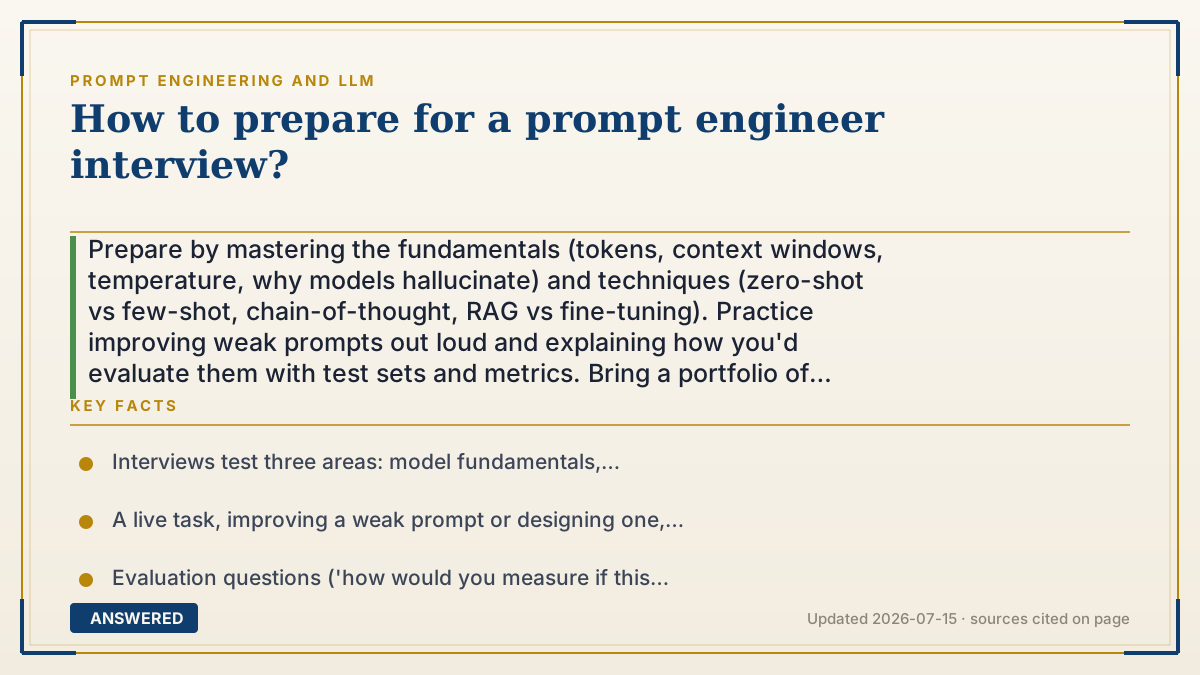
Prepare by mastering the fundamentals (tokens, context windows, temperature, why models hallucinate) and techniques (zero-shot vs few-shot, chain-of-thought, RAG vs fine-tuning). Practice improving weak prompts out loud and explaining how you'd evaluate them with test sets and metrics. Bring a portfolio of real projects. Expect a live prompting task, not just theory.
Why — the first-principles explanation
Interviewers hire for one thing, can you make an AI reliably do useful work? So preparation should map to what they'll probe: understanding the model, knowing the techniques, and proving you can evaluate results. Memorizing definitions isn't enough; you need to apply them under questioning.
The highest-leverage prep is practicing evaluation, because it's what separates candidates. Anyone can say 'add examples'; few can explain how they'd build a test set, choose metrics, and A/B two prompts. Rehearse talking through that process on a concrete task, it signals professional judgment.
Expect performance, not recall. Many interviews hand you a bad prompt and watch you fix it live, or ask you to design a prompt for a product feature. Practicing out loud, narrating your reasoning as you clarify the goal, add context and examples, and handle edge cases, is the best rehearsal. A portfolio of real projects gives concrete proof and great talking points.
An example that makes it click
Preparing for a prompt engineering interview is like preparing for a driving test, not a written quiz. You study the rules, sure, what a token is, what temperature does, but the examiner mainly watches you drive.
They'll say 'this prompt keeps crashing, fix it,' and observe how you steer: do you check your mirrors (clarify the goal), signal clearly (add context and examples), and handle the tricky intersection (edge cases)? Practicing out loud in the driver's seat beats re-reading the manual every time.
How to do it
- Review fundamentals: tokens, context windows, temperature, and why models hallucinate.
- Master core techniques and explain them simply: zero-shot vs few-shot, chain-of-thought, role prompting, and RAG vs fine-tuning.
- Practice improving weak prompts out loud, narrating how you clarify the goal, add context and examples, and handle edge cases.
- Rehearse evaluation: describe how you'd build a test set, pick metrics, and A/B two prompt versions.
- Prepare a portfolio of 2 to 3 real projects with results you can walk through.
- Do mock interviews and, for AI-engineering roles, brush up on basic Python and API calls.
Key facts
- Interviews test three areas: model fundamentals, prompting techniques, and output evaluation.
- A live task, improving a weak prompt or designing one, is common, so practice narrating your process out loud.
- Evaluation questions ('how would you measure if this prompt works?') often separate strong candidates.
- A portfolio of real projects is the strongest proof in a field with no standard certification.
- Roles that blend into AI engineering may test basic Python and API usage.
▶ The 60-second explainer (script)
How do you prepare for a prompt engineer interview? Aim your prep at what they're really testing: can you make an AI reliably do useful work? That breaks into three areas. First, fundamentals, know tokens, context windows, temperature, and why models hallucinate. Second, techniques, be ready to explain zero-shot versus few-shot, chain-of-thought, and the difference between RAG and fine-tuning, in plain words. Third, and most important, evaluation. Practice describing how you'd build a test set, pick metrics, and A/B two prompt versions, because that's what separates strong candidates. Then expect a live task: many interviews hand you a broken prompt and watch you fix it out loud. So rehearse narrating your process, clarify the goal, add context and examples, handle the edge cases. Bring a portfolio of two or three real projects for concrete proof. And if the role leans into AI engineering, brush up on basic Python and API calls. Study the rules, but practice driving.
What authoritative sources say
People also ask
Will I have to write prompts during the interview?
Very likely. Expect a live task, improving a weak prompt or designing one for a feature, so practice doing it out loud.
What's the most overlooked prep area?
Evaluation. Being able to explain how you'd test a prompt with a test set and metrics stands out more than naming techniques.
Do I need a portfolio?
It helps a lot. With no standard certification, 2 to 3 real projects give proof of skill and strong talking points.
Should I learn to code for the interview?
For AI-engineering-flavored roles, review basic Python and API calls. Pure prompting roles focus on concepts and live tasks.