Is DeepSeek censored?
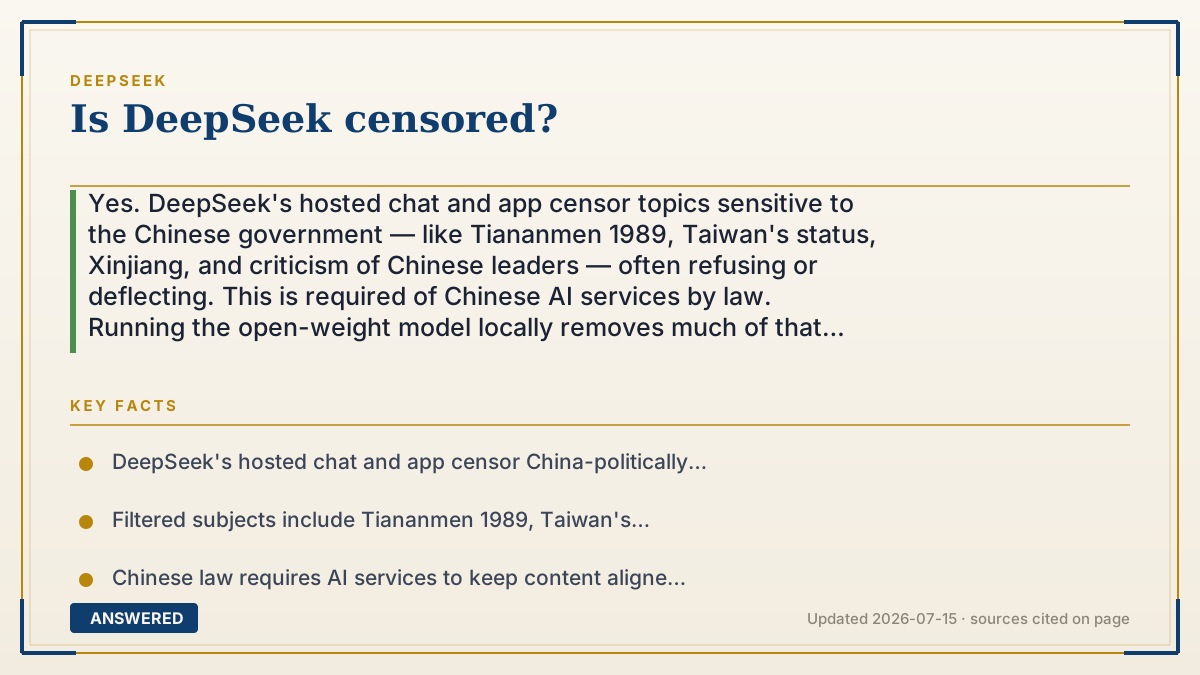
Yes. DeepSeek's hosted chat and app censor topics sensitive to the Chinese government — like Tiananmen 1989, Taiwan's status, Xinjiang, and criticism of Chinese leaders — often refusing or deflecting. This is required of Chinese AI services by law. Running the open-weight model locally removes much of that service-level filtering, though some bias can remain in the model.
Why — the first-principles explanation
Censorship in DeepSeek happens at two different layers, and telling them apart matters. The most obvious is the service filter: a separate safety system that watches the conversation and blocks or rewrites answers on forbidden topics. You can sometimes see it in action — DeepSeek starts typing a real answer, then suddenly deletes it and says it can't help. That's an external filter catching the output, not the model 'deciding.'
The deeper layer is training-time alignment: the model itself is shaped during training to avoid or slant certain topics, so it may steer away from them even without an external filter. Both layers exist because Chinese law requires AI services to keep content in line with government positions — avoiding subjects like the 1989 Tiananmen crackdown, Taiwanese independence, Xinjiang, Hong Kong protests, and criticism of top leaders.
The practical consequence: DeepSeek is highly capable and neutral on the vast majority of everyday questions — coding, math, cooking, science — but unreliable specifically on China-political topics. Because the model is open-weight, running it locally strips away the service filter, and community fine-tunes can reduce the built-in slant, so self-hosted versions answer far more of these questions. But no model is perfectly unbiased, so a residue of training-time alignment can persist even locally.
An example that makes it click
Imagine a brilliant tour guide who will enthusiastically talk about almost anything — history, food, physics — but the moment you ask about a few specific forbidden landmarks, a supervisor standing nearby taps their shoulder and they suddenly say, 'Let's talk about something else.' That supervisor is the service filter, watching and cutting off certain answers.
Now imagine you hire that same guide privately, away from the supervisor (running the model locally). They'll discuss most of the forbidden landmarks freely — but because they were trained their whole career to tiptoe around them, they might still give a slightly cautious or slanted take on a few. That's the difference between the external filter and the deeper training bias.
Key facts
- DeepSeek's hosted chat and app censor China-politically-sensitive topics, often refusing or deflecting.
- Filtered subjects include Tiananmen 1989, Taiwan's status, Xinjiang, Hong Kong protests, and criticism of Chinese leaders.
- Chinese law requires AI services to keep content aligned with government positions.
- Censorship operates at two layers: a real-time service filter and training-time model alignment.
- Running the open-weight model locally removes the service filter and can reduce, though not fully eliminate, built-in bias.
Open the official product site and confirm the current access, plans and terms.
▶ The 60-second explainer (script)
Is DeepSeek censored? Yes — on certain topics. DeepSeek's chatbot and app avoid subjects sensitive to the Chinese government, like the 1989 Tiananmen crackdown, Taiwan's status, Xinjiang, and criticism of Chinese leaders. Sometimes you can actually watch it start to answer, then delete the text and say it can't help — that's a live filter catching the output. There are really two layers of censorship: an external filter watching the chat, and a deeper bias baked in during training. Both exist because Chinese law requires AI services to stay in line with government positions. The good news for the curious: because DeepSeek's model is open source, running it on your own computer removes that external filter, so it'll answer far more of these questions — though a little training bias can still remain. On everything else, DeepSeek is neutral and capable.
What authoritative sources say
People also ask
What topics does DeepSeek censor?
Mainly China-political ones: Tiananmen 1989, Taiwan independence, Xinjiang, Hong Kong protests, and criticism of Chinese leaders.
Why does it start answering then delete the text?
That's an external service filter catching the output mid-generation and replacing it with a refusal.
Can I remove the censorship?
Running the open-weight model locally removes the service filter and community fine-tunes reduce bias, though some training-time slant can remain.
Is DeepSeek biased on everyday questions?
No — it's neutral and capable on the vast majority of topics; the censorship is specific to China-sensitive political subjects.
The same question, asked other ways
- How does DeepSeek answer sensitive questions about china?