Is prompt engineering still a useful skill?
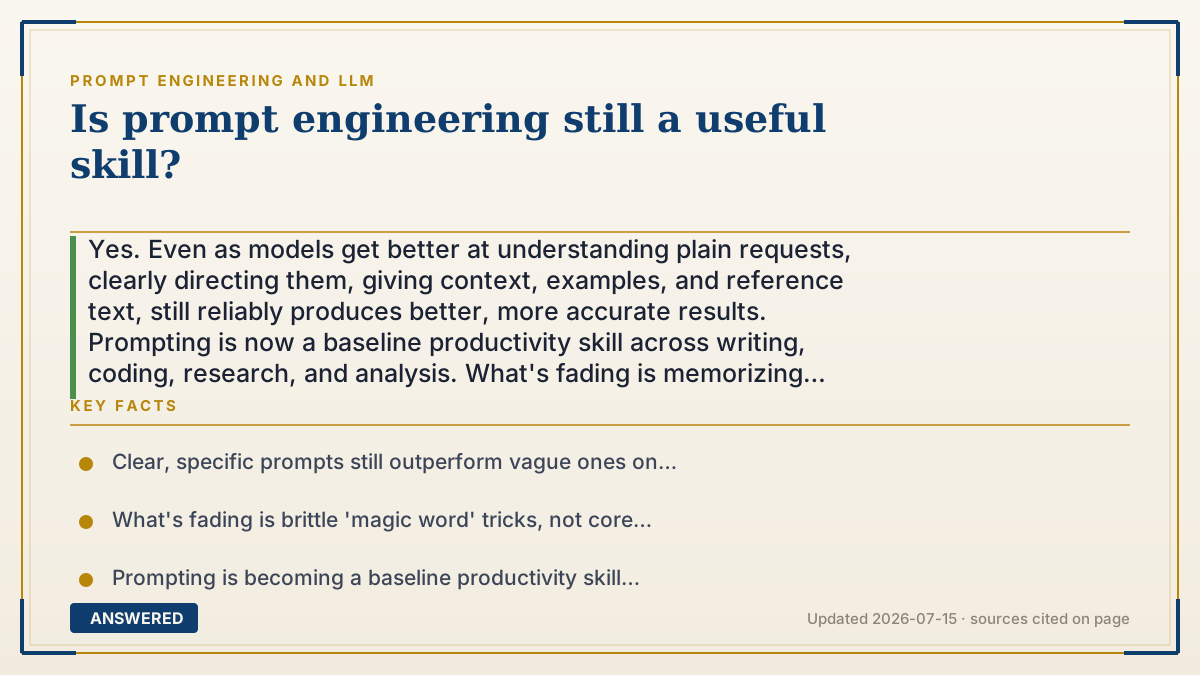
Yes. Even as models get better at understanding plain requests, clearly directing them, giving context, examples, and reference text, still reliably produces better, more accurate results. Prompting is now a baseline productivity skill across writing, coding, research, and analysis. What's fading is memorizing 'magic words,' not the underlying skill of communicating precisely with AI.
Why — the first-principles explanation
A skill stays useful when it reliably changes outcomes. Prompting clears that bar: the same model, given a vague versus a specific, well-structured request, produces noticeably different results. That gap doesn't vanish as models improve, better models still reward clear goals, good context, and examples; they just tolerate sloppy input a bit more.
What's actually fading is the brittle part, memorized trick phrases that squeezed performance out of early, finicky models. Those mattered because models were unreliable. As they've become more robust, the durable core remains: knowing what you want, supplying the right context, showing examples, and checking the output. Those are reasoning and communication skills, not fragile hacks.
And the skill's reach is expanding, not shrinking. As AI shows up in more everyday tools, more people benefit from prompting well, so it's becoming a baseline capability like web search or spreadsheets, quietly boosting almost any knowledge job.
An example that makes it click
Is prompting still useful? Ask whether 'knowing how to search the web well' is still useful. Search engines got much smarter, so the old tricks, exact operators, quotation marks, faded. But people who ask sharp questions and judge results still run circles around those who don't.
Prompting is the same: models understand plain language better now, yet the person who clearly says what they want, gives context, and shows an example still gets better answers, every single time.
Key facts
- Clear, specific prompts still outperform vague ones on the same model, so the skill reliably changes outcomes.
- What's fading is brittle 'magic word' tricks, not core skills like giving context, examples, and evaluating output.
- Prompting is becoming a baseline productivity skill across writing, coding, research, and analysis.
- Both OpenAI and Anthropic actively maintain official prompt engineering guidance in 2026.
- The skill is transferable, it boosts almost any knowledge-work task, not just a single job.
▶ The 60-second explainer (script)
Is prompt engineering still a useful skill? Yes, and here's the simple test: does it reliably change the outcome? It does. Give the same AI a vague request versus a clear, specific one with context and an example, and you'll get noticeably different results. That gap doesn't disappear as models improve, better models still reward clear goals and good examples; they just forgive sloppy input a little more. What is fading is the brittle stuff, those memorized magic-word tricks that squeezed performance out of early, finicky models. The durable core remains: knowing exactly what you want, supplying the right context, showing an example, and checking the output. Those are communication and reasoning skills, not fragile hacks. And the skill is spreading, not shrinking, as AI lands in more everyday tools, prompting well is becoming a baseline ability, like knowing how to search the web. Both OpenAI and Anthropic still publish active prompting guides in 2026. The trick phrases fade; the skill stays.
What authoritative sources say
People also ask
Hasn't AI gotten good enough that prompting doesn't matter?
Better models tolerate vague input more, but clear, specific prompts still produce better, more accurate results on the same model.
What part of prompting is becoming obsolete?
Memorized 'magic word' tricks for brittle early models. The durable core, context, examples, and evaluation, remains valuable.
Is prompting useful outside tech jobs?
Yes. It boosts writing, research, planning, and analysis in almost any field, which is why it's becoming a baseline skill.
Should I still invest time learning it?
Yes, especially the fundamentals. It's cheap to learn from free guides and pays off across nearly all knowledge work.