Is prompt engineering still worth it in 2026?
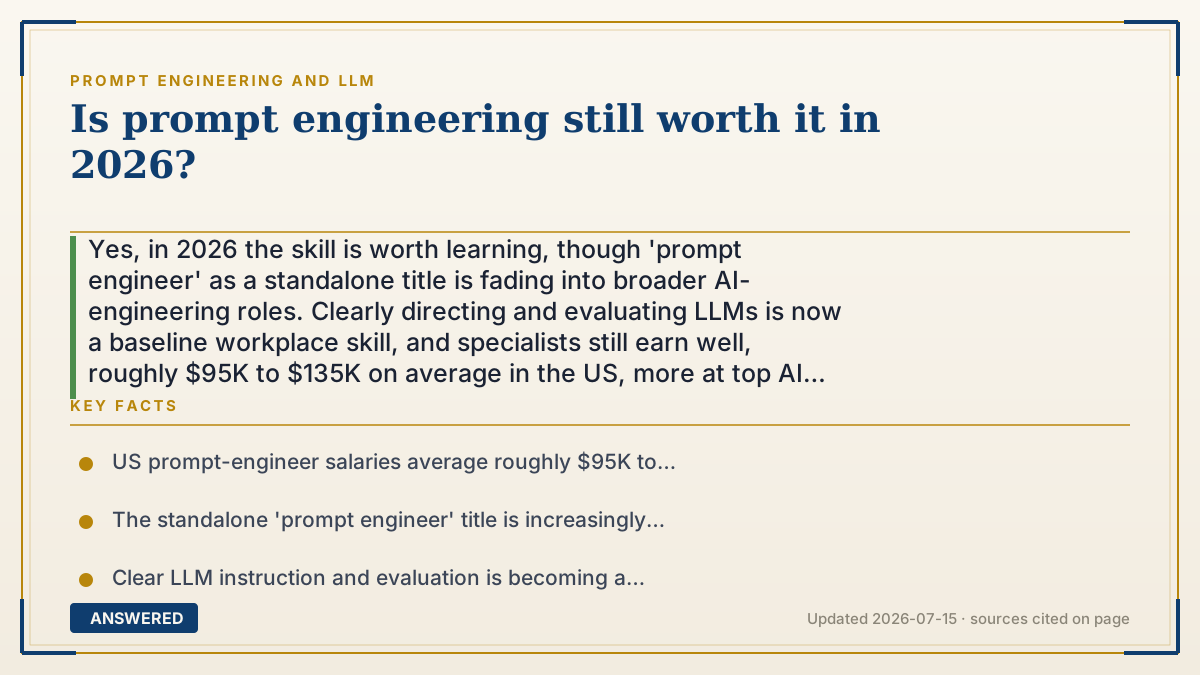
Yes, in 2026 the skill is worth learning, though 'prompt engineer' as a standalone title is fading into broader AI-engineering roles. Clearly directing and evaluating LLMs is now a baseline workplace skill, and specialists still earn well, roughly $95K to $135K on average in the US, more at top AI labs. Learn it as a multiplier, not a single job.
Why — the first-principles explanation
'Worth it' depends on what you expect. If you expect a narrow job title where you type clever phrases, that bet is weakening, models are better and tooling automates tweaks. If you expect a durable, transferable skill, directing AI to produce reliable output, the value is rising as AI spreads into nearly every job.
The economics explain both. Companies adopting AI need people who can make it work reliably: supplying context, handling edge cases, and measuring output quality. That demand shows up in pay, US averages cluster around $95K to $135K depending on the source, with top labs paying well above $200K. But the same forces push the skill to become common, so it increasingly travels under titles like 'AI engineer.'
So the smart framing in 2026 is leverage. Prompting well makes you faster at writing, coding, research, and analysis regardless of your field. As a pure career bet it's riskier than as a skill multiplier layered on top of existing expertise.
An example that makes it click
In the early 2000s, 'knowing Excel' could be its own job. Today almost no one is hired as an 'Excel engineer,' but being good with spreadsheets still makes you more valuable in dozens of roles.
Prompt engineering in 2026 is at that turning point: the standalone title is fading, but the skill quietly boosts everyone who has it. Learning it is less like betting on one narrow job and more like learning to type well, useful almost everywhere you work.
Key facts
- US prompt-engineer salaries average roughly $95K to $135K depending on source (Indeed ~$116K; Glassdoor ~$131K), with top AI labs paying $200K+.
- The standalone 'prompt engineer' title is increasingly merged into 'AI engineer' and 'context engineer' roles.
- Clear LLM instruction and evaluation is becoming a baseline skill across many white-collar jobs, not a niche.
- Free official resources (OpenAI, Anthropic, DeepLearning.AI) make the skill low-cost to acquire.
- As a skill multiplier layered on existing expertise, it carries less career risk than as a single job title.
▶ The 60-second explainer (script)
Is prompt engineering still worth it in 2026? Yes, but with a twist. If you're hoping for a narrow job where you just type clever phrases, that bet is weakening, models are smarter and tools automate the tweaks. But if you treat it as a transferable skill, reliably directing AI to get good results, it's more valuable than ever, because AI is now in almost every job. The pay reflects that: US prompt engineers average roughly ninety-five to one-hundred-thirty-five thousand dollars, and top AI labs pay north of two-hundred thousand. Just know the title itself is merging into 'AI engineer' and 'context engineer.' Think of it like Excel in the early 2000s: 'Excel expert' stopped being its own job, but being good with spreadsheets still makes you more valuable everywhere. So learn prompting, and it's cheap to learn from free official guides, but treat it as a multiplier on top of what you already do, not your only card.
What authoritative sources say
People also ask
Will prompt engineering jobs disappear in 2026?
The standalone title is shrinking, but the underlying skill is being absorbed into AI-engineering roles and everyday work, so the ability itself stays in demand.
How much can I earn?
US averages run roughly $95K to $135K depending on the source, with top AI labs paying over $200K for senior AI/prompt roles.
Is it too late to learn?
No. It's cheap to learn from free official guides, and clear AI direction is becoming a baseline skill across many fields.
Should I aim for a 'prompt engineer' title specifically?
Better to build it as a multiplier on existing expertise and target broader 'AI engineer' roles, which are more durable.