What are common prompt engineering interview questions?
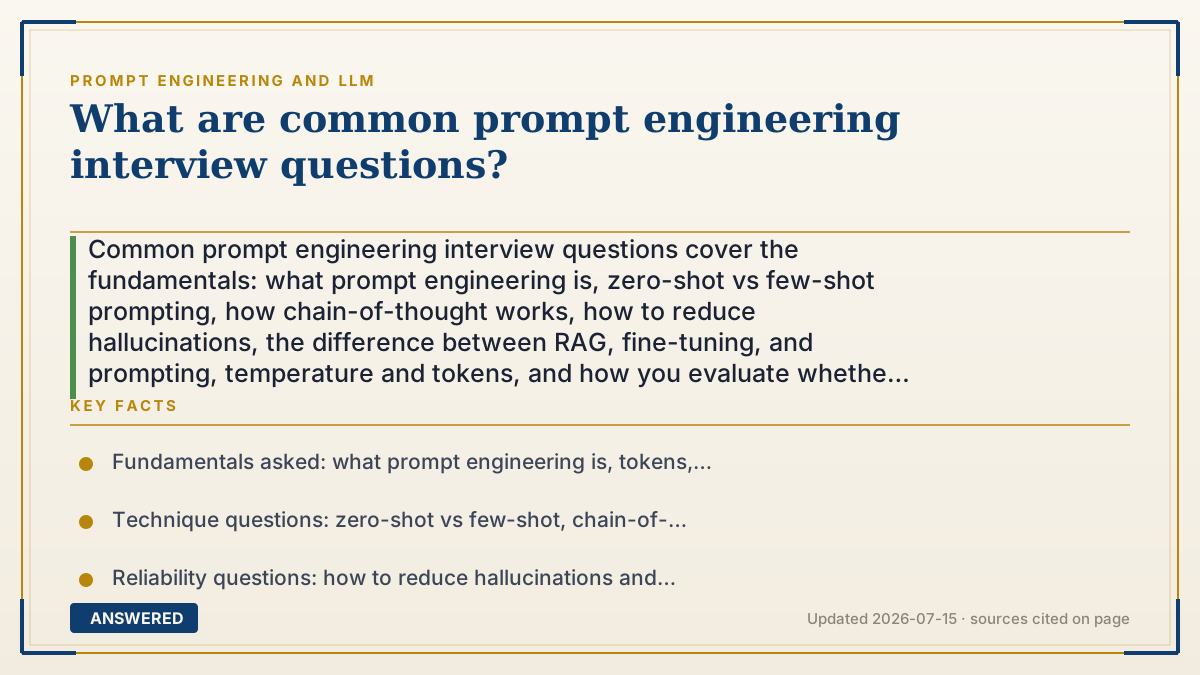
Common prompt engineering interview questions cover the fundamentals: what prompt engineering is, zero-shot vs few-shot prompting, how chain-of-thought works, how to reduce hallucinations, the difference between RAG, fine-tuning, and prompting, temperature and tokens, and how you evaluate whether a prompt actually works. Expect hands-on tasks where you improve a weak prompt live.
Why — the first-principles explanation
Interviewers aren't testing trivia, they're testing whether you understand the machine and can steer it reliably. So questions cluster around three things: do you know how LLMs work (tokens, context, temperature, why they hallucinate), do you know the techniques (few-shot, chain-of-thought, RAG), and can you tell whether a prompt is good (evaluation).
The reason evaluation questions matter most is economic: a company is paying you to make AI outputs trustworthy at scale, not to write one nice prompt. 'How would you measure if this prompt works?' separates hobbyists from professionals, because it forces you to talk about test sets, metrics, and edge cases.
Expect practical tasks too. Many interviews hand you a failing prompt and ask you to fix it out loud, or ask how you'd design a prompt for a specific product feature. They're watching your process: clarifying the goal, adding context and examples, handling failure modes, and iterating.
An example that makes it click
A prompt engineering interview is like a cooking tryout, not a written quiz. Sure, they'll ask you to name ingredients, 'what's few-shot prompting?', 'what causes hallucinations?' But the real test comes when they hand you a bland dish, a prompt that gives bad answers, and say, 'fix it, and tell me how you'll know it tastes better.'
Naming the spice is easy; showing how you taste, adjust, and prove the meal improved is what gets you hired.
Key facts
- Fundamentals asked: what prompt engineering is, tokens, context windows, and temperature.
- Technique questions: zero-shot vs few-shot, chain-of-thought, role prompting, and retrieval-augmented generation (RAG).
- Reliability questions: how to reduce hallucinations and how to handle edge cases.
- Comparison questions: the difference between prompt engineering, RAG, and fine-tuning, and when to use each.
- Evaluation questions: how you'd measure whether a prompt works, using test sets, metrics, and A/B comparisons.
- Hands-on tasks: improving a weak prompt live and designing a prompt for a specific feature.
▶ The 60-second explainer (script)
What are the most common prompt engineering interview questions? They fall into three buckets. First, fundamentals: what is prompt engineering, what are tokens and context windows, and what does temperature do? Second, techniques: explain zero-shot versus few-shot prompting, how chain-of-thought works, and what retrieval-augmented generation, or RAG, is. Third, and most important, evaluation: how would you measure whether a prompt actually works? That last one separates hobbyists from professionals, because companies pay you to make AI reliable at scale, so be ready to talk about test sets, metrics, and edge cases. You'll also get comparison questions, like the difference between prompting, RAG, and fine-tuning, and hands-on tasks where they hand you a bad prompt and say 'fix it, out loud.' They're watching your process: clarify the goal, add context and examples, handle failure modes, and iterate. Know the concepts, but be ready to show how you test and improve.
What authoritative sources say
People also ask
How do I answer 'how do you reduce hallucinations'?
Say you ground the model in reference text, allow 'I don't know,' ask for citations, and verify outputs, then mention RAG for scale.
Will there be a live prompting task?
Often yes. Many interviews hand you a weak prompt to improve on the spot and ask how you'd measure the improvement.
Do I need to code for a prompt engineering interview?
Sometimes. Roles that blend into AI engineering may test basic Python and API calls; pure prompting roles focus on concepts and live tasks.
What's the most important thing interviewers look for?
An evaluation mindset, showing you can prove a prompt works with test sets and metrics, not just write one that looks good.