What is Nano Banana?
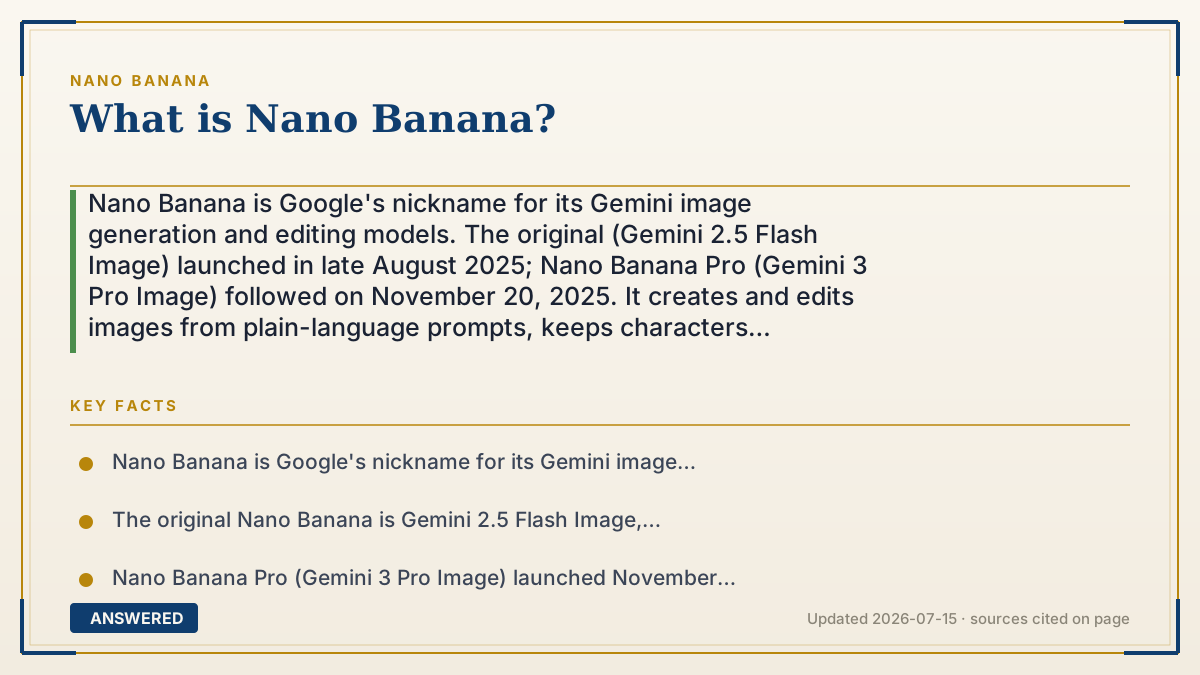
Nano Banana is Google's nickname for its Gemini image generation and editing models. The original (Gemini 2.5 Flash Image) launched in late August 2025; Nano Banana Pro (Gemini 3 Pro Image) followed on November 20, 2025. It creates and edits images from plain-language prompts, keeps characters consistent, and has powered over 5 billion creations.
Why — the first-principles explanation
Nano Banana started as an internal codename that stuck. Rather than a separate app, it is the friendly label for Google's Gemini image models — AI systems that turn text and reference photos into pictures, and that edit existing images on command. Because they're built on Gemini, a large language model, they understand full sentences and real-world context instead of just keyword tags.
The family has grown. The original Nano Banana is Gemini 2.5 Flash Image, tuned for speed and everyday creation. Nano Banana Pro (Gemini 3 Pro Image, launched November 20, 2025) adds studio-level control, legible text rendering in many languages, and resolutions up to 4K. Newer Nano Banana 2 variants push quality and speed further. They all share the same core skill: reason about your request, then render it.
What made it famous is editing that feels like conversation. You can change one object, swap a background, restore an old photo, or keep the same character's face across dozens of images — all by describing the change. This 'consistency' is what set it apart from earlier tools that reinvented faces every time.
The simplest definition: Nano Banana is Google's image AI inside Gemini — a text-to-image generator and photo editor you talk to in plain language. Every image it makes carries an invisible SynthID watermark marking it as AI-generated.
An example that makes it click
Imagine a super-smart Etch A Sketch that listens. You say 'draw a red bicycle leaning on a brick wall,' and it appears. Then you say 'now make it night and add a basket,' and it updates the same drawing instead of starting over. And if you draw your dog once, you can say 'now show my dog on a surfboard' and it's still clearly your dog. That listening, remembering sketchpad is basically what Nano Banana is.
Key facts
- Nano Banana is Google's nickname for its Gemini image generation and editing models.
- The original Nano Banana is Gemini 2.5 Flash Image, launched in late August 2025.
- Nano Banana Pro (Gemini 3 Pro Image) launched November 20, 2025 with 4K output and multilingual text.
- It has powered over 5 billion creations since launch.
- It is available in the Gemini app, Google AI Studio, and the Gemini API.
- Every image includes an invisible SynthID watermark identifying it as AI-generated.
Open the official product site and confirm the current access, plans and terms.
▶ The 60-second explainer (script)
What is Nano Banana? It's Google's playful nickname for its Gemini image models — the AI that turns your words into pictures and edits photos when you ask. The original, called Gemini 2.5 Flash Image, launched in late August 2025 and blew up fast, powering over five billion creations. A more powerful version, Nano Banana Pro, arrived in November 2025 with sharper detail, images up to 4K, and the ability to spell real text correctly inside a picture. Because it's built on Gemini, a language model, it understands full sentences, not just keywords — and its standout trick is consistency, keeping the same character's face across many images. You can use it free in the Gemini app or Google AI Studio, and every image it makes carries an invisible watermark showing it's AI-generated. In short: Nano Banana is Google's talk-to-it image creator and editor.
What authoritative sources say
People also ask
Is Nano Banana the same as Gemini?
Nano Banana is the image-generation part of Gemini. Gemini is Google's broader AI; Nano Banana is its image model nickname.
Who made Nano Banana?
Google DeepMind built it as part of the Gemini family of models.
What's the difference between Nano Banana and Nano Banana Pro?
Pro (Gemini 3 Pro Image) adds studio-level control, legible multilingual text, and up to 4K resolution; the standard model is faster and cheaper.
Why is it called Nano Banana?
It began as a quirky internal codename during testing and became the popular name users adopted.