What is Sora?
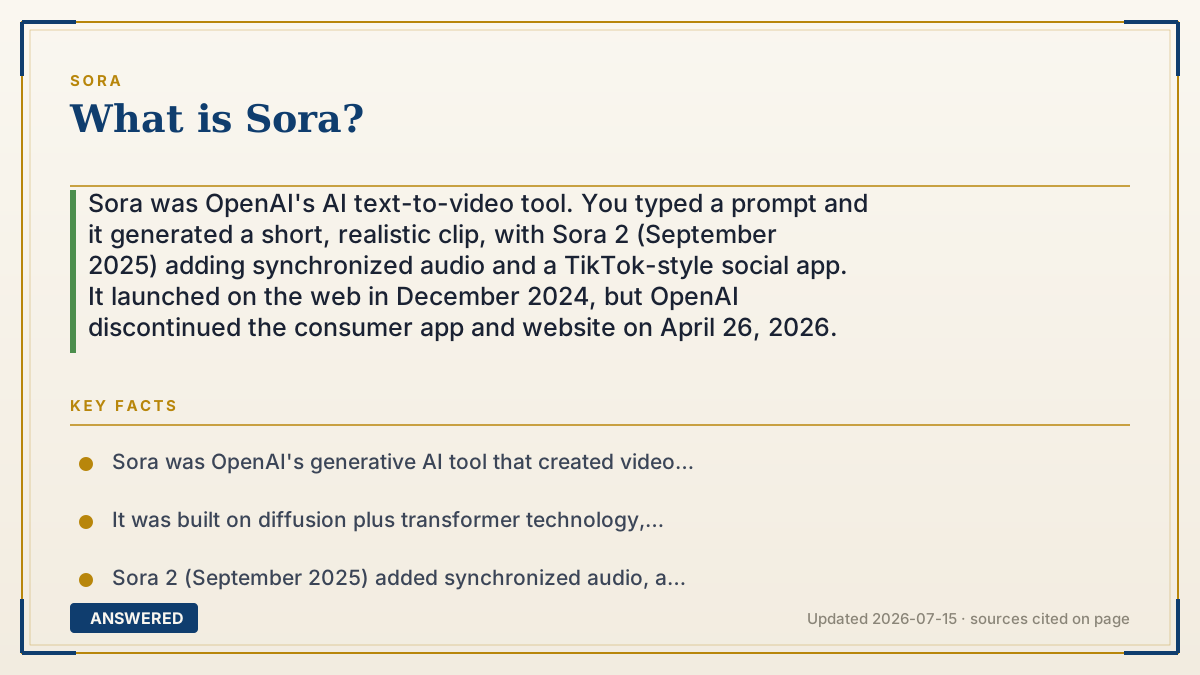
Sora was OpenAI's AI text-to-video tool. You typed a prompt and it generated a short, realistic clip, with Sora 2 (September 2025) adding synchronized audio and a TikTok-style social app. It launched on the web in December 2024, but OpenAI discontinued the consumer app and website on April 26, 2026.
Why — the first-principles explanation
Sora belonged to a category called generative video: software that creates brand-new footage from a description instead of recording it with a camera. You gave it words — 'a paper airplane gliding over a city at dawn' — and it produced a matching clip that never existed before. That's a leap beyond editing tools, which only rearrange footage you already have.
Under the hood, Sora was a diffusion model paired with transformer technology (the same family that powers ChatGPT). It learned from vast amounts of video how objects move, how light falls, and how scenes hold together, then used that knowledge to build clips frame by frame from random noise. Sora 2, released in September 2025, sharpened realism and added synchronized audio — dialogue and sound effects generated with the picture — plus a social app with a shareable feed and a 'Cameo' feature for inserting a consented likeness.
Sora's timeline was short. OpenAI first previewed the model in February 2024, launched Sora on the web in December 2024 for ChatGPT subscribers, and released the Sora 2 app in September 2025. But it proved too expensive to run — about $1 million a day — so OpenAI discontinued the app and website on April 26, 2026, leaving only a developer API that itself ends September 24, 2026.
An example that makes it click
Think of Sora as a storyteller who could paint a moving picture just from your sentence. Tell a normal artist 'draw a cat surfing' and you get a still drawing. Tell Sora the same thing and it hands you a 10-second video of the cat riding a wave, complete with the sound of splashing water, all invented on the spot from your words.
Key facts
- Sora was OpenAI's generative AI tool that created video from text or image prompts.
- It was built on diffusion plus transformer technology, the same family as ChatGPT.
- Sora 2 (September 2025) added synchronized audio, a social feed, and the Cameo feature.
- The model was first previewed in February 2024 and launched on the web in December 2024.
- OpenAI discontinued the consumer app and website on April 26, 2026.
▶ The 60-second explainer (script)
What is Sora? Sora was OpenAI's AI video generator. Instead of filming with a camera, you typed a description, like 'a paper airplane gliding over a city at dawn,' and Sora created a brand-new short video to match. It ran on the same kind of technology as ChatGPT, a diffusion model that learned from huge amounts of footage how the world moves and looks. The upgraded Sora 2, released in September 2025, added synchronized sound and a TikTok-style app where people shared clips and even inserted their own faces with a feature called Cameo. OpenAI first showed Sora off in early 2024 and launched it on the web that December. But it cost roughly a million dollars a day to run, so OpenAI shut down the app and website on April 26, 2026. Only a developer version remains, and even that closes in September 2026.
What authoritative sources say
People also ask
Who made Sora?
OpenAI, the company behind ChatGPT and DALL-E, created Sora.
What could Sora do?
It generated short, realistic videos from text or image prompts, with synchronized audio in Sora 2.
When did Sora launch?
The model was previewed in February 2024, launched on the web in December 2024, and the Sora 2 app in September 2025.
Does Sora still exist?
The consumer app and website closed April 26, 2026; only the developer API remains until September 24, 2026.