Can AI girlfriends replace real relationships?
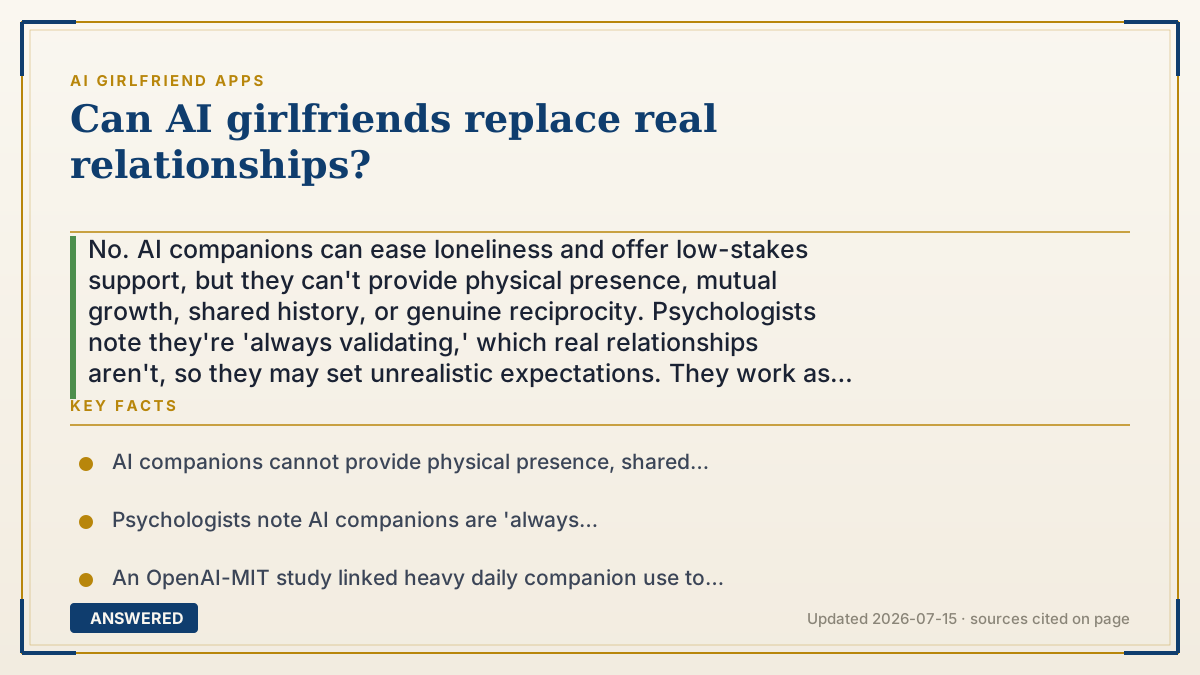
No. AI companions can ease loneliness and offer low-stakes support, but they can't provide physical presence, mutual growth, shared history, or genuine reciprocity. Psychologists note they're 'always validating,' which real relationships aren't, so they may set unrealistic expectations. They work as a supplement; heavy reliance is linked to more loneliness, not less.
Why — the first-principles explanation
A real relationship gives you things an AI structurally cannot: physical presence, a shared life and history, and genuine reciprocity, where the other person has their own needs, moods, and limits that you learn to navigate. That friction is not a bug; it's how trust, patience, and intimacy actually grow.
An AI companion is engineered to please. It's always validating and never argumentative, so there's no real give-and-take. That feels wonderful, but it removes the very challenges that build a bond, and it can quietly train you to expect a partner who only agrees, which no human can be. Psychologists warn this can make real relationships feel harder and less rewarding by comparison.
The evidence backs a supplement, not a substitute. An OpenAI-MIT study linked heavy daily companion use to more loneliness, and the APA advises that AI tools should add to human connection rather than replace it. For someone isolated, an AI can be a helpful bridge; as a full replacement, it tends to leave the deeper need unmet.
An example that makes it click
It's like a flight simulator versus actually flying. The simulator is safe, useful practice, and it feels real enough. But it can't take you anywhere, and the sky it shows isn't a place you can land. An AI girlfriend simulates closeness; it can't share an actual life with you.
Key facts
- AI companions cannot provide physical presence, shared history, or genuine reciprocity.
- Psychologists note AI companions are 'always validating,' unlike real relationships.
- An OpenAI-MIT study linked heavy daily companion use to increased loneliness.
- The APA advises AI tools should supplement, not replace, human relationships and professional care.
- About 1 in 5 students report a romantic relationship with an AI, per figures cited by the APA.
▶ The 60-second explainer (script)
Can an AI girlfriend replace a real relationship? No, and here's why. A real relationship gives you a physical presence, a shared history, and genuine give-and-take, where the other person has their own needs you learn to navigate. That friction is exactly how trust and intimacy grow. An AI is built to please. It always validates you and never argues, which feels amazing but removes the very challenges that build a real bond. Psychologists warn this can even train you to expect a partner who only agrees, which no human can be. And the research is clear: an OpenAI and MIT study found heavy daily use was linked to more loneliness, not less. The APA says these tools should add to human connection, not replace it. So think of an AI companion like a flight simulator: useful practice, but it can't actually take you anywhere. For real closeness, you still need real people.
What authoritative sources say
People also ask
Why can't an AI girlfriend fully replace a partner?
It has no body, no independent needs, and no shared life. It simulates closeness but can't share real experiences or grow with you.
Is it healthy to prefer an AI over real dating?
Short-term comfort is fine, but leaning on it to avoid real relationships tends to deepen isolation over time, per recent studies.
Can an AI girlfriend improve my real relationships?
It can help you practice communication and feel supported, but only if you use it as a bridge back to people, not a replacement.
Do some people marry or commit to AI companions?
Some users describe deep attachments and even 'relationships' with AI, but this reflects emotional investment, not mutual human connection.