Are AI agents autonomous?
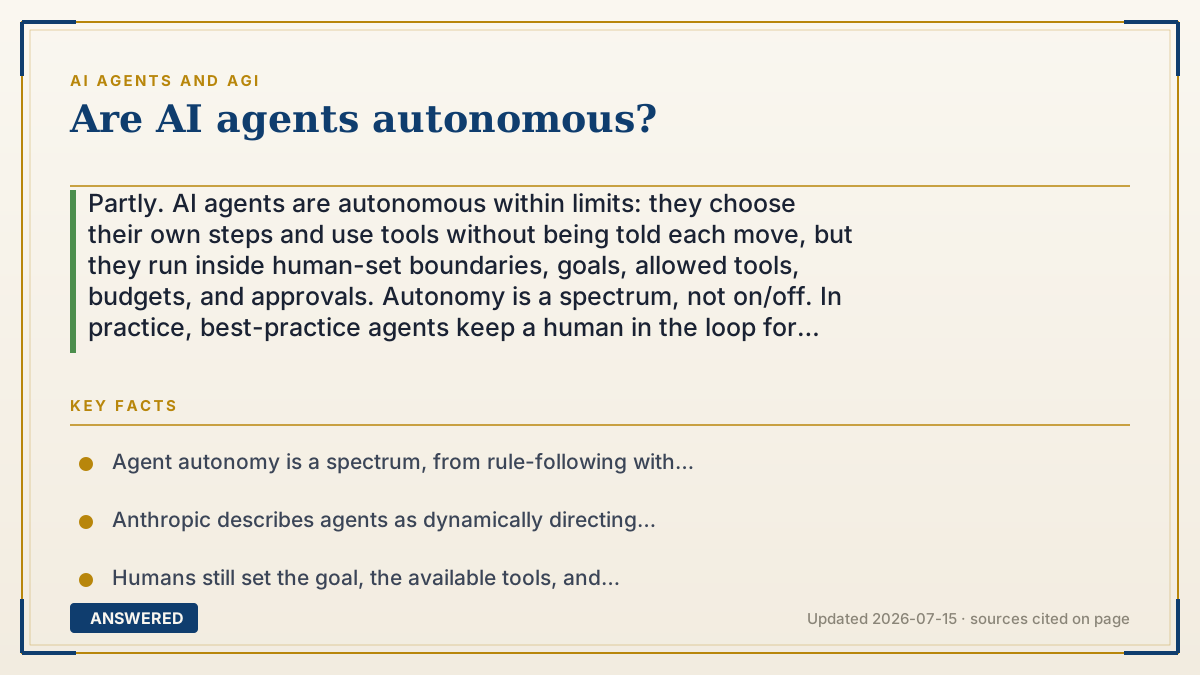
Partly. AI agents are autonomous within limits: they choose their own steps and use tools without being told each move, but they run inside human-set boundaries, goals, allowed tools, budgets, and approvals. Autonomy is a spectrum, not on/off. In practice, best-practice agents keep a human in the loop for risky or irreversible actions.
Why — the first-principles explanation
'Autonomous' sounds binary, but for AI agents it's a dial, and understanding the dial is the whole answer.
At a low setting, an agent just follows fixed rules or asks permission before every action, barely autonomous. At a high setting, you give it a goal and it plans, acts, observes results, and repeats on its own until done. Anthropic captures the high end: agents 'dynamically direct their own processes and tool usage, maintaining control over how they accomplish tasks.' That self-direction over the how is what people mean by agent autonomy.
But even a highly autonomous agent isn't unbounded. Humans set the goal (what to pursue), the tools (what it can touch), and the guardrails (step limits, budgets, sandboxes, and approval checkpoints for sensitive actions). So the agent is autonomous in method but constrained in scope, free to decide how, not free to decide anything.
There's also a reliability reason to cap autonomy. Because agents make mistakes and errors compound across steps, fully unsupervised operation on important tasks is risky. That's why the standard pattern is 'autonomous with a human in the loop': the agent runs on its own for routine steps but pauses for confirmation before anything costly or hard to undo. And none of this is human-level autonomy, that would require AGI, which doesn't exist. Today's agents are self-directed task-doers operating inside a fenced yard, not free agents roaming the world.
An example that makes it click
Think of a robot vacuum. Switch it on and it roams your living room by itself, deciding its own path, avoiding the couch, re-routing around a sock, returning to charge, without you steering. In that sense it's autonomous. But it can't leave the house, it only cleans (its one tool/goal), and it stops if it gets stuck or the battery runs low. You set the boundaries; it decides the moves inside them.
AI agents work the same way. Give one a goal like 'organize my inbox,' and it'll decide the steps on its own, but only using the tools you allowed, within limits you set, and often pausing to ask before deleting anything important. Autonomous inside the fence, not roaming free.
Key facts
- Agent autonomy is a spectrum, from rule-following with constant approvals to self-directed goal pursuit.
- Anthropic describes agents as dynamically directing their own processes and tool usage, autonomy over 'how.'
- Humans still set the goal, the available tools, and guardrails (step limits, budgets, sandboxes, approvals).
- Best practice keeps a human in the loop for risky or irreversible actions because agent errors compound.
- Even highly autonomous agents are narrow AI, not human-level autonomous minds (that would be AGI, which doesn't exist).
Choosing an AI tool for work?
The answer above explains the concept; this next step helps you choose by job, limits and current terms.
▶ The 60-second explainer (script)
Are AI agents autonomous? Partly, and the key is that autonomy is a dial, not an on-off switch. At the low end, an agent follows fixed rules or asks permission before every move. At the high end, you give it a goal and it plans, acts, checks results, and repeats on its own until it's done. Anthropic describes agents as dynamically directing their own processes and tool usage, that self-direction over the 'how' is what autonomy means here. But even the most autonomous agent runs inside a fence. Humans set the goal, the tools it can use, and the guardrails, step limits, budgets, and approval checkpoints for anything risky. Think of a robot vacuum: it roams and re-routes on its own, but it can't leave the house and only vacuums. So agents are autonomous within boundaries, not free to do anything. And this isn't human-level autonomy, that would be AGI, which doesn't exist yet.
What authoritative sources say
People also ask
Can an AI agent act without any human input?
It can run many steps on its own once given a goal, but it operates inside human-set limits, and best practice pauses for approval on risky or irreversible actions.
What limits an agent's autonomy?
The goal you set, the tools it's allowed to use, and guardrails like step caps, budgets, sandboxes, and approval checkpoints. These fence in what it can do.
Why not make agents fully autonomous?
Because they make mistakes that compound across steps. On important or irreversible tasks, unsupervised operation is risky, so a human-in-the-loop is standard.
Is agent autonomy the same as AGI?
No. Agents are self-directed only within narrow tasks and tools. AGI would mean human-level general autonomy across almost any task, which doesn't exist yet.