Does AGI exist yet?
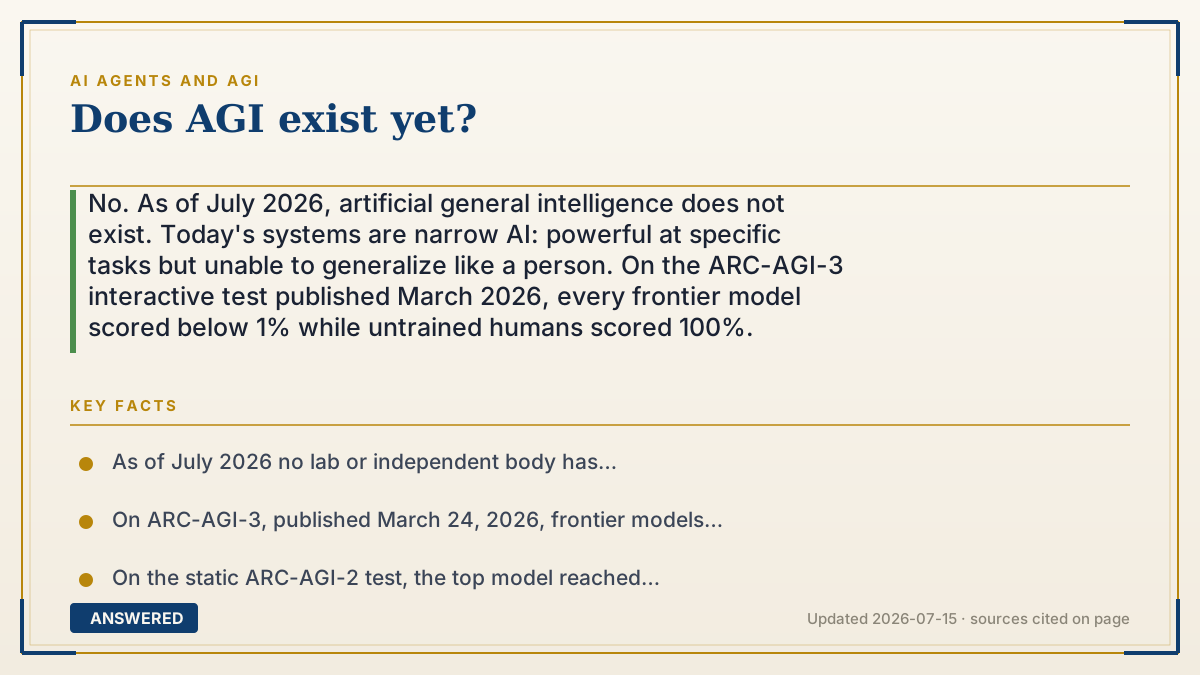
No. As of July 2026, artificial general intelligence does not exist. Today's systems are narrow AI: powerful at specific tasks but unable to generalize like a person. On the ARC-AGI-3 interactive test published March 2026, every frontier model scored below 1% while untrained humans scored 100%.
Why — the first-principles explanation
The key word in AGI is general. Narrow AI, which is everything shipping today, is trained to do particular things: predict the next word, label an image, win at Go. AGI would mean one system that can pick up almost any new intellectual task about as flexibly as a human, including tasks nobody trained it on.
Modern chatbots feel general because they were trained on a huge slice of the internet, so they can talk about almost anything. But underneath, they are pattern-matchers that predict likely text. When a problem sits far outside their training data, they don't reliably reason their way to a new method the way a person does. That gap is exactly what AGI benchmarks are built to expose.
The ARC-AGI tests, run by the ARC Prize Foundation, are designed to be easy for humans but hard for machines. On the 2026 interactive version (ARC-AGI-3), which asks an agent to explore a brand-new environment and figure out the goal on its own, top models from every major lab scored under 1%, while ordinary people solved them completely. That single result is the clearest sign that no existing system is general.
There is also no agreed definition of AGI, so some companies use looser bars and claim they are 'close.' But by the common-sense test, a machine that learns and adapts like a human across the board, nothing today qualifies.
An example that makes it click
Imagine a student who memorized every past exam ever given. On the real test, they ace any question that looks like something they've seen. That's today's AI. Now the teacher hands out a puzzle in a made-up game with rules printed nowhere, and says 'figure it out as you play.' A curious 10-year-old starts poking buttons and cracks it in minutes. The memorizing student freezes, because there was nothing to memorize.
That frozen student is exactly what happened on ARC-AGI-3 in 2026: humans scored 100 out of 100, the best AIs scored under 1. Memorizing the whole library is not the same as being able to think.
Key facts
- As of July 2026 no lab or independent body has demonstrated AGI; all deployed systems are narrow/specialized AI.
- On ARC-AGI-3, published March 24, 2026, frontier models (GPT-5.4, Gemini 3.1 Pro, Claude Opus 4.6, Grok) scored below 1%; untrained humans scored 100%.
- On the static ARC-AGI-2 test, the top model reached roughly 85% by mid-2026 versus a 66% average for individual humans, but this measures puzzle-solving, not general autonomy.
- There is no single agreed definition of AGI, which is why 'are we there yet' answers differ between companies and researchers.
- The ARC Prize framing: 'As long as there is a gap between AI and human learning, we do not have AGI.'
▶ The 60-second explainer (script)
Does AGI exist yet? No, not as of 2026. Everything you use today, ChatGPT, Claude, image generators, is narrow AI. It's brilliant at tasks it was trained on, but it can't flexibly learn brand-new things the way a person can. Here's the proof. In March 2026, researchers released ARC-AGI-3, a test where an AI has to explore a new environment and figure out the goal on its own. Every top model from every big lab scored below one percent. Regular humans, with no training, scored one hundred percent. That's the whole story: real general intelligence means adapting to the unknown, and machines still can't. Companies will keep saying they're 'close,' partly because there's no agreed definition of AGI. But by the common-sense bar, a system that thinks and learns like a human across the board, we are not there yet.
What authoritative sources say
People also ask
Isn't ChatGPT already a form of AGI?
No. Large language models are general-sounding because they were trained on broad data, but they remain narrow AI that predicts text and fails at truly novel reasoning tasks like ARC-AGI-3.
Has any company officially claimed to have built AGI?
No major lab has made a verified AGI claim as of July 2026. Some use loose definitions to say they are 'approaching' it, but none meet the human-level general standard.
Why is it so hard to say for sure?
Because there is no single agreed definition of AGI. Different bars (economic value, benchmark scores, human parity) give different answers, so experts disagree even when looking at the same systems.
What would prove AGI had arrived?
A system that could learn and adapt to almost any new task at human level without task-specific retraining, and close the gap on tests like ARC-AGI-3 that measure on-the-fly learning.