Does ChatGPT give the right answers?
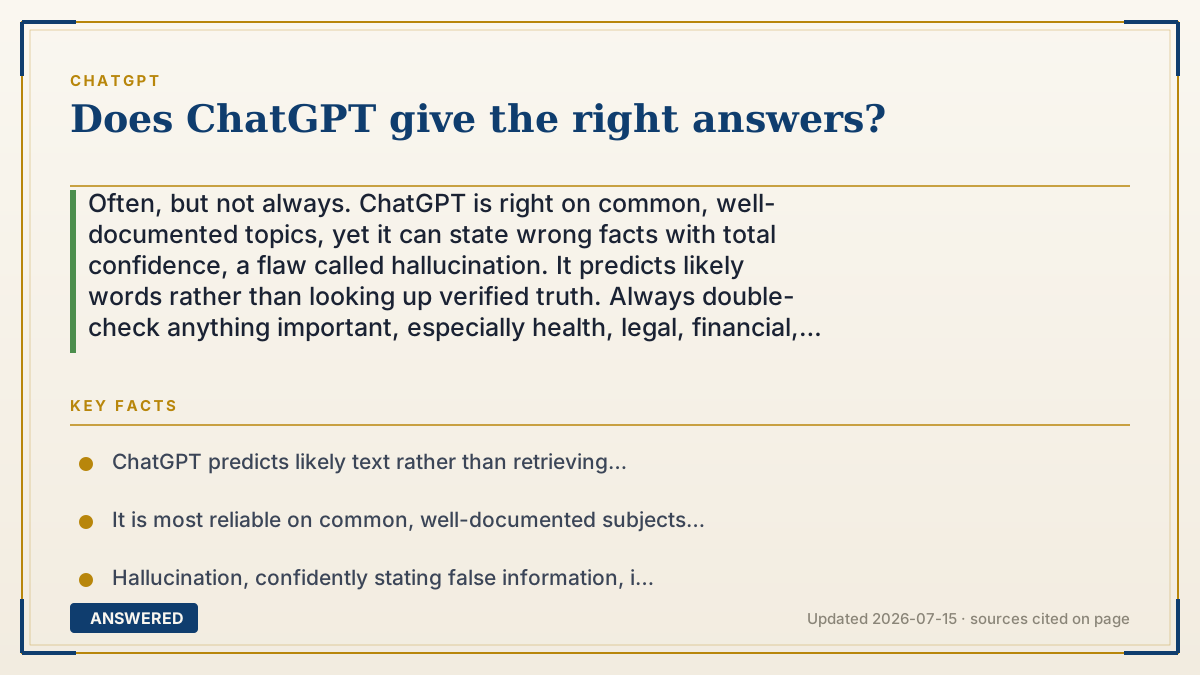
Often, but not always. ChatGPT is right on common, well-documented topics, yet it can state wrong facts with total confidence, a flaw called hallucination. It predicts likely words rather than looking up verified truth. Always double-check anything important, especially health, legal, financial, math, dates, names, and citations.
Why — the first-principles explanation
ChatGPT's accuracy comes from how it works: it's a next-word prediction engine, not a fact database. It learned patterns from huge amounts of text, so when a topic is common and well-documented, the most likely words it predicts also happen to be the correct ones. That's why it nails everyday questions, explanations, and definitions most of the time.
The same mechanism causes errors. When a question is obscure, very recent, or requires exact recall, of a specific citation, a phone number, a court ruling, a precise statistic, the 'most likely' words may be plausible-sounding but false. The model has no built-in sense of certainty and will present a confident guess in the same tone as a fact. This is called a hallucination, and it's a fundamental property of the technology, not a bug that's fully fixed.
Two things improve reliability. First, giving it the source material in your prompt (paste the document, the data, the code) shifts it from guessing to summarizing, which is far more accurate. Second, using web search or 'thinking' modes on newer models lets it check current information and reason step by step. Still, the safe rule for anything that matters is: treat ChatGPT's answer as a knowledgeable draft to verify, not a final authority, especially for high-stakes decisions.
An example that makes it click
Imagine asking a brilliant friend who has read millions of books but is too proud to ever say 'I don't know.' Ask about a famous topic and they're spot-on. Ask for the exact page number of an obscure quote and they'll confidently make one up rather than admit uncertainty, and it'll sound just as sure as their correct answers. ChatGPT is that friend. Enjoy the knowledge, but check the page number yourself before you cite it.
How to do it
- For important facts, ask ChatGPT to show its sources or cite where a claim comes from.
- Paste the actual document, data, or code so it summarizes instead of guessing.
- Turn on web search or the 'thinking' model for recent events or complex reasoning.
- Cross-check names, dates, numbers, quotes, and citations against a primary source.
- For health, legal, financial, or safety decisions, confirm with a qualified professional.
Key facts
- ChatGPT predicts likely text rather than retrieving verified facts, so accuracy varies by topic.
- It is most reliable on common, well-documented subjects and least reliable on obscure, recent, or exact-recall questions.
- Hallucination, confidently stating false information, is an inherent property of large language models.
- Providing source material or enabling web search substantially improves accuracy.
- High-stakes answers (health, legal, financial, math, citations) should always be independently verified.
Open the official product site and confirm the current access, plans and terms.
▶ The 60-second explainer (script)
Does ChatGPT give the right answers? Often, but not always, and knowing the difference matters. Here's why. ChatGPT isn't a fact database; it's a next-word prediction engine. It learned patterns from massive amounts of text, so on common, well-documented topics, the most likely words it produces are also the correct ones. That's why it's great for explanations and everyday questions. But on obscure, very recent, or exact-recall questions, like a specific citation or a precise statistic, it can generate something that sounds right but is completely made up. That's called hallucination, and it's built into how the technology works. The model has no sense of doubt; it states a confident guess in the same tone as a fact. To get more reliable answers, paste in the source material so it summarizes instead of guesses, or turn on web search. And for anything high-stakes, health, legal, money, always verify with a trusted source. Treat ChatGPT as a smart draft, not the final word.
What authoritative sources say
People also ask
Why does ChatGPT sometimes make things up?
It predicts likely words, so on questions it can't recall exactly, it may generate plausible-sounding but false details.
How can I make ChatGPT more accurate?
Give it the source material, ask for citations, and enable web search or the 'thinking' model for recent or complex topics.
Can I trust ChatGPT for medical or legal questions?
Use it for general background only, and always confirm high-stakes health, legal, or financial matters with a qualified professional.
Is the paid model more accurate than the free one?
The paid flagship 'thinking' models generally reason better and hallucinate less, but they can still be wrong and need verification.