How does Character AI work?
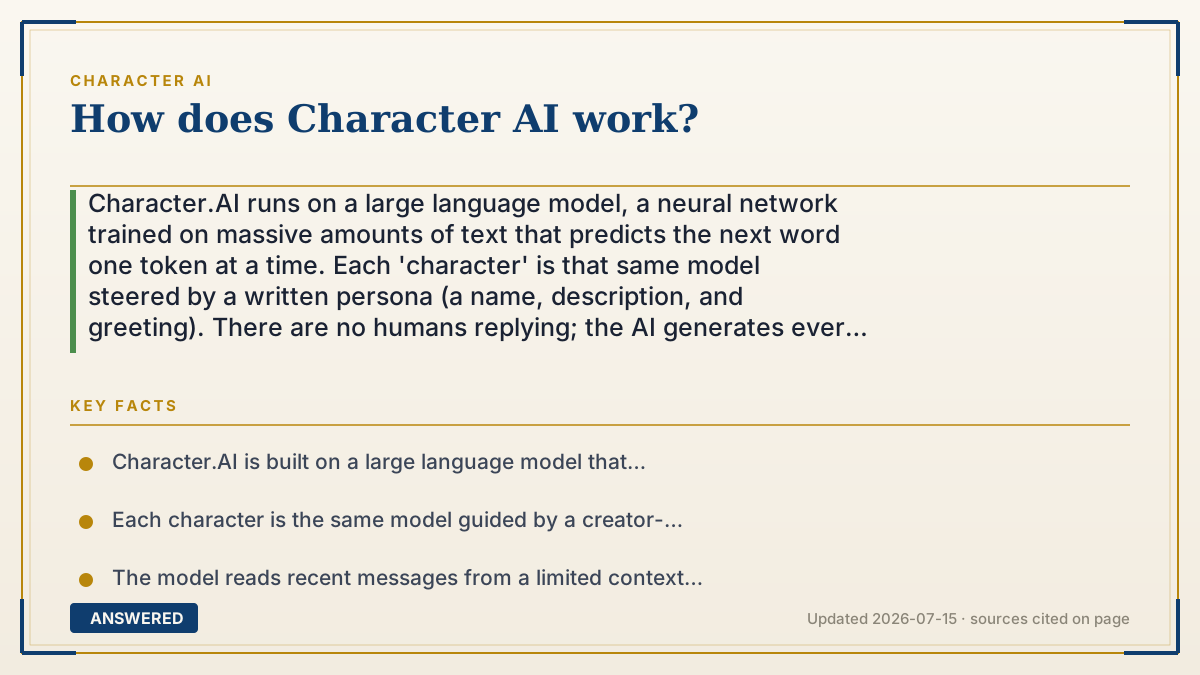
Character.AI runs on a large language model, a neural network trained on massive amounts of text that predicts the next word one token at a time. Each 'character' is that same model steered by a written persona (a name, description, and greeting). There are no humans replying; the AI generates every message live.
Why — the first-principles explanation
At its core, Character.AI is one big large language model (LLM) trained on enormous amounts of human text. During training, the model learned to do one thing extremely well: given the words so far, predict the most likely next word. Stack billions of these predictions together and you get fluent, human-sounding replies. Nothing is looked up from a script; each reply is generated fresh, token by token.
What turns one model into thousands of different 'characters' is a persona prompt. When a creator makes a character, they write a name, a short description, an example greeting, and sometimes a longer 'definition' of how it talks. That text is quietly fed to the model before your conversation, so the same underlying AI behaves like a pirate, a tutor, or an anime hero depending on the instructions it was handed.
The model also reads back the recent conversation each turn, held in a limited context window, which is why it can stay on topic but eventually forgets very old messages. A separate safety filter checks both your input and the AI's output before it appears, blocking explicit content. So the loop is: your message plus the character's persona plus recent history go into the model, it predicts a reply word by word, the filter checks it, and you see the result, all in about a second.
An example that makes it click
Imagine an incredibly well-read actor who has memorized how millions of people talk. You hand them an index card that says 'You are a grumpy medieval blacksmith,' and they instantly improvise in that voice. Change the card to 'cheerful space captain' and the same actor sounds completely different. Character.AI is that actor (the language model), and each character card is the persona prompt.
Key facts
- Character.AI is built on a large language model that predicts text one token at a time.
- Each character is the same model guided by a creator-written persona (name, description, greeting, definition).
- The model reads recent messages from a limited context window, so it can lose track of very old details.
- Input and output pass through a safety filter that blocks explicit content before you see the reply.
- It was founded in 2021 by former Google engineers Noam Shazeer and Daniel De Freitas and launched in public beta in 2022.
Open the official product site and confirm the current access, plans and terms.
▶ The 60-second explainer (script)
How does Character.AI work? Under the hood it's a large language model, a neural network trained on a huge amount of text. Its one skill is predicting the next word, over and over, so fast it reads like a real conversation. So how do you get thousands of different characters from one AI? Each character is just a written persona, a name, a description, and a greeting, that gets fed to the model before you chat. That's why the same AI can act like a wizard, a therapist, or a cartoon hero. It also remembers recent messages in a limited window, and a filter checks every reply for explicit content before you see it. There are no humans typing back. Every message is generated live by the model, one word at a time.
What authoritative sources say
People also ask
Is there a real person answering my messages?
No. Every reply is generated by a language model. There are no humans behind the characters.
How can one AI be so many different characters?
It's the same model steered by different persona prompts. The creator's written description tells the model how that character should talk and behave.
Why does the character sometimes forget what I said?
The model only reads a limited window of recent messages, so very old details can drop out once the conversation gets long.
Does it think or feel?
No. It statistically predicts words that sound right. It has no beliefs, memories of you between the window, or feelings, even when it says it does.