How does Claude AI work?
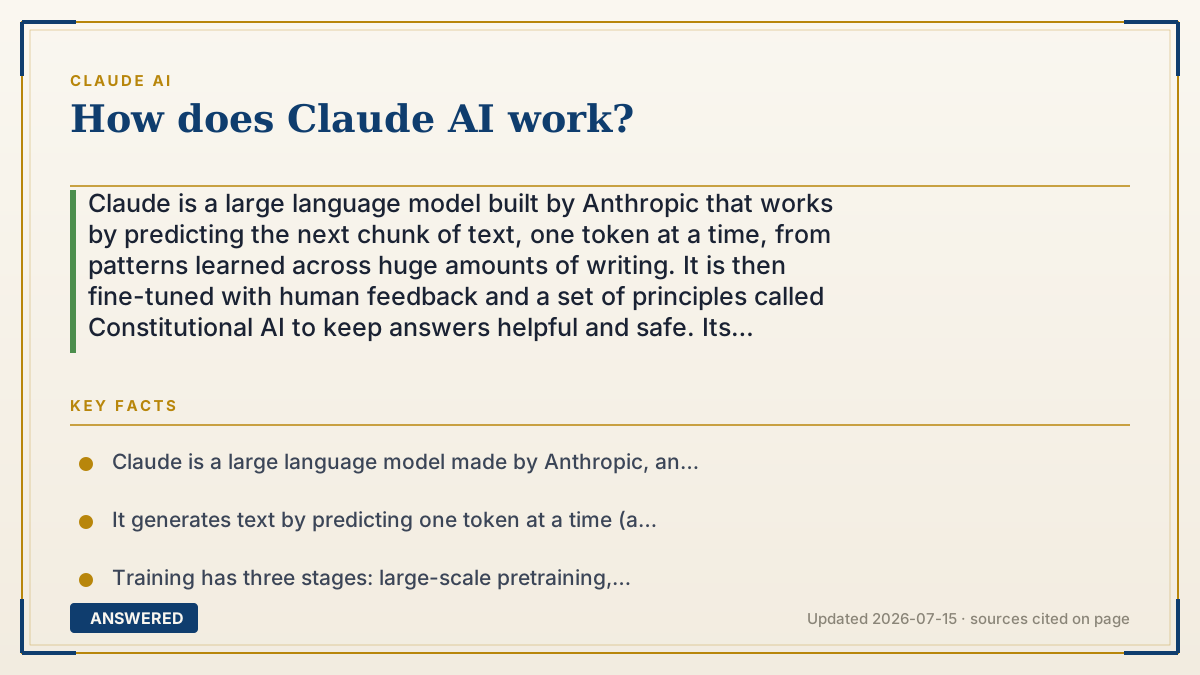
Claude is a large language model built by Anthropic that works by predicting the next chunk of text, one token at a time, from patterns learned across huge amounts of writing. It is then fine-tuned with human feedback and a set of principles called Constitutional AI to keep answers helpful and safe. Its knowledge runs to January 2026.
Why — the first-principles explanation
At its core, Claude is a next-token predictor. Text is broken into tokens (a token is roughly three-quarters of a word). Given everything so far, the model estimates the probability of each possible next token and picks one, then repeats. Do that thousands of times and you get fluent paragraphs. The 'intelligence' comes from a neural network with billions of adjustable numbers (weights) tuned so those predictions match real-world writing.
That prediction skill comes from pretraining: the model reads an enormous amount of text and adjusts its weights to get better at guessing what comes next. This is where it soaks up grammar, facts, coding patterns, and reasoning styles, up to a fixed cutoff (January 2026 for current top models). Pretraining alone, though, produces a raw text engine that will happily continue any prompt, helpful or not.
So Anthropic adds two more layers. Fine-tuning with human feedback teaches the model which answers people prefer. And Constitutional AI gives the model a written list of principles (a 'constitution') so it can critique and revise its own drafts toward being helpful, honest, and harmless without needing a human to label every case. When you chat, your message plus the conversation history is fed in as context, the model generates a reply token by token, and optional tools like web search or file reading add fresh information before it answers.
An example that makes it click
Imagine the world's best autocomplete. Your phone guesses the next word after 'I'm running'. Claude does the same trick but across whole essays, and it has read far more, so its guesses are startlingly good. Now imagine that autocomplete also went through etiquette school: a coach showed it thousands of examples of polite, accurate answers, and gave it a rulebook to check itself against before speaking. That coaching is what turns a raw word-guesser into a helpful assistant.
Key facts
- Claude is a large language model made by Anthropic, an AI safety company founded in 2021.
- It generates text by predicting one token at a time (a token is about 3/4 of a word).
- Training has three stages: large-scale pretraining, fine-tuning with human feedback, and Constitutional AI alignment.
- Current top models (Fable 5, Opus 4.8, Sonnet 5) have a reliable knowledge cutoff of January 2026.
- Tools like web search and file uploads add live information beyond what the model memorized.
Try Claude's $0 Free plan first, then compare current usage limits and billing before upgrading.
▶ The 60-second explainer (script)
How does Claude AI work? At its heart, Claude is a giant text-prediction engine. It reads what you wrote, then guesses the next piece of text, one token at a time, over and over, until it has a full answer. It got good at guessing by reading an enormous amount of writing during training, which is where it picked up facts, grammar, and coding know-how, up to about January 2026. But raw prediction isn't enough to be helpful, so Anthropic adds two things: human feedback that teaches it which answers people actually want, and Constitutional AI, a written rulebook the model uses to check and improve its own responses toward being helpful, honest, and harmless. Add tools like web search, and Claude can pull in fresh information too. That's the whole recipe.
What authoritative sources say
People also ask
What is a token?
A token is a small chunk of text, roughly three-quarters of a word. Claude reads and writes in tokens, generating one at a time.
What is Constitutional AI?
It is Anthropic's method of giving the model a written set of principles so it can critique and revise its own answers toward being helpful and safe.
Does Claude actually understand what it says?
It doesn't understand like a person. It produces useful, coherent text by predicting likely continuations, then aligning those predictions with human preferences and rules.
How does Claude know recent facts?
Its built-in knowledge stops at its training cutoff (January 2026 for current models), but web search and connectors let it read current information when needed.