How does Grok access real-time x data?
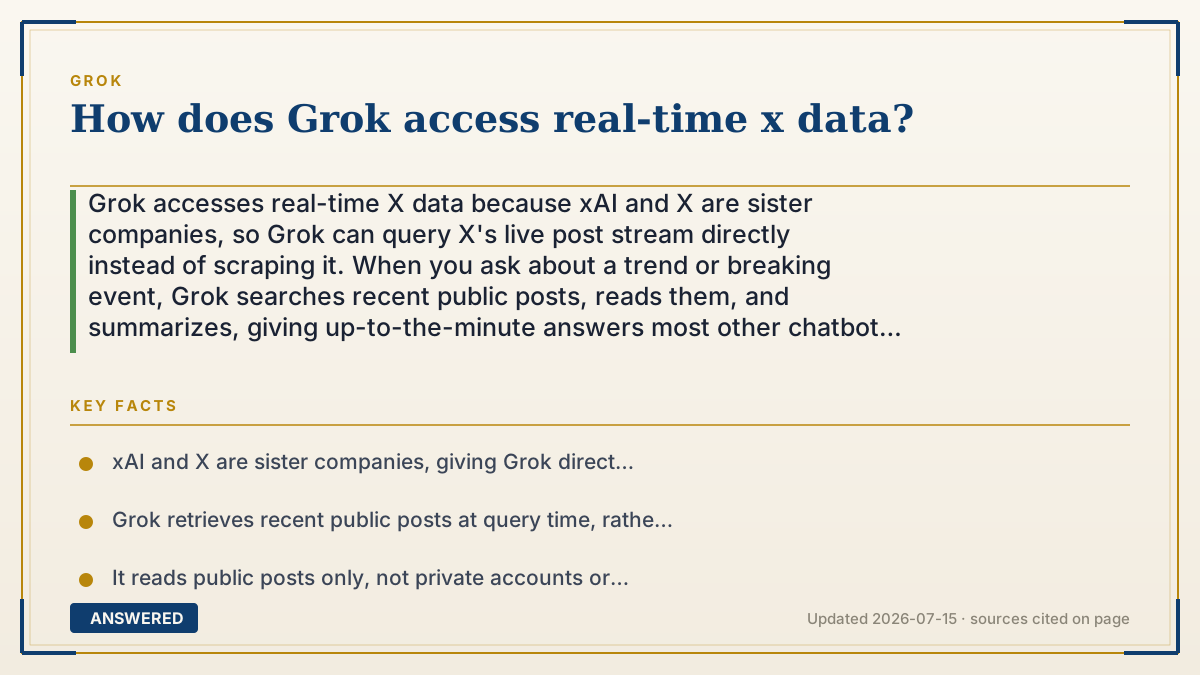
Grok accesses real-time X data because xAI and X are sister companies, so Grok can query X's live post stream directly instead of scraping it. When you ask about a trend or breaking event, Grok searches recent public posts, reads them, and summarizes, giving up-to-the-minute answers most other chatbots can't match.
Why — the first-principles explanation
A trained AI model is frozen at its cutoff date, it can't know what happened this morning. Grok gets around this the same way it searches the web: it retrieves fresh information at the moment you ask, then writes its answer using it. What's special is one of its sources.
Because xAI owns access to X's data (both are part of Elon Musk's corporate family), Grok can tap X's internal firehose of public posts directly. Rival chatbots would have to scrape the web or pay for limited API access; Grok has a privileged, near-real-time pipe. So when you ask 'what are people saying about the game right now,' Grok runs a query against recent public posts, pulls the relevant ones, and condenses them.
Two limits matter. First, it reads public posts, not private or protected accounts, and not your DMs. Second, live posts are raw and unverified, so trends can include rumors, jokes, and bots. Grok summarizes what's being said, which is not the same as what's true. It's a powerful pulse-of-the-moment tool, best paired with a healthy dose of source-checking.
An example that makes it click
Imagine a reporter who has a live police scanner on her desk. Other reporters have to wait for the morning paper, but she hears events as they crackle in and can tell you what's happening this second.
That scanner is Grok's direct line into X's public posts. Ask 'what's blowing up online right now,' and instead of reciting old memory, Grok 'listens' to the live chatter and summarizes it. But like a scanner, it picks up rumors and noise too, so what she reports is 'here's what people are saying,' not 'here's the confirmed truth.'
Key facts
- xAI and X are sister companies, giving Grok direct access to X's live post data.
- Grok retrieves recent public posts at query time, rather than relying only on training data.
- It reads public posts only, not private accounts or direct messages.
- This lets Grok answer about breaking events and trends after its training cutoff.
- Live posts are unverified, so summaries can include rumors, jokes, or bot activity.
Open xAI's current consumer entry point and check plans, limits, privacy and cancellation terms before subscribing.
▶ The 60-second explainer (script)
How does Grok access real-time X data? The short answer: family connections. xAI, which makes Grok, and X, formerly Twitter, are sister companies under Elon Musk. That means Grok can plug directly into X's live stream of public posts, instead of scraping the web the slow way like other chatbots have to. So when you ask Grok 'what's trending right now' or 'what are people saying about this event,' it runs a query against recent public posts, reads the relevant ones, and summarizes them for you, giving answers that are up to the minute. Two things to keep in mind. First, it only sees public posts, not private accounts or your direct messages. Second, live posts are raw and unverified, so what's trending can include rumors, jokes, and bots. Grok tells you what people are saying, which isn't always what's true, so treat hot takes with a grain of salt.
What authoritative sources say
People also ask
Does Grok read my private tweets or DMs?
No. It accesses public posts only, not protected accounts or direct messages.
Is Grok's X data actually live?
Yes, it queries recent public posts at the moment you ask, so it reflects near-real-time activity.
Why can Grok do this when ChatGPT can't?
Because xAI and X are sister companies, Grok has direct, privileged access to X's post data rather than limited scraping.
Can I trust what Grok reports from X?
Treat it as a summary of what people are posting, which may include rumors or bots. Verify important claims elsewhere.