What is Google Veo?
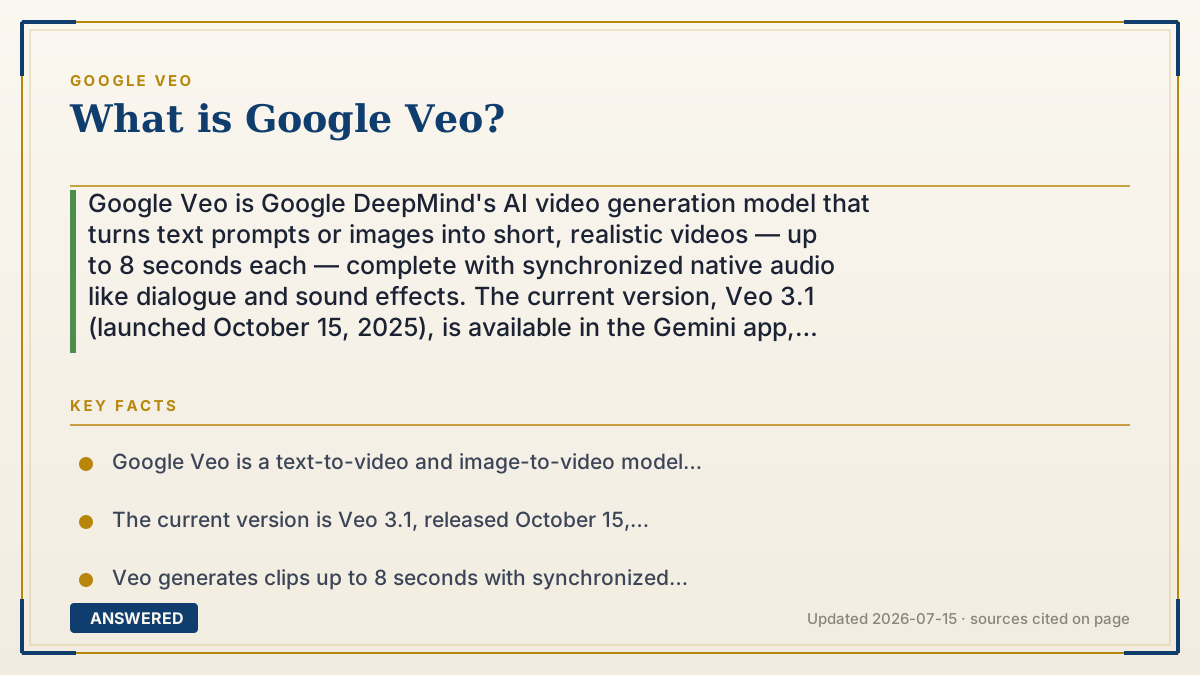
Google Veo is Google DeepMind's AI video generation model that turns text prompts or images into short, realistic videos — up to 8 seconds each — complete with synchronized native audio like dialogue and sound effects. The current version, Veo 3.1 (launched October 15, 2025), is available in the Gemini app, Google Flow, and the Gemini API.
Why — the first-principles explanation
Veo is a generative video model — software trained on huge amounts of video so it learns how the visual world moves: how light falls, how water splashes, how a person's mouth matches their words. When you type a prompt, it doesn't find a matching clip; it predicts, frame by frame, what a brand-new video of that description should look like, then renders it. This is the same core idea as image generators, extended into the much harder dimension of time.
What sets Veo apart from earlier tools is native audio. Most AI video models produced silent clips you had to score afterward. Veo generates the picture and a matching soundtrack together — dialogue with lip-sync, footsteps, ambient noise — because it was trained on video with sound, so it learns which images go with which sounds. That single feature is why Veo felt like a leap when Veo 3 arrived in 2025.
Because holding a long, coherent video 'in mind' is so compute-heavy, Veo works in short building blocks — 8 seconds at a time — which you can chain and extend into longer pieces inside Google Flow. It also accepts a starting image (image-to-video) and reference images to keep characters consistent. In short, Veo is Google's engine for conjuring believable moving footage, with sound, from a sentence.
An example that makes it click
Imagine a painter who has watched millions of hours of video and can now paint a moving picture from a single sentence. Say 'a golden retriever shaking off water in slow motion,' and instead of digging through a stock library, the painter invents that exact 8-second scene from scratch — and hums the matching splash sounds while painting.
That's Veo. It doesn't copy an existing clip; it dreams up a new one, frame by frame, and adds the soundtrack at the same time, the way you might picture a scene in your head with sound already attached.
Key facts
- Google Veo is a text-to-video and image-to-video model built by Google DeepMind.
- The current version is Veo 3.1, released October 15, 2025; Veo 3 launched in May 2025.
- Veo generates clips up to 8 seconds with synchronized native audio (dialogue, sound effects, ambient).
- It supports resolutions up to 4K and both 16:9 and 9:16 aspect ratios.
- Veo is available in the Gemini app, Google Flow, the Gemini API, and Vertex AI.
Open the official product site and confirm the current access, plans and terms.
▶ The 60-second explainer (script)
What is Google Veo? It's Google DeepMind's AI video generator — software that turns a written prompt or a photo into a short, realistic video, up to eight seconds long. But here's what makes it special: it generates the sound too. Earlier AI video tools made silent clips, but Veo produces synchronized native audio — dialogue with lip-sync, footsteps, background noise — all created together with the picture. It learned this by training on millions of videos, so it understands how the world moves and sounds. The current version is Veo 3.1, launched in October 2025, and you can use it in the Gemini app, in Google Flow for filmmaking, or through the Gemini API. In short, Veo turns a sentence into believable moving footage, with sound included.
What authoritative sources say
People also ask
Who makes Google Veo?
Google DeepMind, Google's AI research lab, develops and operates the Veo video models.
What's the latest version of Veo?
Veo 3.1, launched October 15, 2025, with improved editing, reference images, and audio across all features.
Does Veo make sound?
Yes. Veo generates synchronized native audio — dialogue, sound effects, and ambient noise — along with the video.
How long are Veo videos?
Each generation is up to 8 seconds, but you can extend and chain clips in Google Flow to make longer videos.