What is the difference between Claude haiku sonnet and opus?
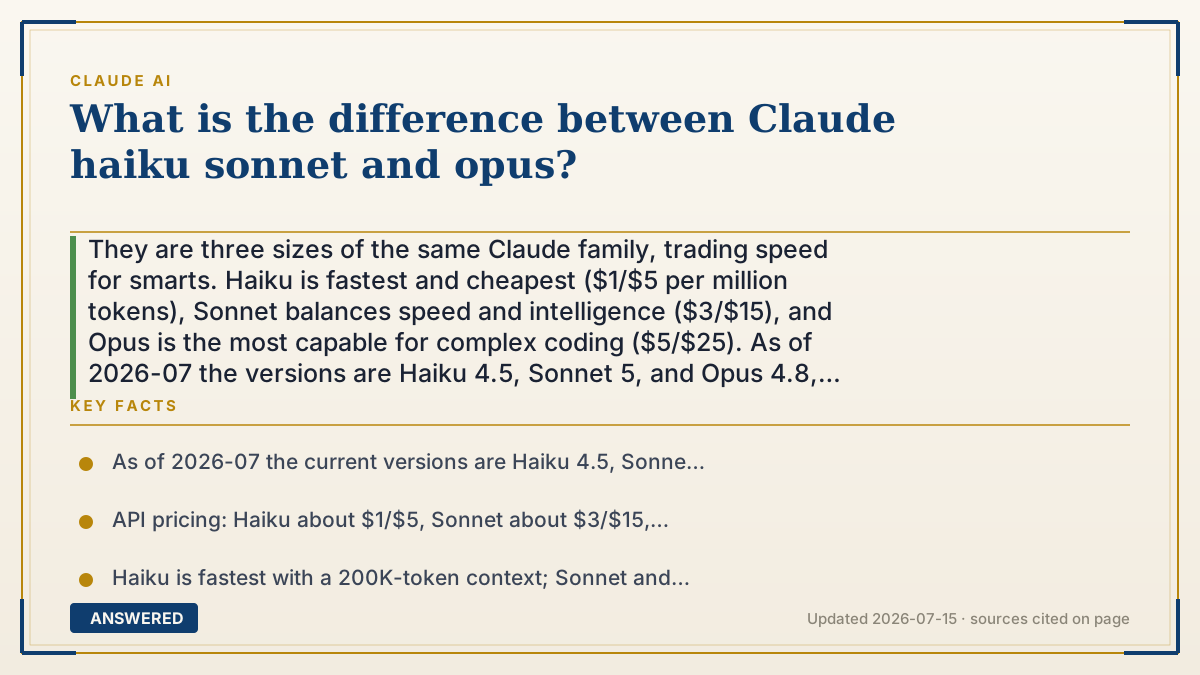
They are three sizes of the same Claude family, trading speed for smarts. Haiku is fastest and cheapest ($1/$5 per million tokens), Sonnet balances speed and intelligence ($3/$15), and Opus is the most capable for complex coding ($5/$25). As of 2026-07 the versions are Haiku 4.5, Sonnet 5, and Opus 4.8, above them the Fable 5 flagship.
Why — the first-principles explanation
Anthropic names its tiers after poem lengths, and that's the mental model: Haiku is short and quick, Sonnet is medium, Opus is a long, elaborate work. Bigger, more capable models do more computation per answer, which makes them smarter but slower and pricier. Rather than force one compromise, Anthropic ships three sizes so you can match the model to the job.
Haiku (currently Haiku 4.5) is the fastest with near-frontier intelligence and the lowest price, ideal for high-volume, simple tasks like routing, classification, and quick answers. Sonnet (currently Sonnet 5) is the workhorse: the best combination of speed and intelligence, handling the majority of real tasks well at moderate cost. Opus (currently Opus 4.8) is built for the hardest work, complex agentic coding and enterprise reasoning, where you want maximum capability and can accept higher latency and cost.
The economics drive the choice. API pricing runs roughly $1/$5 per million input/output tokens for Haiku, $3/$15 for Sonnet, and $5/$25 for Opus. A common pattern is tiered: use Haiku for cheap sub-tasks, Sonnet for the 80% that needs real intelligence, and Opus for the 10 to 15% that demand the deepest reasoning, which cuts cost sharply without hurting quality. Above all three sits Fable 5, the flagship for long-running agents at $10/$50. In the claude.ai app you pick from these in a dropdown; the newest and heaviest models are emphasized on paid plans.
An example that makes it click
Think of three delivery vehicles. A scooter (Haiku) zips through traffic and costs almost nothing, perfect for dropping off a single envelope. A van (Sonnet) carries most jobs comfortably at a fair price. A moving truck (Opus) hauls the heavy, complicated loads but is slower and pricier to run. You wouldn't rent a moving truck to deliver one letter, and you wouldn't move a house on a scooter. Picking the right Claude tier is the same: match the vehicle to the size of the job.
How to do it
- Estimate your task's difficulty: simple/high-volume, everyday, or complex reasoning.
- For fast, cheap, simple work (routing, tagging, quick replies), choose Haiku.
- For most real tasks needing solid intelligence at moderate cost, choose Sonnet.
- For the hardest coding and reasoning, choose Opus (or Fable 5 for long-running agents).
- In the claude.ai app, pick the model from the dropdown; in the API, set the model ID (e.g., claude-sonnet-5).
Key facts
- As of 2026-07 the current versions are Haiku 4.5, Sonnet 5, and Opus 4.8, with Fable 5 as the flagship.
- API pricing: Haiku about $1/$5, Sonnet about $3/$15, Opus about $5/$25 per million input/output tokens.
- Haiku is fastest with a 200K-token context; Sonnet and Opus offer up to 1M tokens.
- Opus 4.8 targets complex agentic coding and enterprise work; Sonnet 5 balances speed and intelligence.
- Sonnet 5 has introductory pricing of $2/$10 per million tokens through August 31, 2026.
Try Claude's $0 Free plan first, then compare current usage limits and billing before upgrading.
▶ The 60-second explainer (script)
What's the difference between Claude Haiku, Sonnet, and Opus? They're three sizes of the same model family, named after poem lengths, and the trade-off is speed versus smarts. Haiku is the short one: fastest and cheapest, around a dollar per million input tokens, great for simple high-volume tasks. Sonnet is the balanced middle: the best mix of speed and intelligence, and the right pick for most everyday work. Opus is the big one: the most capable, built for complex coding and heavy reasoning, but slower and pricier. As of mid-2026 the current versions are Haiku 4.5, Sonnet 5, and Opus 4.8, with a flagship called Fable 5 sitting on top. A smart approach is to mix them: Haiku for cheap sub-tasks, Sonnet for the bulk of the work, and Opus for the hardest problems. Match the model to the job.
What authoritative sources say
People also ask
Which Claude model is best for coding?
Opus 4.8 targets complex agentic coding, while Sonnet 5 delivers nearly the same quality faster and cheaper for most coding tasks.
Which is the cheapest?
Haiku 4.5, at about $1 per million input tokens and $5 per million output tokens, is the cheapest and fastest.
What's above Opus?
Fable 5 is Anthropic's flagship model for long-running agents, priced at $10/$50 per million tokens, above Opus 4.8.
How do I choose between them?
Match the model to the task: Haiku for simple high-volume jobs, Sonnet for everyday work, and Opus for the hardest reasoning and coding.