Are AI detection tools reliable?
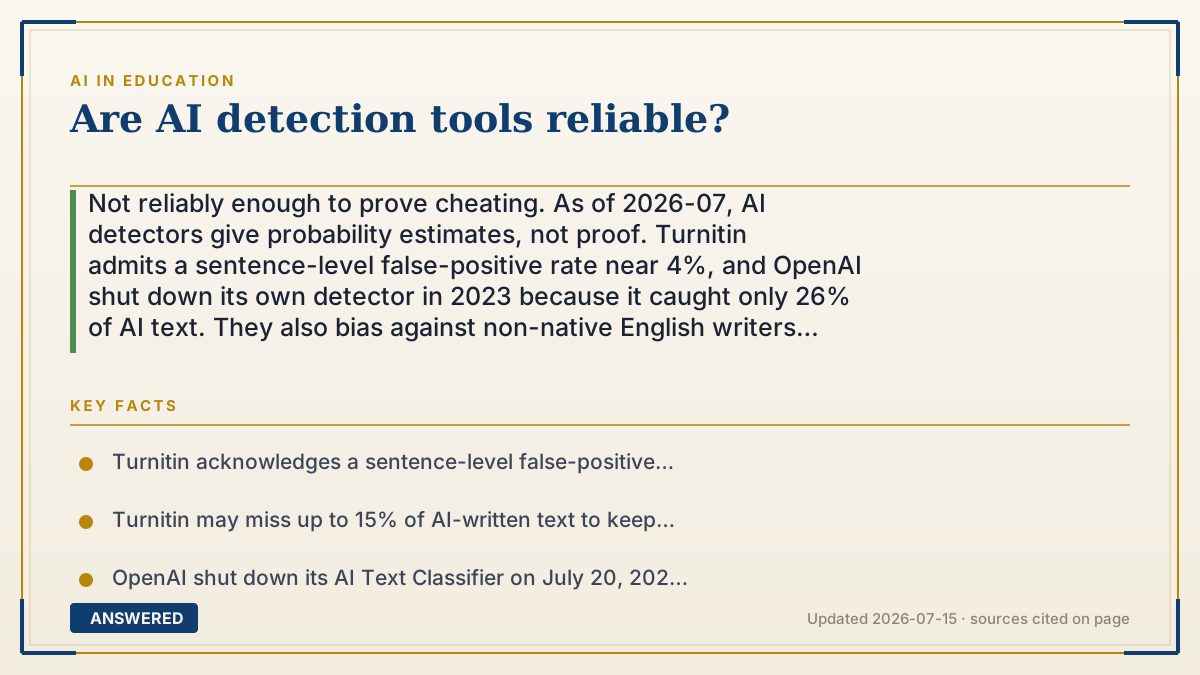
Not reliably enough to prove cheating. As of 2026-07, AI detectors give probability estimates, not proof. Turnitin admits a sentence-level false-positive rate near 4%, and OpenAI shut down its own detector in 2023 because it caught only 26% of AI text. They also bias against non-native English writers and are easily defeated by light editing.
Why — the first-principles explanation
AI detectors work by measuring how predictable a text is. Language models tend to choose the most statistically likely next word, so their writing is smooth and low in surprise. Detectors score that smoothness (using measures like perplexity and burstiness) and guess whether it looks machine-made. The fatal flaw is that plenty of human writing, especially careful, plain, or non-native English, is also smooth and predictable, so it gets flagged too.
The numbers show why this can't be proof. Turnitin claims a document-level false-positive rate under 1%, but its own chief product officer acknowledged the sentence-level rate is about 4%, and it may miss up to 15% of AI text to keep alarms low. OpenAI's own classifier flagged only 26% of AI writing correctly before the company shut it down in 2023 for low accuracy. Independent studies of many detectors found average accuracy far from dependable.
There are two extra problems that matter for fairness. First, detectors disproportionately flag non-native English speakers, whose more uniform phrasing mimics the pattern detectors punish. Second, they're trivially evaded: paraphrasing tools or a few manual edits erase the fingerprints. So a detector score is a hint at best, never a verdict. Responsible schools treat a flag as a reason to look closer, using drafts, version history, and a conversation, not as evidence to accuse a student on its own.
An example that makes it click
Imagine a metal detector at the beach that beeps at anything smooth and shiny. Sometimes it finds a buried coin, but it also beeps at bottle caps, foil, and your belt buckle. You'd never arrest someone for theft just because the detector beeped near them, you'd dig and look.
AI detectors beep at "smooth, predictable writing." A robot wrote smoothly, sure, but so does a careful student and so does someone writing in their second language. The beep is a reason to investigate, not a reason to convict.
Key facts
- Turnitin acknowledges a sentence-level false-positive rate around 4%, despite claiming under 1% at the document level.
- Turnitin may miss up to 15% of AI-written text to keep false positives low, and suppresses scores below a 20% threshold.
- OpenAI shut down its AI Text Classifier on July 20, 2023 because it correctly identified only 26% of AI text.
- Detectors disproportionately flag non-native English speakers due to more uniform phrasing.
- Light paraphrasing or manual editing easily defeats detectors, so scores are estimates, not proof.
▶ The 60-second explainer (script)
Are AI detection tools reliable? Not reliably enough to prove anything. Here's how they work. AI tends to write smoothly, choosing the most predictable next word, and detectors measure that smoothness. The problem is careful human writing is also smooth, and so is writing by non-native English speakers, so they get flagged too. Look at the numbers. Turnitin claims under one percent false positives at the document level, but admits about four percent at the sentence level, and it may miss up to fifteen percent of AI text on purpose. OpenAI's own detector caught only twenty-six percent of AI writing, so they shut it down in 2023. On top of that, detectors are biased against second-language writers and can be beaten by a few edits or a paraphrasing tool. So a detector score is a hint, never a verdict. It's like a beach metal detector that beeps at bottle caps and belt buckles. The beep means dig and look, using drafts and a conversation. It never means convict.
What authoritative sources say
People also ask
Can an AI detector be used to prove I cheated?
No. Detectors give probability estimates with real false-positive rates, so responsible schools require additional evidence like drafts.
Why do detectors flag non-native English speakers more?
Their phrasing tends to be more uniform and predictable, which is exactly the pattern detectors mistake for machine writing.
How accurate is Turnitin's AI detector?
It claims under 1% document-level false positives but admits about 4% at the sentence level, and it may miss up to 15% of AI text.
Can students beat AI detectors?
Often, yes. Light editing or paraphrasing tools erase the statistical fingerprints detectors rely on.