Can AI make mistakes?
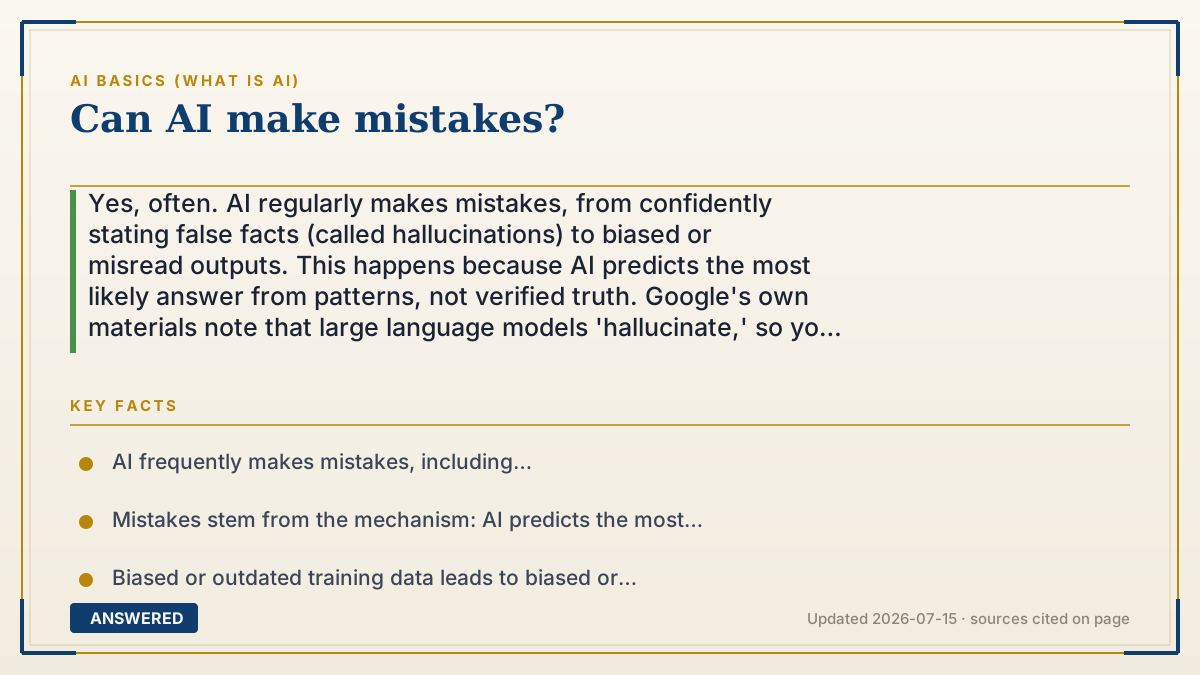
Yes, often. AI regularly makes mistakes, from confidently stating false facts (called hallucinations) to biased or misread outputs. This happens because AI predicts the most likely answer from patterns, not verified truth. Google's own materials note that large language models 'hallucinate,' so you should verify anything important.
Why — the first-principles explanation
AI mistakes aren't glitches; they're a direct result of how it works. A model outputs the statistically most likely response given its training, not a fact it looked up and confirmed. When the likely-sounding answer happens to be false, you get a confident error. Language models even have a name for this: hallucination, inventing plausible details that aren't true.
A second source of error is the data. Models learn from human-made content, which contains mistakes, gaps, and biases. If the training data is skewed or outdated, the model inherits that, producing unfair or wrong outputs and being unaware anything is off. It also has a knowledge cutoff, so it can be confidently out of date on recent events.
Third, AI has no true understanding or self-check. It can't reliably know when it's wrong, and it will often defend a wrong answer just as fluently as a right one. That's why the correct mental model is 'brilliant, fast, and fallible assistant.' It's genuinely useful, but the human stays responsible for verifying facts, especially for health, money, legal, or safety decisions.
An example that makes it click
Imagine asking a super-confident trivia friend who has read a ton but never says 'I'm not sure.' Most of the time they're right and impressively fast. But every so often they'll swear the capital of some country is a city that doesn't even exist, and say it with a totally straight face.
That's AI. It gives you the answer that sounds most likely, delivered with the same confidence whether it's right or wrong. So you enjoy the speed, but for anything that matters, you check the trivia friend's claim before betting on it.
Key facts
- AI frequently makes mistakes, including 'hallucinations': confident, fluent statements that are false.
- Mistakes stem from the mechanism: AI predicts the most likely output, not verified truth.
- Biased or outdated training data leads to biased or wrong outputs the model can't detect.
- Models have a knowledge cutoff and, in base mode, don't check live sources.
- AI can't reliably self-verify, so human review is essential for important decisions.
▶ The 60-second explainer (script)
Can AI make mistakes? Yes, and more often than people expect. AI regularly gets things wrong, sometimes stating a completely false fact with total confidence. There's even a name for it: hallucination. Why does this happen? It's baked into how AI works. The model doesn't look up a verified fact. It predicts the answer that sounds most likely based on its training. When the likely-sounding answer is false, you get a confident mistake. On top of that, AI learns from human data, which contains errors and biases, so it inherits those. And it has a knowledge cutoff, so it can be confidently out of date. The real kicker? AI can't reliably tell when it's wrong. It'll defend a bad answer just as smoothly as a good one. So treat it like a brilliant but fallible assistant. Fast and useful, absolutely. But you're the fact-checker, especially for anything about health, money, or legal matters. When it counts, verify before you trust.
What authoritative sources say
People also ask
What is an AI hallucination?
It's when AI generates a confident, plausible-sounding answer that is actually false, because it predicts likely text rather than checking facts.
Why does AI sound so sure when it's wrong?
It delivers the most likely-sounding wording regardless of accuracy. Confidence in its tone doesn't reflect whether the content is true.
How do I catch AI mistakes?
Cross-check key facts, names, numbers, and dates against a trusted source, and be extra careful with health, legal, or financial topics.
Will AI mistakes go away as it improves?
Newer models make fewer errors, but hallucination and bias haven't been eliminated. Verification remains necessary for important uses.