Can AI predict lottery numbers?
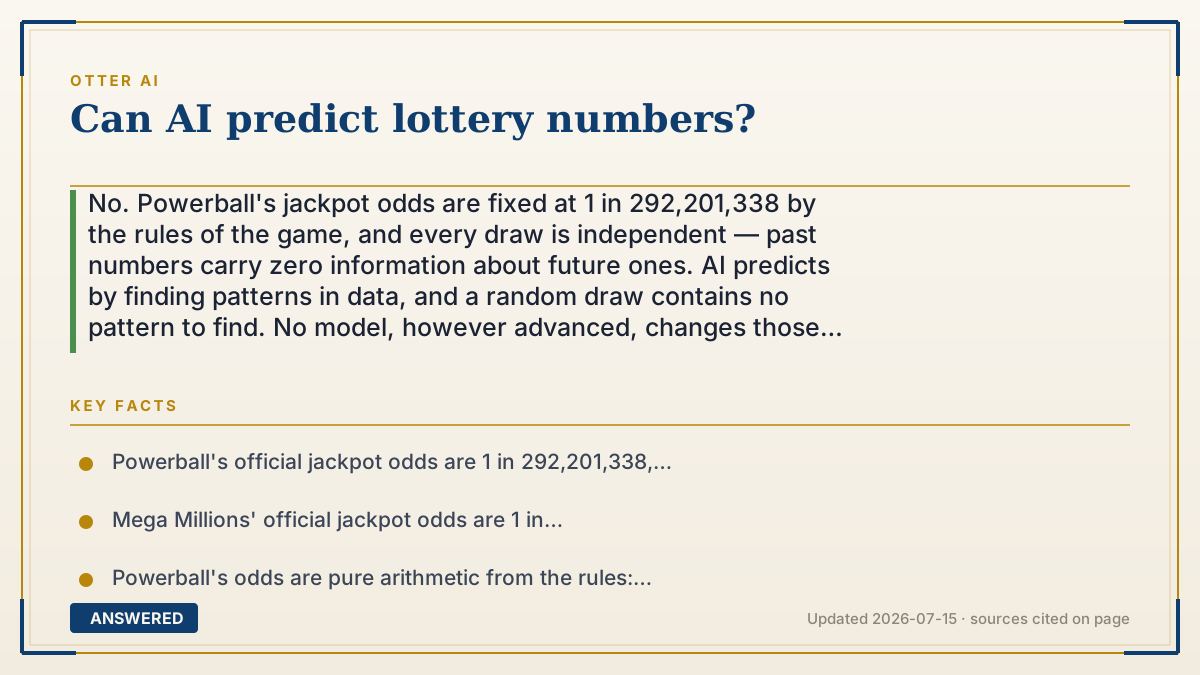
No. Powerball's jackpot odds are fixed at 1 in 292,201,338 by the rules of the game, and every draw is independent — past numbers carry zero information about future ones. AI predicts by finding patterns in data, and a random draw contains no pattern to find. No model, however advanced, changes those odds.
Why — the first-principles explanation
Start with what prediction actually requires. An AI forecasts by finding structure in past data that carries forward into the future. Tomorrow's weather is predictable because today's atmosphere physically causes tomorrow's — there's a chain of cause and effect the model can learn. A lottery draw has no such chain. The balls do not remember last week. Each draw is what mathematicians call independent, and that word has a precise meaning: knowing every previous result changes the probability of the next result by exactly zero. So an AI trained on every lottery draw in recorded history holds precisely as much predictive information as someone who has never seen a single one. That is not a limitation of today's models that a better model will fix someday. It's a property of the game itself.
Now look at where the odds come from, because this is the part that settles the argument. Powerball asks you to pick 5 numbers from 69 white balls plus 1 red Powerball from 26. The number of possible white-ball combinations is 11,238,513; multiply by the 26 red balls and you get 292,201,338 — exactly the official published jackpot odds. Mega Millions: 5 from 70 gives 12,103,014 combinations, times 24 Mega Balls equals 290,472,336, again matching the official figure. Notice what just happened. Those numbers were counted from the rulebook, not estimated from data. That's why no dataset can improve them. There's nothing to estimate. A model that has analyzed ten thousand past draws and a person who just read the rules on the back of the slip know the odds equally well.
So where do "AI lottery predictors" get their air of competence? From the gambler's fallacy in a nicer font. Hot numbers, cold numbers, numbers that are "due" — with enough draws, some balls will have come up more often than others, and a model will faithfully report that. But that's ordinary random variation, not signal; over a long enough run every ball converges to the same frequency, and a ball being "behind" creates no pressure to catch up. There's a second trap specific to chatbots: a language model asked for predicted numbers will always produce some. It returns confident, well-formatted, plausible-looking picks because generating fluent output is what it does, not because a calculation happened underneath. Confidence in the output tells you nothing about information in the input.
Here is the one honest nuance, and it's small but real. AI cannot improve your chance of winning, but jackpots are split among all winning tickets — so your number choice affects how much you'd collect, not how likely you are to collect. Huge numbers of players use birthdays, which means combinations confined to 1–31 get picked far more often. Choosing unpopular numbers doesn't make you more likely to win by even a hair; it makes your share larger in the very unlikely event you do. That's the only mathematically defensible move available, and it needs no AI. Worth knowing too: lotteries have been beaten, but never by prediction — the known cases exploited a broken game rule that briefly made the math favorable, or involved insider access to the drawing machinery. Both are attacks on the mechanism, not forecasts of it. Meanwhile the everyday math stays ugly: the overall odds of winning any Powerball prize are 1 in 24.87, and most of those wins are $4 on a $2 ticket.
An example that makes it click
Show an AI a million coin flips and ask it to call the next one. It might notice heads came up three times in a row and announce that heads is hot. Or it might notice tails is "overdue" and pick tails. Both answers are wrong, and they're wrong for the same reason: the coin has no memory of the last flip. A million flips of history and zero flips of history give you exactly the same forecast — 50/50. More data doesn't help when the data contains no information about the future.
And 1 in 292,201,338 is a bigger number than it feels. Imagine a stranger will pick one exact second somewhere in the next nine and a half years — not the day, the second — and you have to name it. That's roughly Powerball's jackpot odds. Now imagine an AI offering to narrow it down for you. It can't, because the stranger doesn't choose until after you've guessed.
Key facts
- Powerball's official jackpot odds are 1 in 292,201,338, and the overall odds of winning any prize are 1 in 24.87 on a $2 play (Powerball, as of 2026-07).
- Mega Millions' official jackpot odds are 1 in 290,472,336 (Mega Millions, as of 2026-07).
- Powerball's odds are pure arithmetic from the rules: 11,238,513 possible white-ball combinations (5 from 69) × 26 Powerballs = 292,201,338 — counted, not estimated from data.
- Mega Millions works the same way: 12,103,014 combinations (5 from 70) × 24 Mega Balls = 290,472,336.
- The most common Powerball prize tier pays $4 on a $2 ticket, at odds of 1 in 38.32 (Powerball, as of 2026-07).
- Jackpots are shared among all winning tickets, so number choice affects the size of a payout, never the probability of winning one.
▶ The 60-second explainer (script)
No. AI cannot predict lottery numbers, and it's worth understanding exactly why, because the reason is more interesting than the answer. AI predicts by finding patterns in past data that carry into the future. Tomorrow's weather is predictable because today's atmosphere causes it. A lottery draw has no such chain — the balls don't remember last week. Each draw is independent, which means knowing every previous result changes the odds of the next result by exactly zero. So an AI trained on every draw in history has the same predictive information as someone who's never seen one. None. Here's the part that settles it. Powerball's odds come from counting, not from data. Pick 5 from 69 white balls: that's 11,238,513 combinations. Times 26 Powerballs equals 292,201,338 — which is precisely the official published jackpot odds. Those numbers came from the rulebook. There's nothing for a model to estimate and nothing for it to improve. So what about hot numbers and cold numbers and numbers that are due? That's the gambler's fallacy in a nicer font. Random variation always makes some balls look luckier. And ask a chatbot for lottery picks and it will always give you some — confident, tidy, and completely uninformed, because producing fluent output is what it does. One real nuance: jackpots get split among winners, so picking unpopular numbers — avoiding birthday numbers 1 through 31 — doesn't make you more likely to win by even a hair. It just means a bigger share if you do. That's the only honest edge, and it doesn't need AI.
What authoritative sources say
People also ask
Can AI improve my odds of winning even slightly?
No. The only thing that changes your odds is buying more tickets, and that's strictly proportional — two tickets double a 1-in-292-million chance to 2-in-292-million, while doubling what you spend. No analysis of past draws moves the number at all.
What about hot and cold numbers, or numbers that are 'due'?
That's the gambler's fallacy. Random variation guarantees some numbers appear more often over any stretch of draws, but a ball being behind creates no pressure to catch up. Over a long run all balls converge to the same frequency.
Are AI lottery prediction apps scams?
Any product that guarantees wins or claims to beat the odds is making a claim that cannot be true, and one-time fees for "lifetime access" to prediction software are a common pattern. You can report suspected fraud to the FTC at reportfraud.ftc.gov.
Has anyone ever actually beaten a lottery?
Yes, but never by prediction. The documented cases exploited a flawed game rule that briefly made the expected value positive, or involved insider access to the drawing equipment. Both attack the mechanism rather than forecast the outcome.
If AI can't predict, does it hurt to let a chatbot pick my numbers?
Your odds are identical either way, so it does no harm to your chances. The one caveat: if it picks popular patterns like birthday numbers 1 through 31, you'd be more likely to split a jackpot with other winners.