Does Perplexity AI hallucinate?
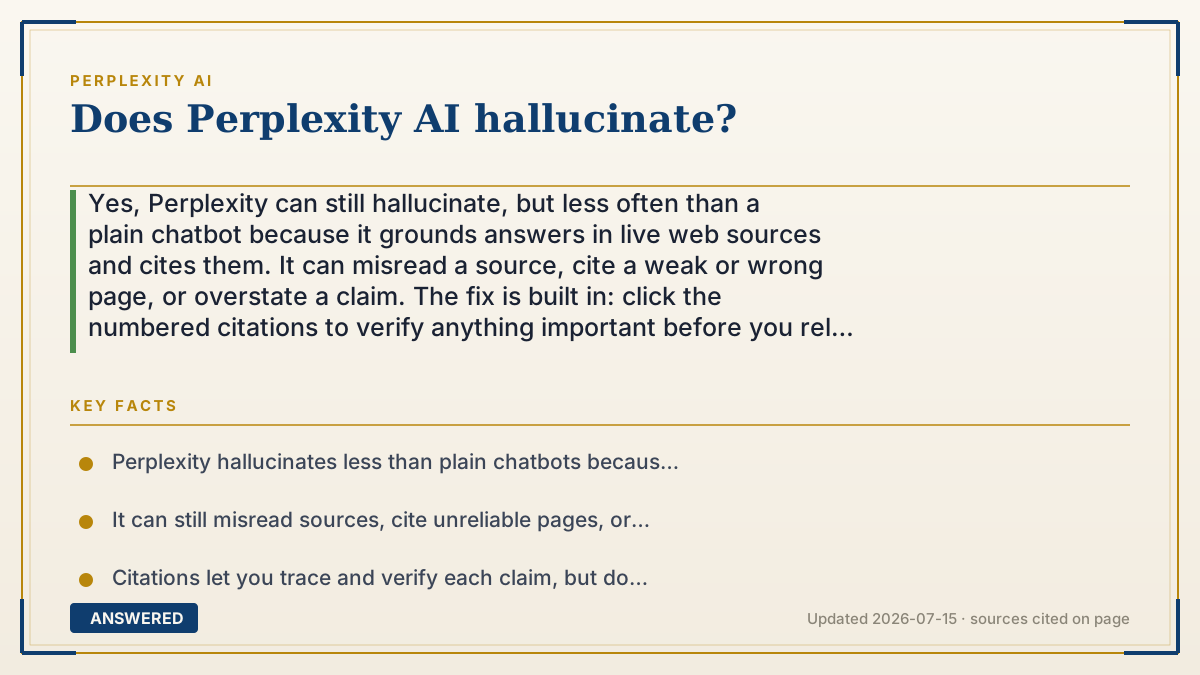
Yes, Perplexity can still hallucinate, but less often than a plain chatbot because it grounds answers in live web sources and cites them. It can misread a source, cite a weak or wrong page, or overstate a claim. The fix is built in: click the numbered citations to verify anything important before you rely on it.
Why — the first-principles explanation
A "hallucination" is when an AI states something false with confidence. It happens because a language model doesn't store facts like a database; it predicts likely-sounding text. When it has no real source, it fills gaps with plausible fiction, a wrong date, a fake quote, an invented statistic.
Perplexity attacks this at the root with retrieval-augmented generation: it searches the web first and tells the model to answer only from the retrieved pages. Grounding the answer in real text sharply lowers the hallucination rate compared with a bare chatbot, because the model is summarizing something that actually exists rather than inventing from memory. The citations are the honesty mechanism, they let you trace each claim back to a source.
But grounding isn't a guarantee. Three failure modes remain: the model can misread a source and summarize it wrong; it can cite a bad source, so the claim is faithfully reported but the underlying page is unreliable; or it can blend several sources and state something none of them actually said. The citations don't disappear when this happens, which can make a wrong answer look trustworthy. That's why the safe habit is to treat citations as things to check, not proof, especially for health, legal, financial, or high-stakes facts.
An example that makes it click
Imagine a student writing a report who's told, 'only use these library books, and put a footnote on every sentence.' They'll make far fewer things up than a student writing from memory, that's Perplexity's advantage.
But the careful student can still slip: they might misunderstand a paragraph, quote a book that turns out to be unreliable, or mash two books together into a sentence neither actually says, all with a neat footnote attached. The footnote makes it look solid. So you, the teacher, still flip to the cited page to check. Same with Perplexity: the citations are your invitation to verify, not a promise it's right.
How to do it
- Read the answer, then click each numbered citation to open the original source.
- Check that the source actually says what the answer claims, not just that a link exists.
- Judge the source itself, prefer official, primary, or reputable pages over random blogs.
- Cross-check important facts across two independent sources.
- For high-stakes health, legal, or financial questions, confirm with a professional or primary document.
Key facts
- Perplexity hallucinates less than plain chatbots because it grounds answers in retrieved web sources.
- It can still misread sources, cite unreliable pages, or blend sources into unsupported claims.
- Citations let you trace and verify each claim, but do not guarantee correctness.
- Newer, larger models reduce but do not eliminate hallucination.
- Verification is most important for health, legal, financial, and other high-stakes topics.
Try source-backed search first, then compare current Pro/Max research limits, credits and billing before upgrading.
▶ The 60-second explainer (script)
Does Perplexity AI hallucinate? Short answer: yes, but a lot less than a regular chatbot. Here's why. A hallucination is when AI confidently makes something up. It happens because language models don't look facts up in a database, they predict likely-sounding words, and when they don't know, they fill the gap with fiction. Perplexity fights this by searching the web first and telling the AI to answer only from the pages it found. That grounding sharply cuts down on made-up facts, and the citations let you trace every claim. But it's not bulletproof. Three things can still go wrong: it can misread a source, it can cite a source that's just plain unreliable, or it can blend several pages into a claim none of them actually made, all with a tidy footnote that makes it look trustworthy. So here's the habit that matters: don't just trust the citation, click it. Make sure the source really says what the answer claims, especially for health, legal, or money questions.
What authoritative sources say
People also ask
Does Perplexity hallucinate less than ChatGPT?
Generally yes for factual queries, because it retrieves and cites live sources instead of answering mainly from model memory.
How do I catch a hallucination in Perplexity?
Click the citations and confirm the source actually supports the claim. If a source is missing, weak, or off-topic, be skeptical.
Can citations themselves be wrong?
Yes. Perplexity can cite an unreliable page or one that doesn't fully support the claim, so judge the source, not just its presence.