How do you use Unstuck AI?
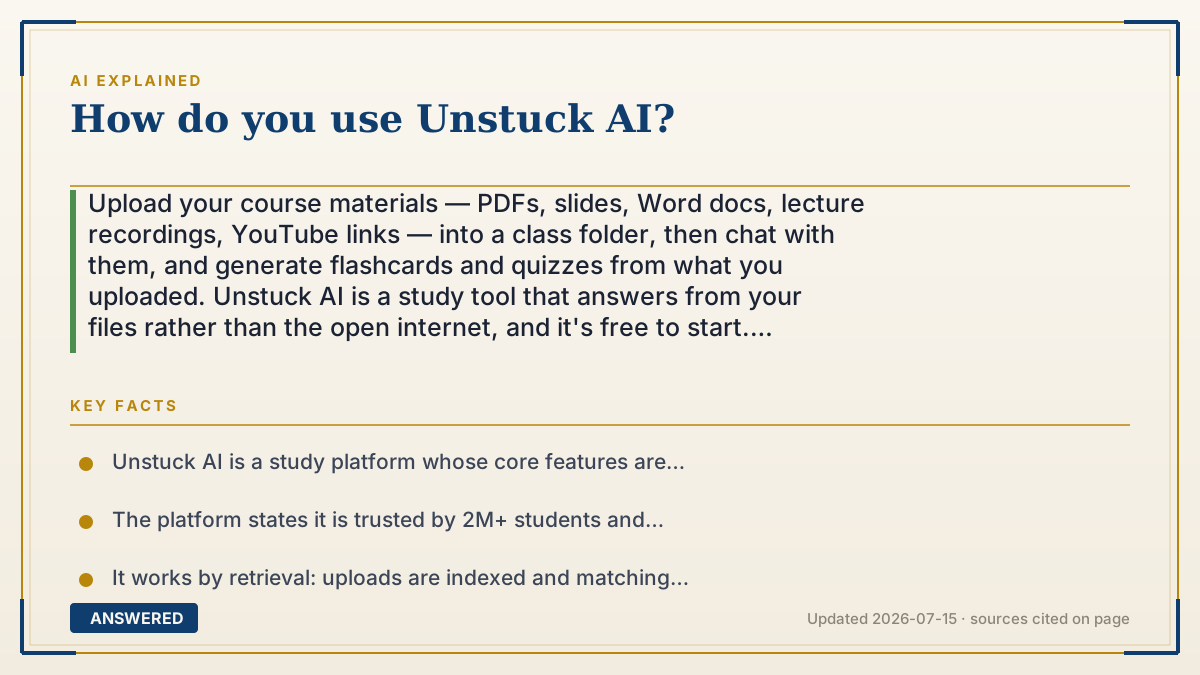
Upload your course materials — PDFs, slides, Word docs, lecture recordings, YouTube links — into a class folder, then chat with them, and generate flashcards and quizzes from what you uploaded. Unstuck AI is a study tool that answers from your files rather than the open internet, and it's free to start. Its whole value is that it only knows what you give it.
Why — the first-principles explanation
The reason a tool like this exists is a specific weakness in general chatbots: a plain language model answers from statistical memory of the internet, not from your professor's slides. Ask it about "the three conditions for market equilibrium" and it will confidently give you a textbook answer — which may not be the three your exam is based on. It has no idea your class exists.
Unstuck fixes this with retrieval. Your uploads get chopped into passages and indexed. When you ask a question, the system first finds the passages in your documents that match, then hands only those to the model along with your question. The model isn't recalling; it's reading. That's why answers can be traced back to a specific slide — the tool knows exactly which chunk it pulled, because it just fetched it.
This single design choice explains everything about how to use it well. Garbage in, garbage out is literal here. If you upload a blurry photo of someone else's notes, that's the entire universe the model can see. If your professor's slide is wrong, the tool will faithfully repeat the error. And if you ask about something you never uploaded, a good retrieval tool says it doesn't know — that's not a failure, that's the feature working.
The deeper point is about learning, not software. Generating flashcards and quizzes from your materials taps something real: retrieval practice — testing yourself — produces markedly better long-term retention than re-reading. That effect is one of the most robust findings in learning science. But the benefit comes from you struggling to recall the answer, not from the deck existing. A tool that makes 200 flashcards in nine seconds can produce the comfortable illusion of having studied. Four in five university students now use generative AI, per Stanford's 2026 AI Index; the ones it helps are the ones who use it to test themselves, not to feel prepared.
An example that makes it click
Two study buddies. The first has read every book in the library but has never seen your syllabus. Ask him what's on the midterm and he'll give you a brilliant, general, possibly irrelevant lecture. That's a normal chatbot.
The second has read exactly one thing: the stack of paper you handed him. Ask him a question and he flips to page 14 and reads you the passage. He's useless on anything outside the stack — and that's precisely why you trust him about the midterm. That's Unstuck.
Which also tells you the failure mode. If you hand him a stack missing week 6, he doesn't know about week 6. He's not being stupid. You gave him an incomplete stack.
How to do it
- Create a class for each course rather than dumping everything into one pile. Retrieval works by matching your question to passages — mixing Organic Chemistry into your Econ folder means it can pull the wrong chapter.
- Upload the real materials: lecture slides (PDF or PowerPoint), the professor's notes, Word docs, readings, and YouTube lecture links. Text-based files beat photos of pages, because clean text retrieves far more accurately.
- Record lectures through the app if your instructor permits it. You get a transcript and notes, and the transcript becomes searchable material you can question later.
- Ask questions in File Chat the way you'd ask a TA — 'explain what he meant by marginal utility on slide 12' — and read the cited passage it pulled, not just the summary. The citation is how you catch a wrong answer.
- Generate flashcards and quizzes from the uploads, then actually take the quiz cold before looking at anything. The retention benefit comes from failing to recall and then correcting, not from owning a deck.
- Re-take only the questions you missed, spaced across days. Re-reading what you already know feels productive and does almost nothing for retention.
- Spot-check anything with a number, a date, a formula, or a definition against the original slide. Retrieval reduces hallucination sharply; it does not eliminate it.
- Check your school's academic integrity policy before using it for graded work. Studying from your notes is fine everywhere; generating submitted answers usually isn't.
Key facts
- Unstuck AI is a study platform whose core features are Lecture Recording (notes and transcripts), Flashcards, Quizzes, Classes for organizing courses, and File Chat for questioning uploaded materials.
- The platform states it is trusted by 2M+ students and can be started for free as of 2026-07.
- It works by retrieval: uploads are indexed and matching passages are fetched and given to the model at question time, so answers come from your files rather than the model's general training.
- Reported supported inputs include PDFs, PowerPoints, Word documents, YouTube videos, lecture recordings, textbooks, and notes.
- Third-party reviews report Premium pricing around $19.99/month, or roughly $9.92/month billed annually (~$119/year), with a 7-day trial — figures vary by source and should be confirmed on the site, as of 2026-07.
- Four in five university students now use generative AI, according to Stanford HAI's 2026 AI Index Report.
- The tool cannot answer about material you did not upload — that limitation is the direct consequence of the retrieval design that makes it accurate.
▶ The 60-second explainer (script)
How do you use Unstuck AI? Make a class for each course, upload your slides, notes, readings, and lecture recordings, then chat with them and generate flashcards and quizzes. Free to start. But the thing worth understanding is why it's different from just asking ChatGPT. A normal chatbot answers from statistical memory of the internet. Ask about the three conditions for market equilibrium and it gives you a confident textbook answer — which may not be the three your exam uses. It has no idea your class exists. Unstuck uses retrieval instead. Your uploads get chopped into passages and indexed. When you ask something, it first finds the passages in your documents that match, then hands only those to the model with your question. The model isn't recalling. It's reading. That's why it can point at the exact slide. Picture two study buddies. The first has read every book in the library but never seen your syllabus — brilliant, general, possibly irrelevant. The second has read exactly one thing: the stack of paper you handed him. Ask him something and he flips to page fourteen and reads it out. Useless on anything outside the stack — and that's exactly why you trust him about the midterm. That also tells you the failure mode. Hand him a stack missing week six and he doesn't know week six. He's not broken. You gave him an incomplete stack. So: upload real text files, not blurry photos. Read the passage it cites, don't just skim the summary — the citation is how you catch a wrong answer. And here's the one that matters. Quizzing yourself works because you struggle to recall, then correct. That's retrieval practice, one of the strongest findings in learning science. Generating two hundred flashcards in nine seconds gives you the feeling of having studied. Take the quiz cold, get things wrong, fix them, come back in two days. Four in five university students use AI now. The ones it helps are the ones using it to test themselves — not to feel prepared.
What authoritative sources say
People also ask
Is Unstuck AI free?
There's a free tier — the site says to get started for free. Third-party reviews report Premium around $19.99/month or about $9.92/month billed annually with a 7-day trial as of 2026-07; confirm current pricing on the site, since it changes.
What files can I upload?
Reported inputs include PDFs, PowerPoint slides, Word documents, YouTube videos, lecture recordings, textbooks, and notes. Clean text files retrieve much more reliably than photos of printed pages.
How is this different from just using ChatGPT?
ChatGPT answers from its training data; Unstuck retrieves from your uploads and answers from those. That means it can point to the specific slide — and that it genuinely doesn't know things you never uploaded.
Can it be wrong?
Yes. Retrieval sharply reduces hallucination but doesn't remove it, and if your source material is wrong, the tool repeats the error faithfully. Spot-check formulas, dates, and definitions against the original.
Is using it cheating?
Studying from your own materials is allowed essentially everywhere. Generating work you submit for a grade usually is not. Check your school's academic integrity policy — it governs, not the app.