How does Google Veo work?
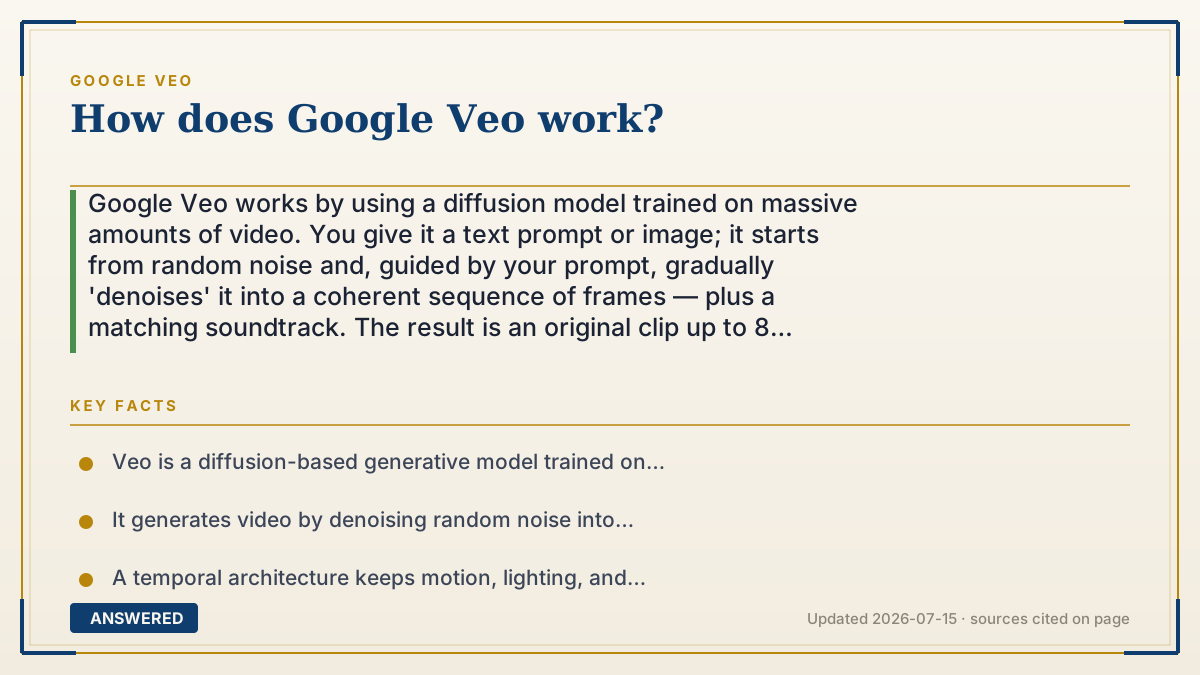
Google Veo works by using a diffusion model trained on massive amounts of video. You give it a text prompt or image; it starts from random noise and, guided by your prompt, gradually 'denoises' it into a coherent sequence of frames — plus a matching soundtrack. The result is an original clip up to 8 seconds with synchronized native audio.
Why — the first-principles explanation
Veo is a diffusion model, the same family behind AI image generators, stretched across time. During training it was shown enormous numbers of real video clips that had been progressively blurred into static, and it learned to reverse the process — to turn noise back into a clean video. Do that starting from fresh random noise, steered by your prompt, and it 'imagines' a brand-new clip that never existed.
The hard part is time and consistency. A video isn't one image; it's many frames that must agree with each other so objects don't flicker or morph. Veo uses a temporal architecture that considers frames together, keeping motion smooth, lighting stable, and physics believable across the whole clip. Your text prompt acts as a steering wheel at every denoising step, nudging the output toward 'golden retriever, slow motion, splashing water.'
Audio works the same way: because Veo learned from video with sound, it generates the soundtrack jointly with the picture, aligning a spoken word to lip movement or a splash to the moment of impact. Finally, every output is stamped with an invisible SynthID watermark for provenance. So under the hood, Veo isn't retrieving clips — it's sculpting a new video and its audio out of noise, one guided step at a time.
An example that makes it click
Imagine a sculptor who starts with a block of TV static and slowly chisels it until a clear moving scene appears. At every tap of the chisel, they glance at your instructions — 'a cat leaping through a window' — and remove a little more fuzz in that direction. After many taps, the static has become a smooth 8-second clip of exactly that cat.
And because this sculptor learned by watching videos with the sound on, they hum the matching 'meow' and the 'whoosh' of the leap at the right instants. That chiseling-from-static, guided-by-your-words process is diffusion — how Veo turns noise into video.
Key facts
- Veo is a diffusion-based generative model trained on large amounts of video data.
- It generates video by denoising random noise into coherent frames, guided by your prompt.
- A temporal architecture keeps motion, lighting, and physics consistent across frames.
- Audio is generated jointly with the picture, aligning sound to on-screen events.
- Every Veo output is embedded with an invisible SynthID watermark for provenance.
Open the official product site and confirm the current access, plans and terms.
▶ The 60-second explainer (script)
How does Google Veo actually work? At its core, Veo is a diffusion model — the same idea behind AI image generators, stretched across time. Here's the trick: during training, Veo watched huge numbers of real videos that had been blurred into pure static, and it learned to reverse that, turning noise back into clean footage. So when you give it a prompt, it starts from random static and, step by step, chisels away the fuzz — always steered by your words — until a brand-new clip appears. The hard part is keeping every frame consistent so nothing flickers, which Veo handles with a time-aware design. And because it learned from video with sound, it generates the audio together with the picture, matching a splash or a spoken word to the exact frame. Finally, it stamps each clip with an invisible SynthID watermark.
What authoritative sources say
People also ask
Does Veo copy existing videos?
No. It generates original clips by denoising random noise guided by your prompt, not by retrieving stock footage.
How does Veo keep frames consistent?
It uses a time-aware architecture that considers frames together, so motion, lighting, and physics stay stable.
How does Veo make matching sound?
It learned from video with audio, so it generates the soundtrack jointly with the picture and aligns them.
What is the SynthID watermark?
An invisible signal embedded in every Veo output to verify it was AI-generated, resistant to editing.