How many people use AI?
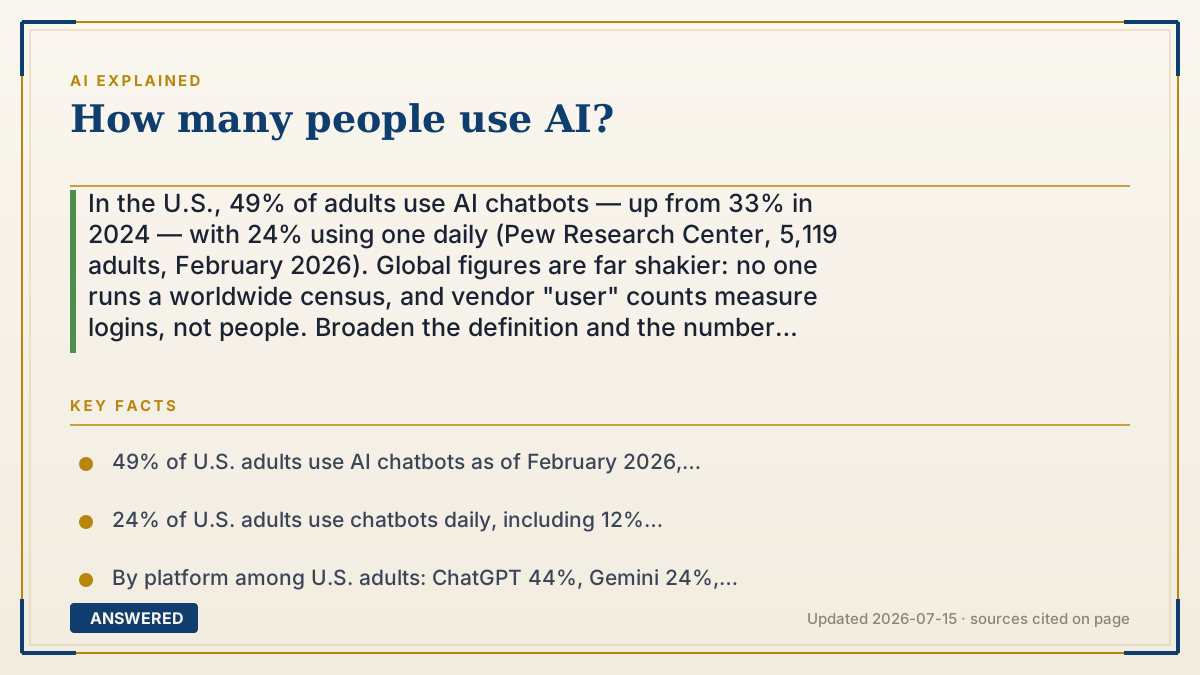
In the U.S., 49% of adults use AI chatbots — up from 33% in 2024 — with 24% using one daily (Pew Research Center, 5,119 adults, February 2026). Global figures are far shakier: no one runs a worldwide census, and vendor "user" counts measure logins, not people. Broaden the definition and the number approaches everyone.
Why — the first-principles explanation
Any number you see depends entirely on where you draw the line, and almost nobody tells you where they drew it.
Draw it at "deliberately opened a chatbot": Pew's measurement is the solid one. 49% of U.S. adults, up from 33% in 2024 and more than double 2023. ChatGPT 44%, Gemini 24%, Copilot 17%, Meta AI 14%, Grok 8%, Claude 6%. Those add to well over 49% because people use more than one. About 24% use chatbots daily, including 12% several times a day and 4% almost constantly.
Draw it at "encountered AI output": the number jumps immediately. 60% of U.S. adults say they read AI summaries in search engines — most of them never chose to use AI, it just appeared above the results. Add spam filters, autocomplete, photo sorting, recommendation feeds, fraud detection on your card, and "how many people use AI" collapses into "how many people use the internet." That's not a trick answer; it's why the question needs a definition before it has a number.
Now the global problem, which is where most published figures are worst. There is no worldwide equivalent of Pew's survey. So the big round numbers you see — "a billion users" — usually come from vendors reporting weekly active accounts. Those are not people. One person with a work account and a personal account is two. A shared classroom login is one account and thirty people. A bot-driven signup is a user forever. Vendors have every incentive to count generously and no incentive to reconcile across companies. Adding OpenAI's number to Google's double-counts everyone who uses both — which, per Pew, is a lot.
So the defensible claim is: in rich, English-speaking, connected countries, roughly half of adults deliberately use a chatbot, and adoption has roughly tripled since 2023. Beyond that, be suspicious of precision. Pew also finds adults under 50 are about twice as likely as those 50+ to use ChatGPT (57% vs 28%) — so "how many people" hides an enormous spread depending on which people.
An example that makes it click
Ask "how many people use electricity" and you'd get different answers depending on the line. People who flip a light switch on purpose? Almost everyone. People who own a generator? Very few. People touched by electricity today, including the traffic light they drove through and the pump that moved their water? Literally everyone.
AI is at the awkward stage where all three answers are still different. Pew is counting the light switch. The 60% reading AI summaries in search are the traffic light — they never chose it, it was just already on.
Key facts
- 49% of U.S. adults use AI chatbots as of February 2026, up from 33% in 2024 and more than double the 2023 share — Pew Research Center, 5,119 U.S. adults, American Trends Panel, fielded February 17–23, 2026.
- 24% of U.S. adults use chatbots daily, including 12% several times a day and 4% almost constantly.
- By platform among U.S. adults: ChatGPT 44%, Gemini 24%, Copilot 17%, Meta AI 14%, Grok 8%, Claude 6% — totals exceed the 49% figure because people use multiple tools.
- ChatGPT usage has more than doubled since 2023, when it stood at 18%.
- 60% of U.S. adults report reading AI summaries in search engines — passive exposure exceeds deliberate use.
- Adults under 50 are about twice as likely as those 50 and older to use ChatGPT (57% vs 28%).
- No equivalent global survey exists; vendor-reported "weekly active user" counts measure accounts rather than individuals and cannot be summed across companies without double-counting.
▶ The 60-second explainer (script)
In the United States, 49% of adults use AI chatbots. That's Pew Research Center, surveying 5,119 adults in February 2026 — up from 33% in 2024, and more than double 2023. About a quarter use one every day. But every number here depends on where you draw the line, and almost nobody tells you where they drew it. Draw it at "deliberately opened a chatbot" — that's the 49%. ChatGPT 44%, Gemini 24%, Copilot 17%, Meta AI 14%, Grok 8%, Claude 6%. Those add up past 49% because people use more than one. Draw it at "encountered AI output" and it jumps. Sixty percent of Americans say they read AI summaries in search. Most of them never chose that — it just appeared above the results. Add spam filters, autocomplete, photo sorting, fraud detection on your card, and the question becomes how many people use the internet. Now the global number, where things get bad. There's no worldwide Pew survey. So those billion-user headlines come from vendors reporting weekly active accounts. Accounts aren't people. One person with a work login and a personal login is two. A shared classroom account is one account and thirty kids. And you can't add OpenAI's number to Google's, because everybody using both gets counted twice — and per Pew, that's a lot of people. So here's what's defensible: in rich, connected, English-speaking countries, roughly half of adults deliberately use a chatbot, and adoption roughly tripled since 2023. Past that, be suspicious of precision. Even within America the spread is huge — under 50, it's 57%. Over 50, it's 28%.
What authoritative sources say
People also ask
How many people use AI worldwide?
Nobody credibly knows. There's no global equivalent of Pew's survey, and the big headline figures come from vendors counting weekly active accounts — which double-count people with multiple logins, undercount shared accounts, and can't be summed across companies. Treat any precise global number with suspicion.
How many people use ChatGPT?
In the U.S., 44% of adults report using it, up from 18% in 2023 — that's Pew's survey-based figure and it's the solid one. OpenAI's own user counts measure accounts and activity, not individuals, so they answer a different question.
Is AI use still growing?
Yes, quickly. U.S. chatbot use went from 33% in 2024 to 49% in early 2026, and ChatGPT more than doubled since 2023. But growth from half the population is arithmetically slower than growth from a fifth — the easy adopters are already in.
Why do AI user numbers differ so much between sources?
Because of definitions. Deliberate chatbot use is 49% of U.S. adults. Reading AI summaries in search is 60%. Counting spam filters and recommendation feeds pushes it near 100%. Same country, same month, three different answers — all defensible, depending on the boundary.
Who doesn't use AI?
About half of American adults, and the split is sharply generational — 57% of under-50s use ChatGPT versus 28% of those 50 and older. Pew has published separate work on why people don't use chatbots, which is a bigger group than most tech coverage implies.
The same question, asked other ways
- How many people use AI daily?