How to create an AI model?
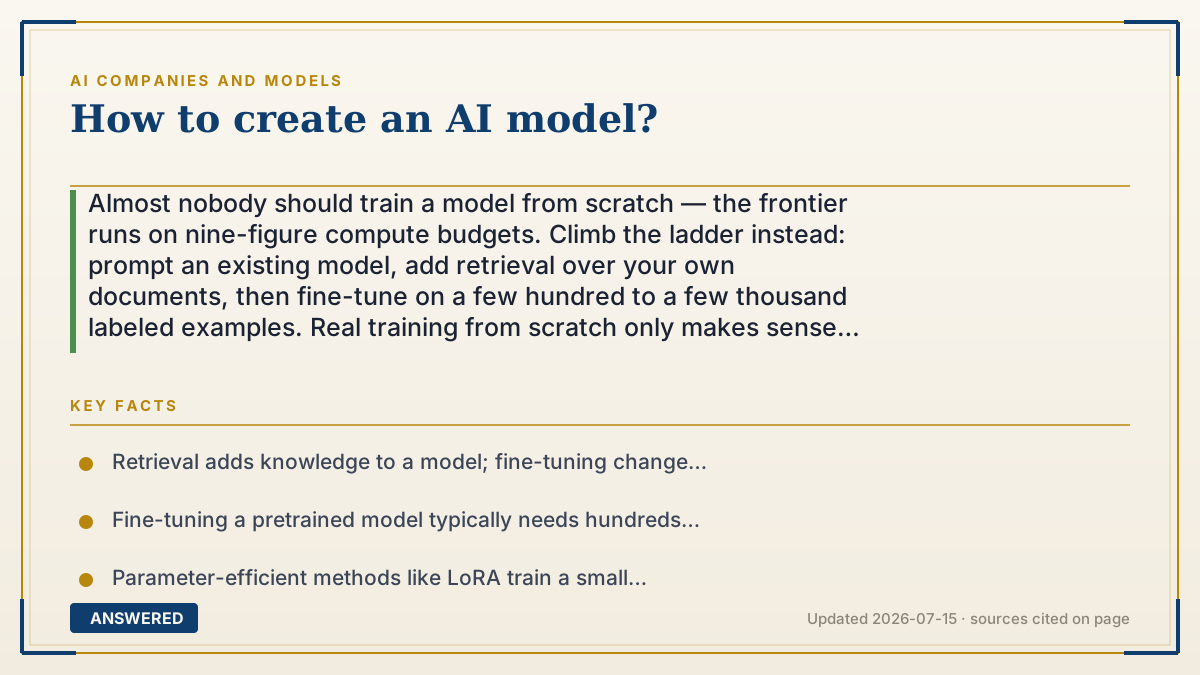
Almost nobody should train a model from scratch — the frontier runs on nine-figure compute budgets. Climb the ladder instead: prompt an existing model, add retrieval over your own documents, then fine-tune on a few hundred to a few thousand labeled examples. Real training from scratch only makes sense for narrow, small models on data nobody else has.
Why — the first-principles explanation
"Create an AI model" hides four very different projects with cost differences spanning a million to one. Sorting out which one you mean is 90% of the work.
The physics is unforgiving at the top. A frontier language model is a stack of matrices — billions of numbers — nudged slightly on every example until predictions improve. That nudging requires reading through trillions of words on thousands of specialized chips running for weeks. The bill lands in the tens or hundreds of millions of dollars, and money isn't even the hard part: the hard parts are the data (a legally defensible corpus at internet scale), the engineering (thousands of GPUs fail, stall, and desync in ways that eat months), and the fact that you'd be spending a fortune to reproduce something you can rent by the token. This is not a path that opens up if you try harder. It opens up if you have a few hundred million dollars and a reason.
So the useful question becomes: what's the cheapest rung that solves your problem? Rung one is prompting — the model already knows the general skill; you're just describing the task. Rung two is retrieval (RAG) — the model doesn't know your facts, so you fetch the relevant chunks of your own documents and paste them into context at question time. This is the rung most people actually need, and they skip it because "fine-tuning" sounds more serious. The distinction is sharp and worth memorizing: retrieval gives a model new knowledge; fine-tuning gives it new behavior. If your model doesn't know your return policy, that's a retrieval problem, and fine-tuning is the wrong, expensive answer.
Rung three is fine-tuning: take a pretrained model and continue training it on a few hundred to a few thousand of your own input-output pairs, teaching format, tone, or a narrow classification. Techniques like LoRA train only a small adapter instead of all the weights, so this runs on one GPU for the price of a dinner. It works well when you can show far more than you can explain. Rung four, training from scratch, is genuinely reasonable in one situation: a small, narrow model — fraud scoring, defect detection on your factory line, a domain classifier — where your proprietary data is the asset and no general model has seen anything like it. Here a classical model like gradient-boosted trees on a laptop routinely beats a giant language model, and costs nothing.
Whatever rung you're on, the ordering rule is the same: data quality dominates everything else. A thousand carefully labeled examples beat a hundred thousand scraped ones, and no architecture choice rescues bad labels. Build your evaluation set before you build the model, or you'll have no way to know whether any of it worked.
An example that makes it click
Think about getting a meal. You can order takeout — that's calling an API. You can order takeout and ask them to hold the onions — that's prompting. You can bring your own spice blend to the table — that's retrieval, adding your specific stuff at serving time. You can send the cook to a two-day class on your restaurant's plating style — that's fine-tuning: same cook, same skills, new habits.
Or you can raise the cow. That's training from scratch. It is a real thing people do, it takes years and a ranch, and if you're doing it because the takeout came with onions, something has gone badly wrong in your planning. There is exactly one good reason to raise the cow: you need a kind of animal that doesn't exist anywhere, and you happen to own the only pasture where it grows. That's what proprietary data is.
How to do it
- Write the task as one sentence with a measurable target: 'classify support tickets into 8 categories at 95% accuracy' — not 'build an AI'.
- Build the evaluation set first: 50-200 real examples with correct answers, held back and never published.
- Try prompting an existing model. Measure against your eval set. Many projects stop here — that's a win, not a failure.
- If it lacks your facts, add retrieval: chunk your documents, embed them, fetch the relevant pieces at query time and put them in the prompt.
- If it lacks the right behavior or format, fine-tune: collect a few hundred to a few thousand input-output pairs and train an adapter (LoRA) on a pretrained base.
- For narrow structured problems on tabular data, skip language models — train gradient-boosted trees or a small neural net on your own data. It's often more accurate and vastly cheaper.
- Only consider from-scratch pretraining if you have proprietary data at scale, a narrow domain, and budget measured in hundreds of thousands or more.
- Re-run your eval set after every change, log the score with the date and version, and red team before shipping.
- Deploy behind monitoring: real inputs drift away from your test set within months.
Key facts
- Retrieval adds knowledge to a model; fine-tuning changes behavior and format — using fine-tuning to inject facts is a common and expensive mistake.
- Fine-tuning a pretrained model typically needs hundreds to a few thousand labeled examples, versus trillions of tokens for pretraining from scratch.
- Parameter-efficient methods like LoRA train a small adapter rather than all weights, cutting fine-tuning to a single GPU for many tasks.
- For tabular and structured prediction problems, classical models such as gradient-boosted trees frequently outperform large language models at a tiny fraction of the cost.
- NIST's AI Risk Management Framework (released January 26, 2023) organizes model development around four functions — Govern, Map, Measure, Manage — with a Generative AI Profile added July 26, 2024.
- Label quality dominates dataset size: a small, correctly labeled set outperforms a large noisy one, and no architecture choice compensates for bad labels.
Ready to try AI?
The answer above explains the concept; this next step helps you choose by job, limits and current terms.
▶ The 60-second explainer (script)
How do you create an AI model? First, understand that this question hides four different projects, and they differ in cost by about a million to one. At the top is training a frontier model from scratch. That means thousands of specialized chips running for weeks over trillions of words, and a bill in the tens or hundreds of millions. That path doesn't open up because you tried harder. It opens up because you have a few hundred million dollars. So the real question is: what's the cheapest rung that solves your problem? Rung one, prompting — the model already has the skill, you just describe the task. Rung two, retrieval — the model doesn't know your facts, so you fetch the right chunks of your own documents and paste them into the prompt at question time. Memorize this distinction, it saves people months: retrieval gives a model new knowledge, fine-tuning gives it new behavior. If it doesn't know your return policy, that's retrieval. Fine-tuning is the wrong tool and it costs more. Rung three, fine-tuning — take a pretrained model, train it on a few hundred to a few thousand of your own examples to lock in format or tone. With LoRA you train a tiny adapter on one GPU for the price of dinner. Rung four, from scratch — genuinely correct in exactly one case: a small, narrow model where your proprietary data is the whole asset. And if your data is a spreadsheet, skip language models entirely. Gradient-boosted trees will beat them and cost nothing. One rule across all four rungs: data quality beats everything. A thousand good labels beat a hundred thousand scraped ones, and no clever architecture saves you from bad labels. Build your evaluation set before you build the model — otherwise you'll never know if any of it worked.
What authoritative sources say
People also ask
How much does it cost to train an AI model?
It spans a million to one. Fine-tuning a small adapter can cost tens of dollars on one GPU; pretraining a frontier language model runs into the tens or hundreds of millions.
Should I fine-tune or use retrieval?
Retrieval if the model lacks your facts; fine-tuning if it lacks the right behavior, tone, or output format. Using fine-tuning to inject knowledge is the most common expensive mistake.
How much data do I need to fine-tune?
Often a few hundred to a few thousand high-quality input-output pairs. Label accuracy matters far more than volume — noisy labels teach the model to be wrong confidently.
Do I need a language model at all?
Frequently not. For structured or tabular prediction, gradient-boosted trees typically beat LLMs on accuracy, latency, and cost. Match the tool to the data shape.
Can I train a model on my laptop?
Yes, for small classical models and some LoRA fine-tunes on modest hardware. Pretraining anything resembling a modern chat model is not laptop territory by many orders of magnitude.