How to use AI in marketing?
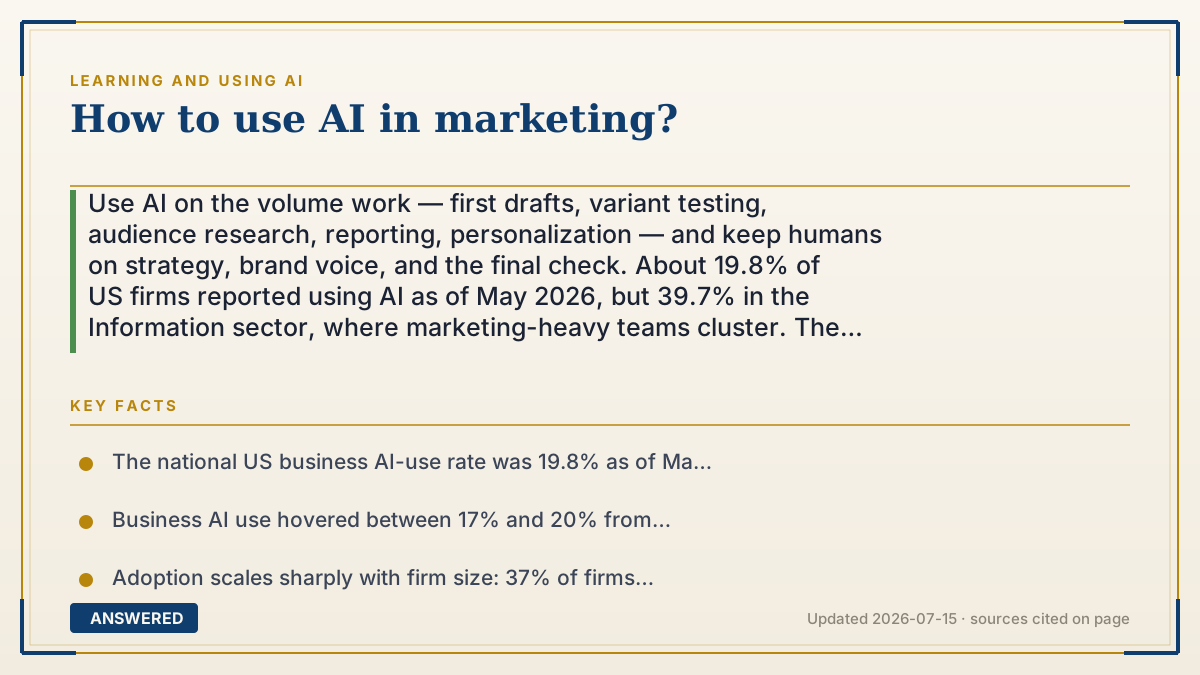
Use AI on the volume work — first drafts, variant testing, audience research, reporting, personalization — and keep humans on strategy, brand voice, and the final check. About 19.8% of US firms reported using AI as of May 2026, but 39.7% in the Information sector, where marketing-heavy teams cluster. The gain is speed per campaign, not fewer marketers.
Why — the first-principles explanation
Marketing has always been throttled by a single constraint: producing variations is expensive. You want to test five headlines, but writing five good headlines takes a copywriter an afternoon, so you test two. You want emails tailored to twelve segments, but you have budget for two, so you send generic ones. Nearly every mediocre marketing outcome traces back to that throttle. AI removes it. Variations are now close to free, which is the entire source of the advantage — not the writing quality, which is merely fine.
But removing a constraint only helps if the next constraint isn't worse. And it is. Once you can generate 50 headlines, your bottleneck becomes knowing which one is right — and that's a judgment problem, not a generation problem. If you don't have a way to test (traffic, a list, real conversion data), 50 headlines is 50 guesses, which is strictly worse than two considered ones. This is why AI helps big-volume marketers enormously and helps a business with 40 monthly visitors almost not at all. The tool multiplies your feedback loop; if you don't have a loop, it multiplies zero.
The second thing to understand is why AI-written marketing tends to underperform. The model predicts the most likely next words — the statistical center of everything ever written about your category. The center is, by definition, what your competitors already sound like. Differentiation is a deviation from the average, so a tool optimized for the average will erase it unless you actively supply what's specific: your customer's real objection, your actual pricing decision, the thing you do that they don't. Feed it your voice and your facts; ask it for finished copy and you'll get competent generic mush.
So the sound division of labor follows from the mechanism. AI is unbeatable at breadth — drafts, variants, translations, summarizing 400 reviews, reformatting a report into six channels. Humans stay on the choice — positioning, what's true about the product, what we refuse to say, and whether this is actually on brand. Teams that invert this ship faster and perform worse.
An example that makes it click
Picture a bakery testing a sign. Before, writing one good sign took the owner an evening, so she wrote one and left it up all month: "Fresh Bread Daily." Now she can produce forty signs before the oven preheats. That sounds like a huge win — until you notice her problem was never sign-writing. It was that only nine people walk past. Forty signs and nine walkers tells her nothing; she still can't tell which sign worked.
The bakery across town gets 3,000 walkers a day. She swaps signs each morning and by Friday knows that "Sourdough out of the oven at 7:15" beats everything else by triple. Same tool, wildly different value — because the second baker had a feedback loop and the first didn't. AI doesn't create the signal. It just lets you ask more questions of the signal you already have.
How to do it
- Audit for volume work first: anything you'd do more of if it were free — headline variants, subject lines, ad copy, segment-specific emails, product descriptions, repurposing one asset into six channels. That's where AI pays.
- Use it for research synthesis, which is underrated: paste 200 reviews, support tickets, or call transcripts and ask for recurring objections and the exact language customers use. This gives you your copy, in their words.
- Feed it your specifics before asking for anything — real positioning, real pricing, the actual customer objection, three examples of copy you liked. Skip this and you get the statistical average of your category, which is what your competitors sound like.
- Generate variants only if you can test them. No traffic and no list means no feedback loop, and 50 untested headlines are worse than 2 considered ones.
- Keep the strategy call human: who we're for, what we claim, what we refuse to say. The model has no access to any of it and will confidently invent it.
- Fact-check every claim before publishing. Models invent statistics, features, and specifications fluently — and in advertising, a made-up claim is a legal exposure, not just an error.
- Never paste customer PII, unreleased pricing, or NDA'd material into a consumer chatbot. Use an enterprise tier with data controls if you need to work with real customer data.
- Measure against a real baseline. If AI-assisted campaigns don't beat your pre-AI conversion rates, you've bought speed at the cost of performance.
Key facts
- The national US business AI-use rate was 19.8% as of May 3, 2026, but the Information sector reported 39.7% and Finance and Insurance 33.9% (Census Bureau BTOS).
- Business AI use hovered between 17% and 20% from December 2025 to May 2026, with 20-23% of businesses expecting to use AI within the next six months (Census Bureau BTOS).
- Adoption scales sharply with firm size: 37% of firms with 250+ employees use AI versus under 20% of firms with four or fewer employees — and 50-60% among very large firms in Information, Professional Services, and Finance (Census Bureau BTOS).
- 38% of employed US adults who use chatbots use them for work tasks, and 24% of chatbot users create or edit images or video (Pew Research Center, February 2026, n=5,119).
- 18% of firms used AI in a business function in November 2025-January 2026, rising to 32% on an employment-weighted basis — meaning AI-using firms employ a disproportionate share of workers (Census Bureau BTOS).
Choosing an AI tool for work?
The answer above explains the concept; this next step helps you choose by job, limits and current terms.
▶ The 60-second explainer (script)
How do you use AI in marketing? Put it on the volume work — drafts, variants, research, reporting — and keep humans on strategy and the final check. Here's why that split, from first principles. Marketing has always been throttled by one thing: making variations is expensive. You want to test five headlines, but five good headlines cost a copywriter an afternoon, so you test two. You want twelve tailored emails, you send one generic blast. Almost every mediocre campaign traces back to that throttle. AI removes it. Variations are now nearly free — and that, not the writing quality, is the whole advantage. But removing one constraint just exposes the next one, and the next one is worse. Once you can make fifty headlines, your problem becomes knowing which is right. That's judgment, not generation. Fifty headlines with no way to test them is fifty guesses — strictly worse than two considered ones. Think of a bakery testing a sign. Forty AI signs won't help if only nine people walk past. The bakery with three thousand walkers swaps a sign every morning and by Friday knows 'sourdough out at 7:15' triples her sales. Same tool. Totally different value. AI doesn't create the signal — it lets you ask more questions of the signal you already have. Second thing to know: why AI marketing copy underperforms. The model predicts the most likely next words — the statistical center of everything written about your category. And the center is exactly what your competitors already sound like. Differentiation is a deviation from average, so a tool built on the average erases it. Feed it your real positioning, your customer's actual objection, your pricing — or you'll get fluent generic mush. One hard rule: fact-check everything. Models invent statistics and features in a confident voice, and in advertising, a made-up claim isn't an error. It's a legal problem.
What authoritative sources say
People also ask
What is AI actually good at in marketing?
Breadth: first drafts, headline and ad variants, segment-specific emails, translations, repurposing one asset across channels, and summarizing hundreds of reviews or call transcripts into recurring objections. All of it is volume work that used to be rationed.
Will AI replace marketers?
It replaces the drafting hours, not the judgment. Someone still has to decide positioning, catch invented claims, and know what's true about the product. Teams are shipping more per person, not disappearing.
Why does AI-generated marketing copy feel generic?
Because the model outputs the statistical center of your category — which is what your competitors already sound like. Differentiation is a deviation from the average. Supply your real positioning and customer language, or you'll get the average.
Is AI worth it for a small business with little traffic?
Less than the hype suggests. AI's main gift is cheap variations, and variations only pay if you can test them. With 40 monthly visitors you have no feedback loop, so it mostly saves drafting time rather than improving results.
Can I put customer data into an AI tool?
Not into a consumer chatbot. Customer PII, unreleased pricing, and NDA'd material need an enterprise tier with contractual data controls. Assume anything typed into a free tool may be retained or reviewed.
The same question, asked other ways
- How to use AI for marketing?720/mo