Is AGI possible?
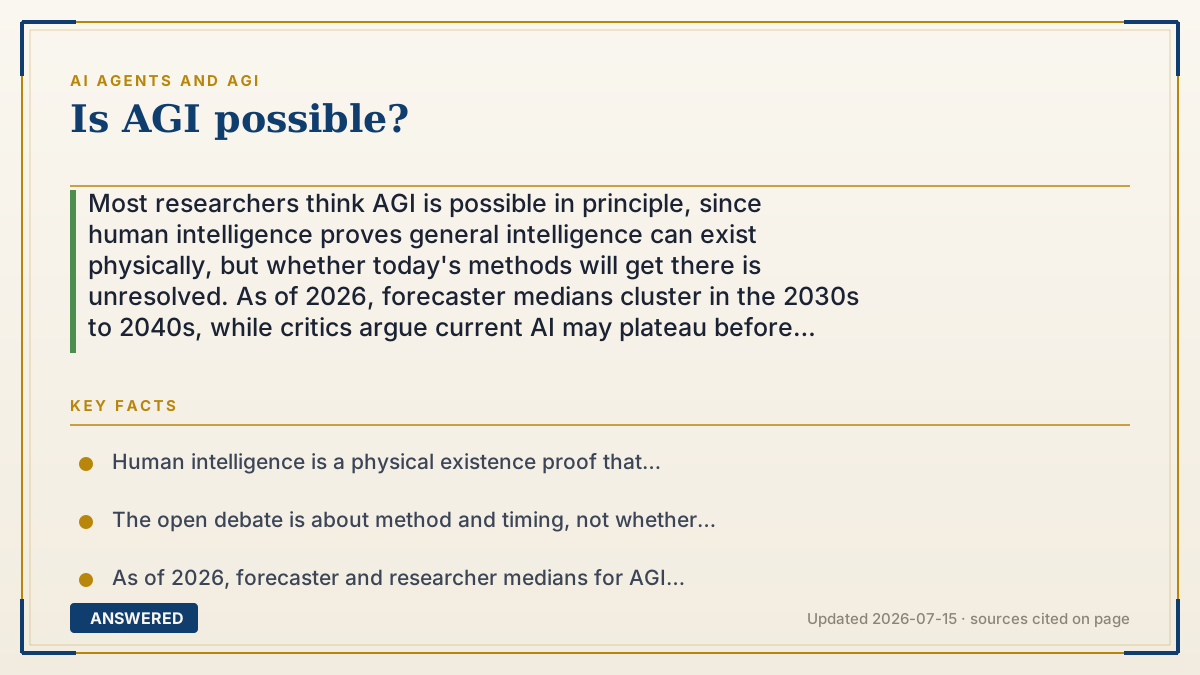
Most researchers think AGI is possible in principle, since human intelligence proves general intelligence can exist physically, but whether today's methods will get there is unresolved. As of 2026, forecaster medians cluster in the 2030s to 2040s, while critics argue current AI may plateau before reaching true generality.
Why — the first-principles explanation
The strongest argument that AGI is possible is simple: it already exists in humans. The brain is a physical system that produces flexible, general intelligence. Unless there's something magical and non-physical about thinking, a sufficiently advanced machine should be able to do the same in some form. This is why very few scientists say AGI is outright impossible.
The real debate is about the path, not the possibility. Today's leading systems learn by finding statistical patterns in enormous amounts of data. That approach has produced startling results, but it may have limits: these systems struggle to reason about situations far from their training data, to learn a genuinely new skill from a few examples, or to form and pursue their own goals. Skeptics argue that scaling up the current recipe will hit a ceiling, and that reaching AGI will need new ideas we don't have yet.
Optimists counter that each time people predicted a hard limit, more data, bigger models, and better training blew past it. They point to fast-rising benchmark scores as evidence the trend will continue.
So the careful answer separates two questions. Can a machine ever be generally intelligent? Almost certainly yes, biology is the proof of concept. Will the specific technology we have in 2026 become AGI, and when? That's genuinely uncertain, with credible experts ranging from 'within a decade' to 'not with these methods.'
An example that makes it click
Think of flight. For centuries people asked, 'is a flying machine even possible?' Birds already proved it was, heavier-than-air things can fly. So the answer to 'possible?' was clearly yes. The real question was which design would work, and flapping-wing contraptions kept failing until the fixed wing and engine cracked it.
AGI is at a similar spot. Human brains are the 'birds' proving general intelligence is physically possible. The open question is whether today's approach, giant pattern-learning models, is the fixed wing that finally flies, or another flapping contraption that will need a new invention first.
Key facts
- Human intelligence is a physical existence proof that general intelligence is possible, which is why few experts call AGI impossible in principle.
- The open debate is about method and timing, not whether general machine intelligence can exist at all.
- As of 2026, forecaster and researcher medians for AGI range from the 2030s to roughly 2047, reflecting deep uncertainty.
- Skeptics argue current pattern-learning systems may plateau on tasks requiring novel reasoning, such as interactive ARC-AGI-3, where models scored under 1% in 2026.
- There is no single agreed definition of AGI, which shapes both 'is it possible' and 'when' answers.
▶ The 60-second explainer (script)
Is AGI possible? In principle, almost certainly yes, and here's the clean reason: human brains already exist. They're physical systems that produce flexible, general intelligence. Unless thinking is somehow magical and non-physical, a machine should eventually be able to do it too. So very few scientists say AGI is impossible. The real argument is about the path. Today's AI learns by spotting patterns in massive data. Optimists say keep scaling that up and we'll get there. Skeptics say this recipe will hit a wall on truly novel problems, and we'll need new inventions first. It's like early flight: birds proved flying was possible, but it still took the right design to actually do it. So: general machine intelligence, possible? Almost surely. With exactly today's technology, and by when? That part is genuinely uncertain.
What authoritative sources say
People also ask
Do any scientists say AGI is impossible?
A few argue it's impossible with current methods, but almost none say general machine intelligence is impossible in principle, because human brains already prove it can physically exist.
Could today's AI simply scale up into AGI?
Maybe. Optimists say bigger models and more data will keep improving. Skeptics say pattern-learning will plateau on novel reasoning and new approaches will be required.
If it's possible, why isn't it here yet?
Current systems lack reliable on-the-fly learning, long-term memory, and goal-forming. Building those pieces well is an unsolved research problem, not just a matter of more compute.
Does 'possible' mean 'soon'?
No. Possibility and timing are separate. Being physically possible doesn't tell us the date, which is why credible estimates still span decades.
The same question, asked other ways
- Why do many AI researchers believe AGI is unachievable?