Is Character AI safe?
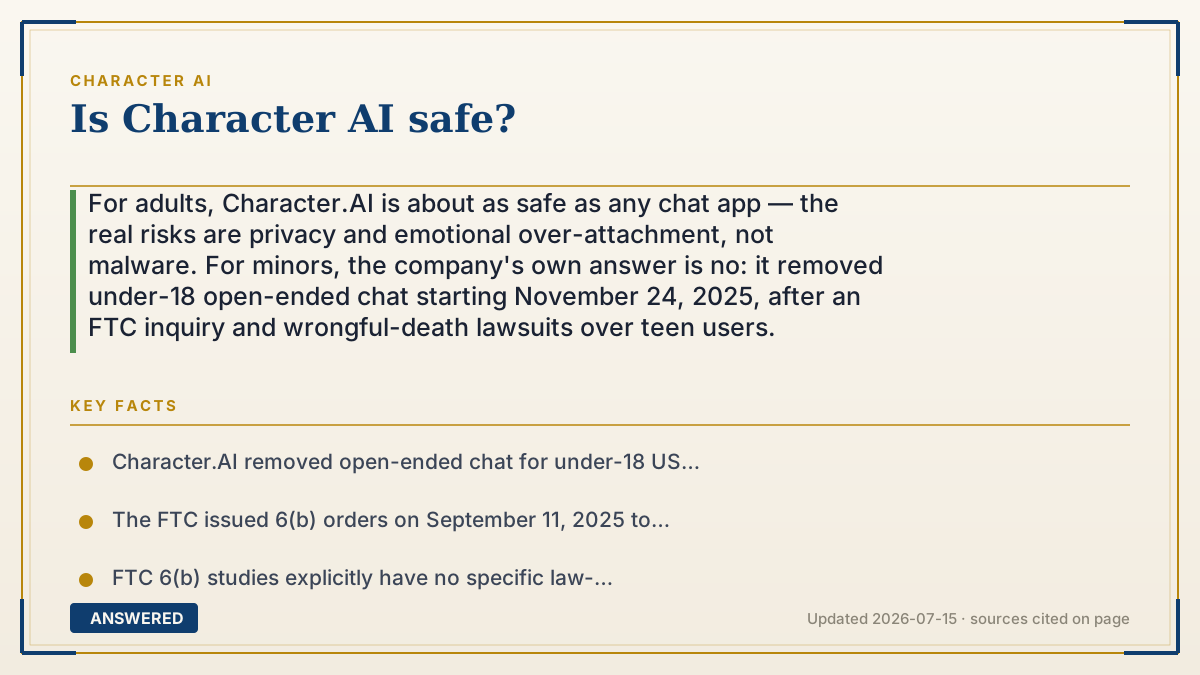
For adults, Character.AI is about as safe as any chat app — the real risks are privacy and emotional over-attachment, not malware. For minors, the company's own answer is no: it removed under-18 open-ended chat starting November 24, 2025, after an FTC inquiry and wrongful-death lawsuits over teen users.
Why — the first-principles explanation
"Safe" bundles four different questions, and mixing them is why the internet's answers are useless. Take them separately.
Is the software malicious? No. Character.AI is a legitimate company — Character Technologies, founded by two ex-Google researchers — whose technology Google licensed for roughly $2.7 billion in August 2024. It's not a scam or a malware vector. The danger is not your device.
Is your data private? Only in the ordinary sense. Everything you type is sent to and stored on Character.AI's servers, and companion chats are unusually intimate — people disclose things there they wouldn't tell a friend. Since late 2025, age assurance may also route your face to Persona, a third-party verifier, meaning biometric data joins the pile. There is no end-to-end encryption and no confidentiality privilege. Treat every message as permanently recorded by a company, because it is.
Is the content safe? Mostly filtered, never guaranteed. Characters are written by users, and the model can be steered. The FTC, launching its inquiry, cited allegations of chatbots engaging in sexualized dialogue with minors, giving harmful medical misinformation, and amplifying self-harm ideation. Those are allegations under study, not established findings — but they're the specific worries a federal regulator thought worth compelling data about.
Is it psychologically safe? This is the honest hard one, and the truth is we don't know the base rate. There is no credible study quantifying how often Character.AI harms typical users. What exists is a small number of severe documented cases and a plausible mechanism: a system optimized to keep you talking, that mimics intimacy and never gets tired. The strongest evidence is behavioral — the company voluntarily cut off a huge portion of its own users rather than keep serving minors. Firms don't do that unless the risk is real. But "real for some vulnerable teenagers" is not the same claim as "dangerous for everyone," and anyone telling you either extreme is guessing.
An example that makes it click
Ask if a swimming pool is safe. For a strong adult swimmer: yes, trivially. For a toddler alone: it's the leading way toddlers die. Same pool, same water, opposite answers — because safety isn't a property of the pool, it's a property of the pairing.
Character.AI is that pool. An adult who uses it for an hour of fiction and closes the tab is fine. A lonely 14-year-old talking to it four hours a night instead of to humans is in different water entirely. And notice what the lifeguard did here: rather than add another rope, they banned the toddlers from the pool.
How to do it
- Assume permanence: never type anything — real name, address, school, workplace, passwords, secrets — that you'd mind a company storing indefinitely.
- Don't use it for medical, legal, or financial advice. The model produces confident text, not verified facts, and the FTC's inquiry specifically flagged harmful medical misinformation as a concern.
- Don't use it as a therapist. It has no clinical training, no duty of care, and no crisis-escalation protocol. Character.AI itself points users to a helpline network of 1,500 services across 170 countries.
- Watch usage patterns, not content. Hours per day, chatting instead of sleeping, or preferring the bot to people are the warning signs — not what the character says.
- Read Persona's privacy terms before submitting a selfie or ID for age verification; that's a separate company handling biometric data.
- For parents: US under-18 accounts lost open-ended chat starting November 24, 2025. If a teen still has access, the account is likely misreporting its age.
Key facts
- Character.AI removed open-ended chat for under-18 US users starting November 24, 2025, after announcing the change October 29, 2025.
- The FTC issued 6(b) orders on September 11, 2025 to seven companies including Character Technologies, citing allegations of sexualized dialogue with minors, harmful medical misinformation, and amplification of self-harm ideation.
- FTC 6(b) studies explicitly have no specific law-enforcement purpose — the inquiry compels information and does not establish that harm occurred.
- On May 21, 2025 a federal judge in the Middle District of Florida declined to dismiss Garcia v. Character Technologies on First Amendment grounds, treating the chatbot as a product.
- Filings unsealed January 7, 2026 disclosed mediated settlements in five cases in Florida, Colorado, New York and Texas, terms undisclosed.
- Age assurance may route users to Persona, a third-party verifier, for selfie-based age estimation, with government ID as a fallback.
- No peer-reviewed study as of 2026-07 quantifies the population-level rate of psychological harm from companion chatbots.
Open the official product site and confirm the current access, plans and terms.
▶ The 60-second explainer (script)
Is Character.AI safe? That question is actually four questions, and mixing them is why every answer online is useless. One: is it malware? No. It's a real company — Google paid about two point seven billion dollars to license their tech in twenty twenty-four. Your device is fine. Two: is your data private? Not really. Everything you type is stored on their servers, there's no encryption, and companion chats are unusually personal. Since late twenty twenty-five, age checks may also send your face to a company called Persona. Assume every message is permanent. Three: is the content safe? Mostly filtered, never guaranteed. When the FTC opened its inquiry in September twenty twenty-five, it cited allegations of sexualized dialogue with minors, harmful medical misinformation, and amplifying self-harm ideation. Allegations under study — not proven findings. Four, the hard one: is it psychologically safe? Honestly, nobody knows the base rate. There's no good study. What we have is a few severe documented cases, a plausible mechanism — a system built to keep you talking that imitates intimacy and never tires — and one loud piece of evidence: the company voluntarily cut off its under-eighteen users on November twenty-fourth, twenty twenty-five. Companies don't torch their own audience over nothing. So: adults, fine, with privacy caution. Kids, the company's own answer is no.
What authoritative sources say
People also ask
Is Character.AI safe for a 13-year-old?
Character.AI's own answer is no. It removed open-ended chat for under-18 US users starting November 24, 2025. If a young teen still has chat access, the account is almost certainly misreporting its age.
Can Character.AI staff read my chats?
Your conversations are stored on the company's servers and are used for moderation and system operation. There's no end-to-end encryption and no confidentiality protection. Assume they are readable.
Is it safe to give Character.AI my selfie or ID?
That data goes to Persona, a third-party verifier with its own privacy and retention terms. Read those terms before submitting. Refusing means restricted access to open-ended chat.
Is Character.AI addictive?
There is no clinical measurement of addiction rates for companion chatbots as of 2026-07. The design does optimize for continued engagement, and heavy daily use displacing sleep or human contact is the pattern worth watching.
Can I trust health advice from a character?
No. Harmful medical misinformation was one of the specific concerns the FTC named. Characters generate plausible-sounding text with no verification and no accountability.