Is there an AI with no restrictions?
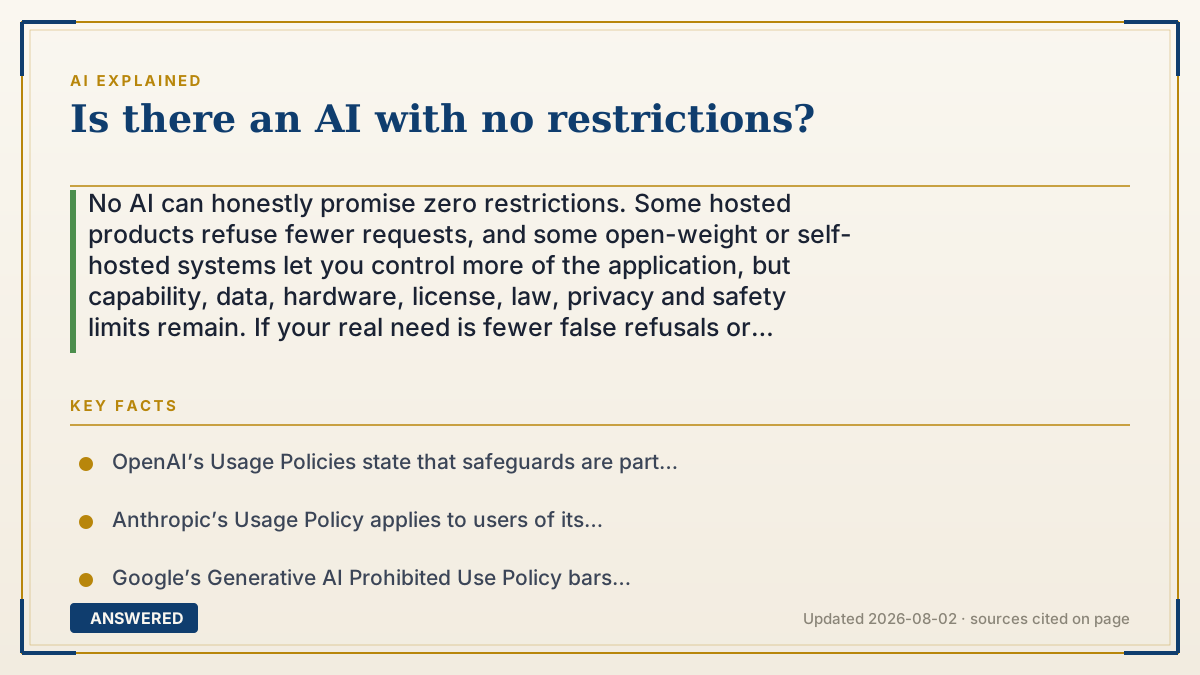
No AI can honestly promise zero restrictions. Some hosted products refuse fewer requests, and some open-weight or self-hosted systems let you control more of the application, but capability, data, hardware, license, law, privacy and safety limits remain. If your real need is fewer false refusals or more privacy, compare those controls directly instead of trusting an “uncensored” label.
Why — the first-principles explanation
“No restrictions” mixes several different limits. Separate them before choosing a tool.
Provider or refusal policy: A hosted service may decline requests, apply age gates, rate limits or account enforcement. Those rules can differ by product and may change. A system with fewer refusals is not automatically more capable or more accurate, and trying to circumvent a provider’s safeguards can violate its usage policy.
Model and data limits: Removing a refusal message does not add facts, reasoning ability, current information or reliable intent. A model can still be wrong, omit context, leak a secret supplied in a prompt, or produce unsafe instructions. The output is a probabilistic result, not a permission slip.
Application and infrastructure limits: Open-weight or self-hosted systems can give an operator more control over weights, prompts, routing, retention and network access. They still depend on hardware, software, licenses, model cards, connected tools and the quality of the data. Open-weight is not the same as open-source, and local execution is not automatically private if logs, telemetry or connectors remain enabled.
Legal, contractual and human limits: Laws, intellectual-property rights, privacy duties, platform terms and professional responsibilities do not disappear when a model runs on your machine. Meta’s Llama license, for example, incorporates an acceptable-use policy and places responsibility for the materials and outputs on the user. NIST’s generative-AI profile likewise treats risk as a function of the model, access to weights, data, deployment context and use case.
The honest answer is therefore: systems with fewer provider-level refusals exist, but “unrestricted” is a marketing shortcut, not a measurable safety or quality category. A lawful creative or research workflow may need a different policy, local processing or an appeal path. Choose that requirement explicitly, document the trade-offs, and keep a person accountable for anything consequential.
An example that makes it click
Suppose a game studio wants a private assistant to brainstorm fictional conflict and summarize its own design files. The useful questions are whether the tool permits that content, whether files stay inside the approved environment, whether the model can cite the supplied material, and whether the license allows the planned release. Calling a service “uncensored” answers none of those questions. A locally run model may reduce data egress, but the studio still needs access controls, content review, rights checks and a policy for harmful or deceptive use.
How to do it
- Name the actual friction: a false refusal, missing capability, privacy requirement, current-data need, file limit or cost problem. Do not use “unrestricted” as the specification.
- Separate model behavior from application policy. Ask whether a different approved provider, model, prompt format or human-review path solves the legitimate task without removing safeguards.
- If evaluating open-weight or self-hosted software, verify the model card, license, provenance, supported hardware, update path and known limitations before downloading or deploying it.
- Read the provider’s acceptable-use policy and your own organization’s rules. Treat “fewer refusals” as a policy trade-off, not evidence that every use is permitted.
- Map data flow: prompts, files, logs, telemetry, backups, connectors and outbound network calls. Keep secrets and personal data out unless the workflow is explicitly approved.
- Test only benign, representative tasks. Record helpfulness, refusal consistency, factual error, latency, cost and failure recovery; do not probe safeguards with harmful instructions.
- Use least privilege for tools and accounts. Prefer read-only, scoped files and reversible actions, with confirmation before publishing, messaging, purchases, deletion or other side effects.
- Verify important output against primary sources, tests, rights records and qualified review. A model that answers more often may also signal uncertainty less often.
- Set a stop condition and owner: pause the system when policy, provenance, privacy, safety or licensing is unclear, and document who approves the final use.
Key facts
- OpenAI’s Usage Policies state that safeguards are part of a broader safety ecosystem, prohibit circumventing safeguards and say inappropriate use can lead to loss of access or other penalties.
- Anthropic’s Usage Policy applies to users of its products and services, describes detection and monitoring, and says access may be throttled, suspended or terminated for violations; outputs may also be blocked or modified.
- Google’s Generative AI Prohibited Use Policy bars illegal or harmful activity, rights violations, unsupervised high-impact automated decisions and circumvention of abuse protections or safety filters.
- Meta’s Llama 3 Community License grants limited rights subject to the agreement, applicable law and the incorporated Acceptable Use Policy; it also states that materials and outputs are provided as-is and that the user is responsible for judging appropriateness.
- NIST’s Generative AI Profile says risk depends on characteristics including model architecture, training, data, access to model weights and application context; mitigations differ across model, system and use-case levels.
- Open-weight means model weights are available under stated terms. It does not by itself mean the training data, code, license, safety controls, commercial rights or outputs are unrestricted.
- Local inference can reduce a provider’s direct access to prompts, but privacy still depends on the runtime, operating system, extensions, logs, telemetry, backups and any connected network tools.
- Lower refusal rates do not prove higher accuracy, better reasoning, current knowledge, lawful use or safe deployment.
Choose control without confusing it with safety
Define the real requirement—privacy, fewer false refusals, capability or cost—then compare documented controls, terms and review paths.
▶ The 60-second explainer (script)
Is there an AI with no restrictions? Not literally. The phrase hides four different limits. A hosted product may refuse fewer requests, but it still has account rules and safety policies. Removing a refusal does not add facts, current data or accuracy. Open-weight and self-hosted systems can give you more control over prompts, retention and network access, but hardware, model terms, licenses, privacy and law still apply. Local does not automatically mean private, and uncensored does not mean safe. If your real need is fewer false refusals or more privacy, define that requirement, read the model card and acceptable-use policy, map data flow, test benign tasks, use least privilege and keep a human accountable for consequential output.
What authoritative sources say
People also ask
Is there an AI with no restrictions?
No system can honestly guarantee zero restrictions. Some products have fewer refusal behaviors or let you run open-weight models yourself, but capability, license, privacy, infrastructure, law and human-accountability limits still apply.
What does “uncensored AI” usually mean?
It is a loose marketing term for a model or service that refuses fewer requests, often after different tuning or with fewer visible provider controls. It is not a standard certification for accuracy, legality, privacy or safety.
Are open-weight models the same as open-source AI?
No. Open weights may be downloadable while the training data, code, license, usage terms and commercial rights remain separate. Read the model card and license for the exact version and planned use.
Is it legal to run a model with fewer refusals?
Access and use are separate questions. The model’s license and your jurisdiction govern what you may download, modify or distribute, while ordinary law and platform terms govern what you do with the output. This is not legal advice.
Are less restricted models more accurate?
No. Fewer refusals do not add knowledge or improve verification. A system may answer more often while producing confident errors, missing context or unsafe suggestions.
Does running AI locally make it private?
It can reduce direct provider transmission, but check local logs, telemetry, backups, browser extensions, remote connectors and operating-system access. Privacy is a system property, not a label.
Why might someone want fewer refusals for a legitimate task?
A benign creative, research or internal workflow may be overblocked by a particular policy. First try an approved provider with a clearer policy, an appeal or review path, better context and a human checkpoint.
Can I bypass ChatGPT, Claude or Gemini safety filters?
Do not treat bypassing safeguards as a product feature. It can violate the provider’s usage policy and remove useful protection. Choose a tool whose documented policy supports your lawful task instead.
How should I vet a hosted “unrestricted AI” website?
Look for a named operator, current terms, model provenance, privacy and retention rules, deletion controls, age safeguards, abuse reporting, payment transparency and a clear answer about whether prompts are logged or reused.
What should a business check before self-hosting an open-weight model?
Review license and acceptable-use terms, data flow, access control, patching, model provenance, evaluation set, incident response, cost, hardware, output rights and human approval for high-impact use.
The same question, asked other ways
- Which AI has the fewest content restrictions right now?