What AI is better than ChatGPT?
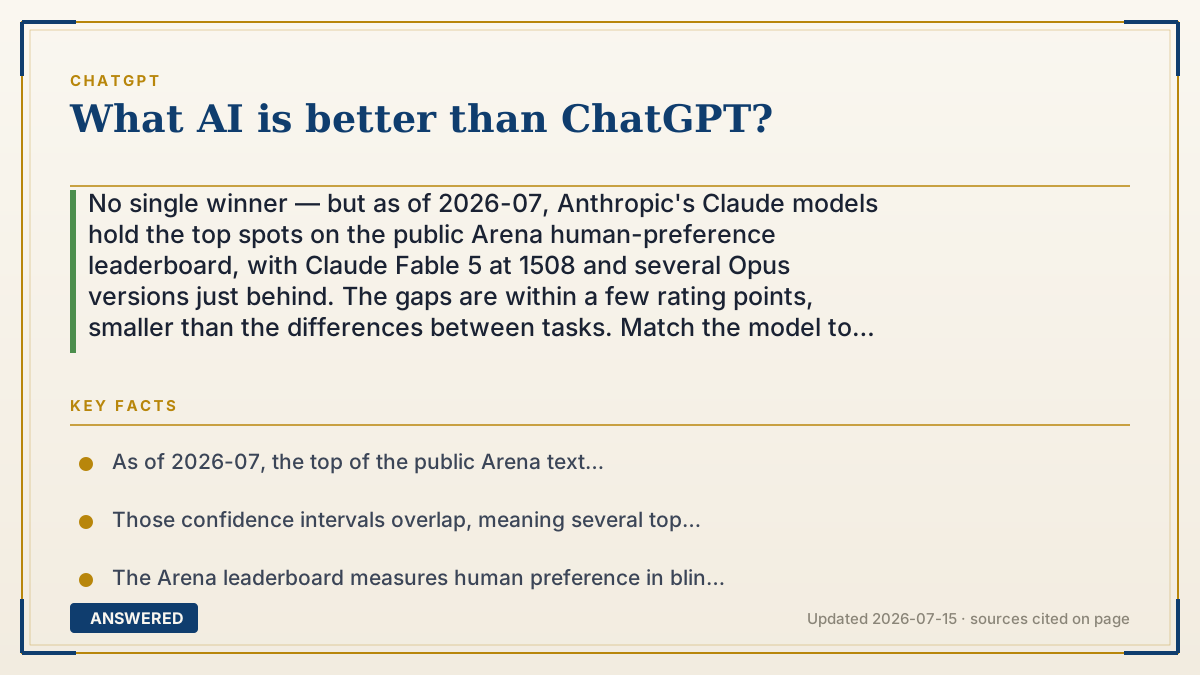
No single winner — but as of 2026-07, Anthropic's Claude models hold the top spots on the public Arena human-preference leaderboard, with Claude Fable 5 at 1508 and several Opus versions just behind. The gaps are within a few rating points, smaller than the differences between tasks. Match the model to the job, not to a leaderboard.
Why — the first-principles explanation
The honest answer starts with a definitional problem: "better" isn't one measurement. Ask which car is better and you'd at least ask "for what?" — nobody hauls lumber in a Miata. Model comparisons get written as if there were a single scoreboard, and there isn't. There are dozens, they disagree, and each measures something narrow.
Here's what the leaderboards actually capture. The public Arena (formerly LMArena) shows anonymous users two answers and asks which they prefer, then converts the votes into a rating. As of 2026-07 the top of that text board is Anthropic — Claude Fable 5 at 1508 ±7, Claude Opus 4.6 Thinking at 1504 ±4, Claude Opus 4.7 Thinking at 1503 ±4. Look at those error bars: several of those models are statistically tied. And note what's being measured — which answer people liked more when they read it. That rewards clarity, formatting, and confidence. It does not check whether the answer is true. A model that sounds better than it is will score well here.
Coding benchmarks measure something different again — whether generated patches actually pass a repository's tests — and produce different rankings. Reasoning benchmarks like GPQA Diamond measure graduate-level science recall and produce a third ordering. Each is real; none is "better" in general.
Meanwhile the frontier moves faster than any article can. OpenAI shipped the GPT-5.6 family on July 9, 2026 — Luna, Terra, and Sol — with Sol positioned as its strongest coding model. Any ranking published today has a shelf life measured in weeks, which is the actual reason to distrust every "best AI 2026" listicle: not that they're lying, but that they're describing a photograph of a moving object.
So the useful frame isn't ranking, it's fit. Price differs by roughly 5x across the GPT-5.6 tiers alone ($1 to $5 per million input tokens). Context windows, ecosystem integration, tool support, and data-handling terms differ more between vendors than raw quality now differs at the top. The frontier models are close enough that for most people the deciding factor is cost, what it plugs into, and which one you already trust — not a rating point.
An example that makes it click
It's like asking which knife is better than a chef's knife.
A chef's knife is the right answer 80% of the time, which is exactly why it's the one in everyone's kitchen. But if you're filleting a fish, a flexible boning knife is better — not slightly, dramatically. If you're cutting bread, a serrated blade wins and the chef's knife just mangles it. None of that makes the chef's knife bad. It makes "which knife is better" a badly formed question.
ChatGPT is the chef's knife: enormous reach, huge ecosystem, fine at nearly everything. The question worth asking isn't which model outranks it — it's whether the specific thing you do all day has a better blade for it. Usually you'd know within an afternoon of trying two.
How to do it
- Name the task first — long-document analysis, code that must pass tests, creative drafting, cheap high-volume classification. The answer changes completely between these.
- Check a leaderboard that measures your task, not overall preference. Human-preference ratings reward answers that read well; coding boards measure whether patches pass tests.
- Read the error bars. As of 2026-07 the top Arena models sit within a few points of each other with ±4 to ±7 confidence intervals — many are statistically tied, so rank order is noise.
- Price it out if you're using an API. As of 2026-07, GPT-5.6 tiers alone span $1 to $5 per 1M input tokens and $6 to $30 output — a 5x spread for models in the same family.
- Run your own three real tasks through two or three contenders. Your actual workload beats any benchmark, and it takes an afternoon.
- Check the non-quality factors that usually decide it: data retention terms, what it integrates with, context window, and whether your team will actually adopt it.
Key facts
- As of 2026-07, the top of the public Arena text leaderboard is Claude Fable 5 (1508 ±7), Claude Opus 4.6 Thinking (1504 ±4), Claude Opus 4.7 Thinking (1503 ±4), Claude Opus 4.6 (1498 ±4), and Claude Opus 4.7 (1494 ±4) — all Anthropic.
- Those confidence intervals overlap, meaning several top models are statistically tied rather than ranked.
- The Arena leaderboard measures human preference in blind head-to-head votes — which answer readers liked — not factual accuracy.
- OpenAI released the GPT-5.6 family on July 9, 2026 in three variants: Luna, Terra, and Sol, with Sol described as its best coding model yet, available across ChatGPT, Codex, and the API.
- GPT-5.6 API pricing as of 2026-07, per 1M tokens: Sol $5 input / $30 output; Terra $2.50 / $15; Luna $1 / $6 — a 5x spread within a single family.
- Arena breaks results into subcategories including Coding, Math, Creative Writing, Instruction Following, and Hard Prompts, which do not produce identical rankings.
Open the official product site and confirm the current access, plans and terms.
Compare current model evidence
Leaderboards change by task and date; use a transparent evaluation source rather than a permanent winner claim.
▶ The 60-second explainer (script)
What AI is better than ChatGPT? Here's the real answer: better isn't one measurement. As of July 2026, if you look at the public Arena leaderboard — where anonymous users see two answers and vote for the one they prefer — the top spots are all Anthropic. Claude Fable 5 at 1508. Opus 4.6 Thinking at 1504. Opus 4.7 Thinking at 1503. But look closer. Those error bars are plus or minus four to seven points. Several of those models are statistically tied. There is no clean first place. And notice what that board measures: which answer people liked reading. That rewards clarity, structure, confidence. It does not check whether the answer is true. A model that sounds better than it is will do great there. Coding benchmarks measure something else — does the generated patch pass the tests. Reasoning benchmarks measure science recall. Three benchmarks, three different orderings. All real. None of them is better in general. Meanwhile OpenAI shipped GPT-5.6 on July ninth — Luna, Terra, and Sol — so any ranking has a shelf life of weeks. Which is why the useful question isn't which model wins. It's what you do all day. Price varies five-x across one family alone. Context windows, integrations, and data terms differ more between vendors than quality now differs at the top. Run your own three real tasks through two of them. That afternoon beats every leaderboard.
What authoritative sources say
People also ask
Is Claude better than ChatGPT?
On the public Arena human-preference board as of 2026-07, Anthropic's models hold the top spots — but by a few rating points, within overlapping error bars, and that board measures which answer people liked, not accuracy.
Is Gemini better than ChatGPT?
It leads on some reasoning benchmarks and competes hard on price, and it wins by default if you live inside Google Workspace. On general preference it trades places with the others release to release.
Why do rankings disagree so much?
Because they measure different things: preference votes, test-passing patches, and science recall are three different questions. A model can top one and place fourth on another without any contradiction.
What's the best free alternative?
All major vendors have free tiers with usage caps as of 2026-07. The free tiers usually run smaller, faster models, so free-tier quality differences say little about frontier quality.
Should I switch?
Only if a specific task you do often is measurably better elsewhere. At the frontier, price, integrations, context window, and data-handling terms now matter more than a few rating points.
The same question, asked other ways
- Is ChatGPT the best AI?