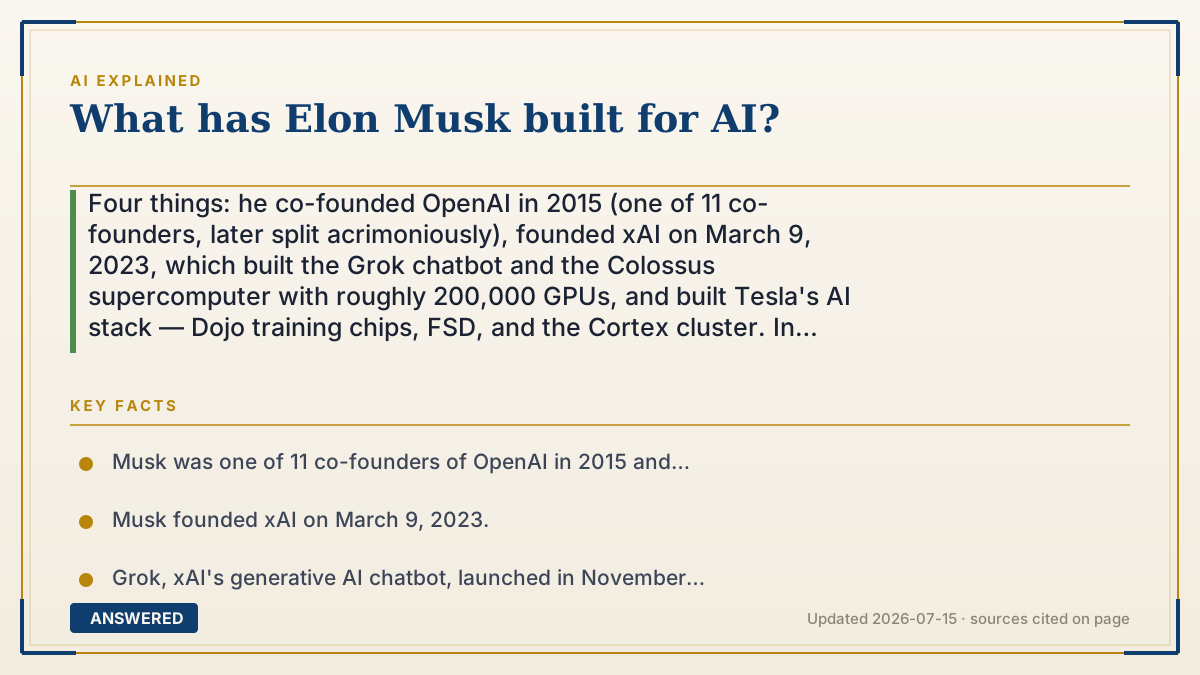
What has Elon Musk built for AI?
Four things: he co-founded OpenAI in 2015 (one of 11 co-founders, later split acrimoniously), founded xAI on March 9, 2023, which built the Grok chatbot and the Colossus supercomputer with roughly 200,000 GPUs, and built Tesla's AI stack — Dojo training chips, FSD, and the Cortex cluster. In May 2026 xAI folded into SpaceX, rebranding as SpaceXAI in July 2026.
Why — the first-principles explanation
Musk's AI work makes more sense if you notice the strategy underneath it: he keeps trying to own the whole stack, and he keeps losing control of the parts he doesn't own outright.
Start with OpenAI. Musk was one of 11 co-founders in 2015 and initially co-chaired it with Sam Altman. He left the board in 2018. OpenAI then restructured toward a capped-profit model, took Microsoft's investment, and became the thing Musk had explicitly founded it not to be — a closed, commercial lab. The subsequent litigation is the direct consequence of having helped build something he couldn't steer. That's the pattern.
So xAI, founded March 9, 2023, was built the opposite way — wholly under his control. It shipped Grok in November 2023, a chatbot deliberately given a rebellious, sarcastic personality and, critically, wired into X's live firehose. That last part is the actual technical differentiator: most models train on a snapshot of the web and go stale, while Grok has a pipe into a real-time stream of what people are posting right now. Owning the data source is the moat.
Then Colossus, and this is the part that matters most. Musk built a supercomputer of roughly 200,000 GPUs, and Grok 3 was trained with about 10x the compute of Grok 2. This looks like an infrastructure story; it's really a speed story. The binding constraint in frontier AI isn't ideas — it's who can assemble tens of thousands of GPUs, power them, and cool them, fastest. Colossus was notable specifically for how quickly it went up. xAI then turned that capability into a data center business of its own.
Separately, Tesla is a vertically integrated AI company that happens to sell cars: custom Dojo training chips, custom FSD inference hardware, a fleet of vehicles acting as a data collection network, and the Cortex cluster (~50,000 GPUs) at Giga Texas. The point of owning both the chip and the model is co-optimization — you can design each around the other instead of accepting someone else's tradeoffs.
And then the twist. In May 2026 Musk announced xAI would cease to exist as a separate company, with Grok and X becoming SpaceX's AI division; in July 2026 it was rebranded SpaceXAI. Also in 2026: under oath in a California federal court, Musk testified that xAI trained Grok on OpenAI models via distillation, calling it general practice across the industry. Which is a fitting bookend — the lab he built to escape OpenAI learned partly from OpenAI.
An example that makes it click
Think about a chef who helps open a famous restaurant, then gets pushed out and watches it become exactly the kind of place he hated. So he builds his own restaurant — but this time he also buys the farm, the mill, and the trucking company, because he's decided the only way nobody takes it from him is to own every link.
That's Musk's AI strategy. xAI is the restaurant. Colossus is the farm. X is the ingredient supply nobody else can buy. Tesla is a second restaurant that grows its own wheat. And OpenAI is the place across the street he helped build, that he's now suing.
Key facts
- Musk was one of 11 co-founders of OpenAI in 2015 and initially co-chaired it with Sam Altman; he departed the board in 2018.
- Musk founded xAI on March 9, 2023.
- Grok, xAI's generative AI chatbot, launched in November 2023, designed with a deliberately rebellious and sarcastic personality.
- xAI built the Colossus supercomputer containing roughly 200,000 GPUs; Grok 3 was trained with approximately 10x the compute used for Grok 2.
- Tesla runs its own AI stack: custom Dojo training chips, custom FSD inference hardware, a vehicle-based data collection fleet, and the Cortex AI supercluster with about 50,000 GPUs at Giga Texas.
- In May 2026, Musk announced xAI would cease to exist as a separate company, with Grok and X becoming the AI division of SpaceX; in July 2026 xAI was rebranded as SpaceXAI.
- On April 30, 2026, Musk testified in a California federal court that xAI used distillation techniques on OpenAI models to train Grok, asserting it was general practice among AI companies.
▶ The 60-second explainer (script)
What has Elon Musk built for AI? Four things — and there's a pattern connecting them. First, OpenAI. He was one of eleven co-founders in 2015 and co-chaired it with Sam Altman. He left the board in 2018. OpenAI then restructured toward capped-profit, took Microsoft's money, and became exactly what Musk founded it not to be — a closed commercial lab. The lawsuits are the direct consequence of building something he couldn't steer. That's the pattern. So xAI, founded March 9th 2023, was built the opposite way: entirely his. It shipped Grok in November 2023 — deliberately sarcastic, deliberately rebellious, and critically, wired into X's live firehose. That's the real differentiator. Most models train on a snapshot of the web and go stale. Grok has a pipe into what people are posting right now. Owning the data source is the moat. Then Colossus — roughly two hundred thousand GPUs. Grok 3 trained on about ten times Grok 2's compute. This looks like infrastructure. It's actually about speed. The binding constraint in frontier AI isn't ideas, it's who can assemble, power, and cool tens of thousands of GPUs fastest. Separately, Tesla is a vertically integrated AI company that sells cars — custom Dojo training chips, custom FSD inference hardware, a fleet collecting data, and the Cortex cluster, fifty thousand GPUs at Giga Texas. Own the chip and the model, and you co-optimize both. Then the twist: May 2026, Musk announced xAI would cease to exist as a separate company — Grok and X became SpaceX's AI division, rebranded SpaceXAI in July. And in April 2026 he testified under oath that xAI trained Grok on OpenAI models through distillation. Fitting bookend.
What authoritative sources say
People also ask
Did Elon Musk found OpenAI?
He was one of 11 co-founders in 2015 and initially co-chaired it with Sam Altman, but left the board in 2018. He did not found it alone, and he does not control it now.
Does xAI still exist?
Not as a standalone company. Musk announced in May 2026 that xAI would cease to exist separately, with Grok and X becoming SpaceX's AI division. It was rebranded SpaceXAI in July 2026.
What makes Grok different from ChatGPT?
Two things: a deliberately rebellious, sarcastic personality, and real-time access to X's post stream. The second is the substantive one — most models train on a static snapshot and go stale.
What is Colossus?
xAI's supercomputer, containing roughly 200,000 GPUs. Grok 3 was trained on it with about 10x the compute of Grok 2. xAI also turned that infrastructure into a data center business.
Is Tesla an AI company?
Substantially, yes. It designs Dojo training chips and FSD inference hardware, runs the ~50,000-GPU Cortex cluster at Giga Texas, and uses its vehicle fleet as a data collection network.