What is DeepSeek AI?
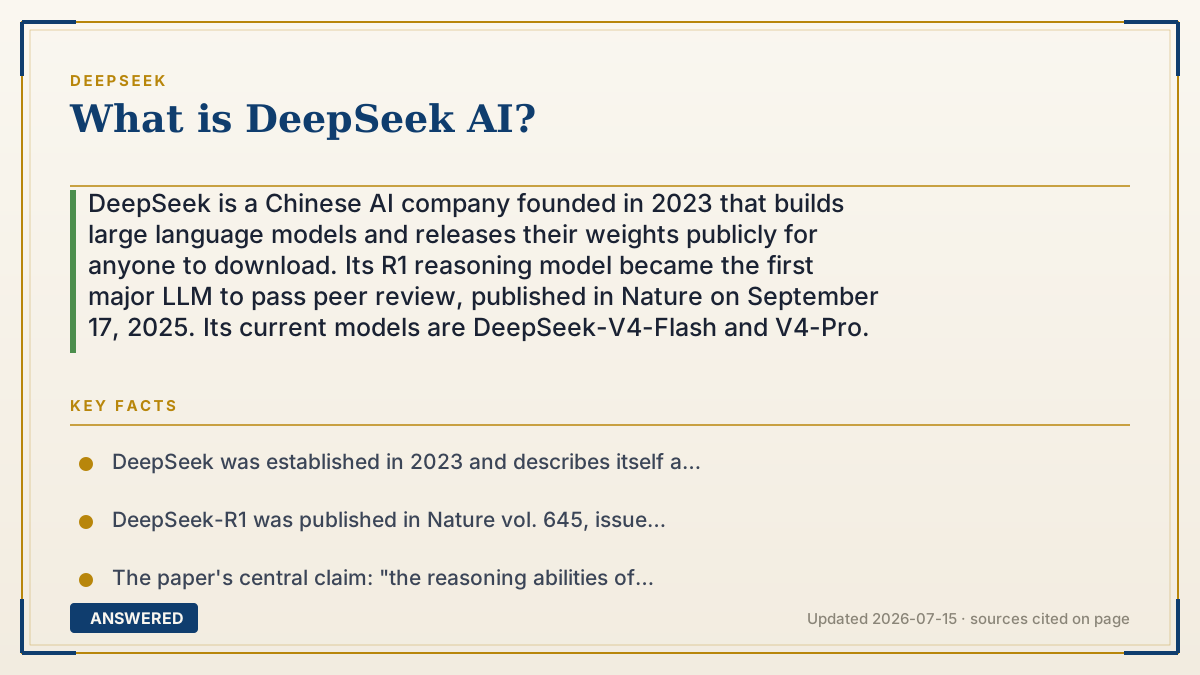
DeepSeek is a Chinese AI company founded in 2023 that builds large language models and releases their weights publicly for anyone to download. Its R1 reasoning model became the first major LLM to pass peer review, published in Nature on September 17, 2025. Its current models are DeepSeek-V4-Flash and V4-Pro.
Why — the first-principles explanation
To understand why DeepSeek matters, you have to understand what it did differently. Most frontier AI labs keep their models locked up: you rent access through an API, and the actual trained model — the weights, meaning the billions of numbers that are the model — never leaves their servers. DeepSeek publishes its weights. Anyone can download DeepSeek-V4-Flash or V4-Pro from Hugging Face and run it on their own hardware. This is usually called open-weight, not open-source, because you get the finished numbers but not the training data or the full recipe.
The technical result that made DeepSeek famous is narrower and more interesting than most coverage suggests. Conventional wisdom held that to make a model reason — to work through a math problem step by step — you first had to show it thousands of human-written examples of good reasoning. DeepSeek's R1 paper showed you don't. Using pure reinforcement learning, they simply rewarded the model for correct final answers and let it discover its own method. Behaviors like self-reflection, checking its own work, and changing strategy mid-problem emerged on their own, without anyone demonstrating them. In the paper's words, this obviates "the need for human-labelled reasoning trajectories." That's a claim about what reasoning is — it suggests reasoning can be grown from a reward signal rather than copied from humans.
Then there's the money, which is where you should be careful. DeepSeek reported that R1's reinforcement learning run cost $294,000 on 512 Nvidia H800 chips. That number got shortened in headlines to "DeepSeek built a frontier model for under $300K," which is not what it says. The $294,000 covers only the final RL stage. It excludes the roughly $6 million to train the base model R1 was built on, and it excludes the GPU cluster itself, the salaries, the failed experiments, and all prior research. It is a marginal cost for one training run, not a total cost of ownership. When Silicon Valley figures called the claims dubious in early 2025, this boundary confusion was much of the argument. Peer review at Nature validated the methodology — it did not certify that anyone can build a frontier lab for the price of a house.
The honest summary: DeepSeek is a real research lab producing genuinely strong open-weight models and at least one result of lasting scientific importance. It is also a Chinese company, which means its hosted service operates under Chinese law and content rules — a separate consideration from the quality of the weights, and the reason several governments have restricted the app on official devices while the downloadable models remain freely usable.
An example that makes it click
Imagine two restaurants with equally good signature dishes. The first sells you the dish but guards the recipe — you can eat there forever and never learn how it's made. The second hands you a printed copy of the recipe on the way out. You still can't grow the ingredients or use their kitchen, but you can cook it yourself, tweak it, and teach it to a friend. DeepSeek is the second restaurant. That's the whole open-weight idea.
And the famous price tag? Picture that chef announcing the dish cost $3 in ingredients. True — but the $3 doesn't count the kitchen, the oven, the years of training, or the forty attempts that got thrown out. Cheap final step, expensive everything else. Both parts of that sentence are real, and headlines usually printed only the first.
Key facts
- DeepSeek was established in 2023 and describes itself as "a Chinese company dedicated to making AGI a reality" (Hugging Face organization page, as of 2026-07).
- DeepSeek-R1 was published in Nature vol. 645, issue 8081, pages 633–638, epub September 17, 2025, DOI 10.1038/s41586-025-09422-z — the first major open-weight LLM published after independent peer review.
- The paper's central claim: "the reasoning abilities of LLMs can be incentivized through pure reinforcement learning (RL), obviating the need for human-labelled reasoning trajectories."
- R1's reinforcement learning run was reported at $294,000 using 512 Nvidia H800 chips — a figure that excludes the roughly $6 million base-model training it was built on, plus hardware, staff, and prior research.
- Current models as of 2026-07 are DeepSeek-V4-Flash (158B parameters) and DeepSeek-V4-Pro (862B parameters), with base variants up to 1.6T parameters published on Hugging Face.
- The DeepSeek API is OpenAI- and Anthropic-compatible at https://api.deepseek.com, offering a 1M-token context window at $0.14–$0.435 per million input tokens as of 2026-07.
An open-weight Chinese model family that matched frontier quality at low cost.
▶ The 60-second explainer (script)
DeepSeek is a Chinese AI company founded in 2023 that builds large language models — and unlike most frontier labs, it gives the models away. Not the source code exactly, but the weights: the actual trained numbers that make the model work. You can download them from Hugging Face and run them yourself. That's called open-weight. Its current models are DeepSeek-V4-Flash and V4-Pro. But the reason you've heard of DeepSeek is a model called R1. In September 2025, R1 became the first major language model to pass academic peer review, published in the journal Nature. And what it proved is genuinely surprising. Everyone assumed that to teach a model to reason, you had to show it thousands of examples of humans reasoning. DeepSeek showed you don't. They just rewarded the model for getting right answers and let it figure out its own approach — and behaviors like double-checking its work and changing strategy mid-problem emerged on their own. Now, the number you've probably seen: two hundred ninety-four thousand dollars to train it. That's real, but it's the cost of the final reinforcement learning step only. It doesn't include the roughly six million dollars for the base model underneath it, and it doesn't include the GPUs, the salaries, or the failed attempts. Cheap last mile, expensive everything before it. One more thing worth knowing: DeepSeek is a Chinese company, so its hosted app runs under Chinese law and content rules. Several governments restrict it on official devices. The downloadable models are a separate question from the hosted service.
What authoritative sources say
People also ask
Is DeepSeek free?
The chat app at deepseek.com is free to use, and the model weights are free to download from Hugging Face. The developer API is prepaid and billed per token — as of 2026-07, $0.14 per million input tokens for V4-Flash.
Is DeepSeek actually open source?
It is open-weight, which is not quite the same. You get the finished trained model and can run or modify it, but DeepSeek does not release the training data or the complete pipeline needed to rebuild it from scratch.
Did DeepSeek really train a frontier model for $294,000?
No — that figure is only the final reinforcement learning run for R1 on 512 H800 chips. It excludes roughly $6 million for the base model beneath it, plus hardware, staff, and failed experiments. The methodology was peer-reviewed; the headline framing was not.
Is DeepSeek safe to use?
The downloadable weights and the hosted app are different questions. The hosted service is operated by a Chinese company under Chinese law and content rules, and several governments have restricted the app on official devices. Running the weights yourself avoids sending data to DeepSeek at all.
What models does DeepSeek offer now?
As of 2026-07, DeepSeek-V4-Flash (158B parameters) and DeepSeek-V4-Pro (862B parameters). The older deepseek-chat and deepseek-reasoner API names are retired on 2026-07-24 at 15:59 UTC.