What is generative AI?
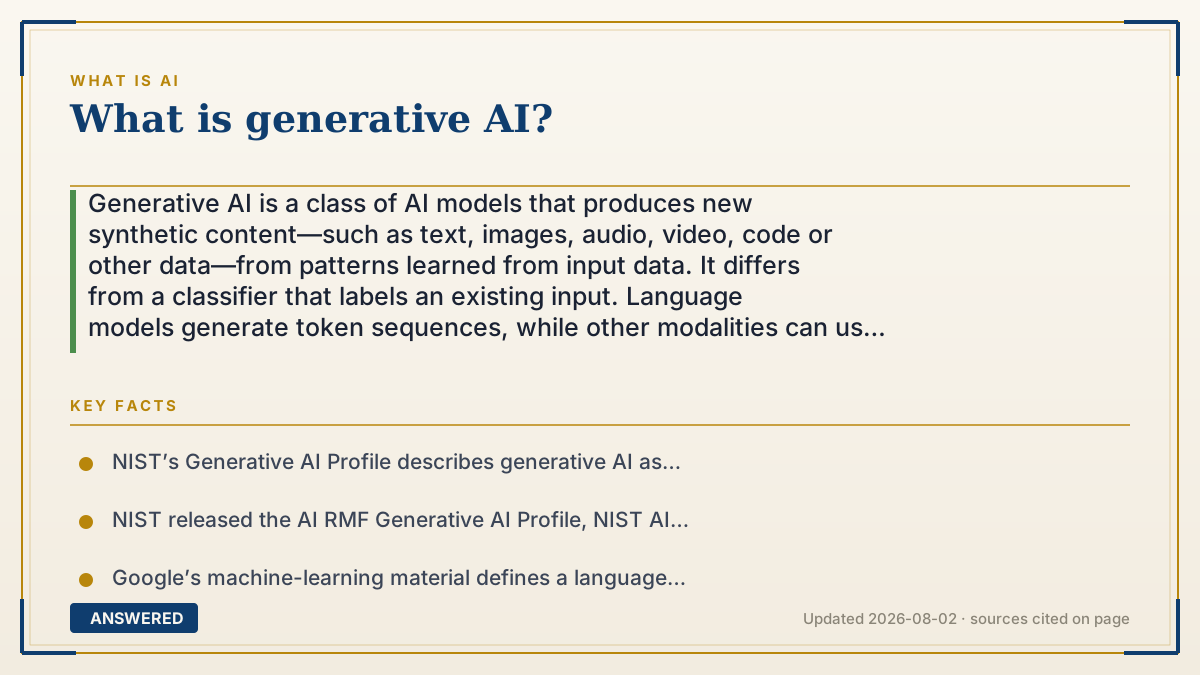
Generative AI is a class of AI models that produces new synthetic content—such as text, images, audio, video, code or other data—from patterns learned from input data. It differs from a classifier that labels an existing input. Language models generate token sequences, while other modalities can use different architectures. Useful output is not automatically true, original, sourced or safe.
Why — the first-principles explanation
Generative AI answers a different kind of question from a classifier. A spam filter labels an existing message; a generative system produces a new passage, image, sound, video, code sample or structured response. NIST describes generative AI as a class of models that emulate the structure and characteristics of input data to generate derived synthetic content. That definition describes the output goal, not a promise about quality or truth.
The mechanism depends on the modality and model. For a language model, Google’s machine-learning material describes a model that estimates the probability of tokens or token sequences in context; an application can use those probabilities to generate text, translation or summaries. Image, audio and video systems can use different architectures and conditioning signals. Retrieval, tools, fine-tuning, safety filters and human review may be added around a model, but those additions are application design—not evidence that the model knows every fact or that the output is original.
This explains both the usefulness and the risk. A model can produce a coherent draft, variation or transformation because it learned statistical structure. Coherence is not verification. The output can contain an invented citation, outdated fact, biased framing, unsafe instruction or material too close to protected content. NIST’s Generative AI Profile treats risks and controls across governance, content provenance, pre-deployment testing and incident disclosure; the right response is to verify claims, disclose meaningful assistance and apply the rules for the domain.
Use generative AI as a capability matched to a task: draft or brainstorm, transform a supplied document, summarize a known source, generate code for review, or create a visual concept. Before choosing a product, check modality, grounding and citations, editability, privacy and retention, rights and provenance, usage limits, cost, and the human review step. Do not choose a tool merely because it says “generative AI,” and do not confuse a fluent sample with proof that the system is reliable.
An example that makes it click
A conventional search filter can sort an existing photo into “cat” or “not cat.” A generative image system can create a new cat image from a prompt or transform a supplied photo. A language model can draft a product description from a brief, but it can also invent a feature that was never supplied. The generation is useful; the claim still needs a source and review.
How to do it
- Name the output: text, image, audio, video, code, structured data or a transformation of supplied content.
- Separate generation from retrieval and classification. Decide whether you need a new draft, a sourced answer, a label, or a deterministic calculation.
- Provide the model with the necessary context and source material, and specify what it must not invent. Use retrieval or tools when current or verifiable facts matter.
- Check the output against primary sources, tests, calculations, policy and human expertise. Treat citations, code and safety instructions as claims to verify.
- Review privacy, retention, training-use terms, copyright or licensing, provenance signals and disclosure requirements before uploading or publishing content.
- Measure the workflow on representative examples, including failures and edge cases. Compare quality, latency, cost, edit time and review burden—not just a polished demo.
- Keep a human accountable for high-impact decisions, public claims, medical or legal guidance, financial actions and anything that changes another person’s rights or access.
Key facts
- NIST’s Generative AI Profile describes generative AI as models that emulate the structure and characteristics of input data to generate derived synthetic content, including images, video, audio, text and other digital content.
- NIST released the AI RMF Generative AI Profile, NIST AI 600-1, on July 26, 2024 as a companion resource for identifying and managing risks unique to or intensified by generative AI.
- Google’s machine-learning material defines a language model as estimating the probability of a token or sequence of tokens in context; this explains language generation, not every image, audio or video architecture.
- Generative AI can be wrapped in retrieval, tools, structured outputs, filters, provenance records and human review; those controls belong to the application or workflow around the model.
- A generated answer can be fluent while containing unsupported or incorrect claims. Verification and source quality remain separate from the model’s ability to produce plausible content.
- NIST’s AI RMF is voluntary guidance for incorporating trustworthiness into the design, development, use and evaluation of AI products, services and systems.
- Generative AI is a capability category, not a guarantee of originality, authorship, copyright clearance, factual accuracy, safety or artificial general intelligence.
Choose generative AI by task and controls
Move from the definition to a practical workflow for work, creation, study and tool comparison.
▶ The 60-second explainer (script)
What is generative AI? It is a class of AI models that creates new synthetic content from patterns learned from data: text, images, audio, video, code or structured output. That differs from a classifier, which labels something that already exists. For language models, generation is based on token probabilities in context. Other modalities can use different architectures, so “predicts the next word” is not a complete explanation of all generative AI. The useful part is that a model can draft, transform, summarize or create variations. The catch is that fluent output is not automatically true, original, sourced or safe. Use retrieval and primary sources when facts matter, review code and high-impact advice, check privacy and rights, and keep a human accountable. Choose generative AI by task and controls, not by the label alone.
What authoritative sources say
People also ask
What is generative AI in one sentence?
It is AI that generates new synthetic content from patterns learned from data, rather than only assigning labels or scores to existing inputs.
Is ChatGPT generative AI?
Yes. A text assistant is one generative-AI application. Image, audio, video and code generators are other applications, and their underlying architectures and controls may differ.
Is generative AI the same as a large language model?
No. A large language model is one kind of generative model focused on language. Generative AI also includes systems for images, audio, video, code and other modalities.
Does generative AI understand or know the truth?
It can model patterns and produce useful responses, but generation alone does not verify facts. For current or high-stakes claims, use authoritative sources, retrieval, tests and human review.
Does generative AI copy its training data?
It generates from learned parameters rather than simply opening a stored document, but memorization and close reproduction can occur. The answer depends on the model, prompt, data and use; check the provider’s terms and the content’s rights.
Can generative AI create original work?
It can produce new combinations or variations, but “new” does not automatically settle copyright, authorship, licensing or similarity questions. Preserve prompts and source material, check applicable rules and disclose meaningful assistance.
What should businesses check before using generative AI?
Define the task and risk, then check data handling, retention, training use, access controls, grounding, evaluation, cost, provenance, output rights and human approval. A polished demo is not a production risk assessment.
The same question, asked other ways
- What is generative AI (gen AI)?
- What does generative AI mean?
- Which is the best description of generative AI?
- What is generative AI definition?