What is tako AI?
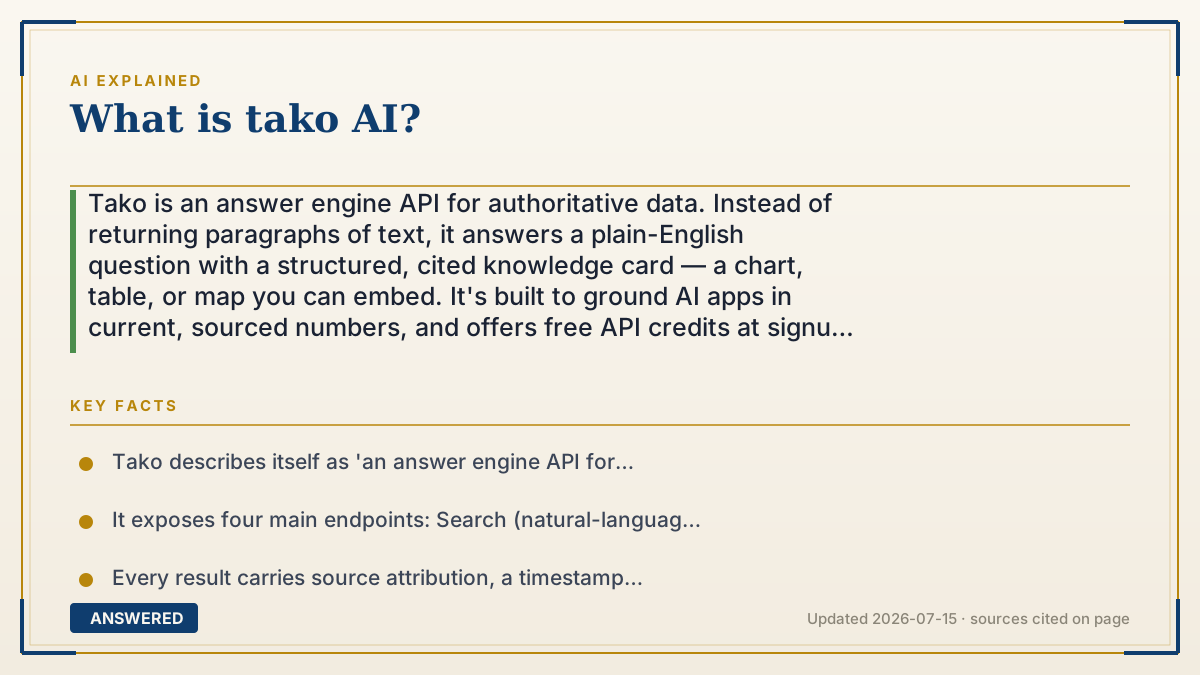
Tako is an answer engine API for authoritative data. Instead of returning paragraphs of text, it answers a plain-English question with a structured, cited knowledge card — a chart, table, or map you can embed. It's built to ground AI apps in current, sourced numbers, and offers free API credits at signup as of 2026-07.
Why — the first-principles explanation
Tako exists because of a specific failure mode in chatbots: language models are trained to produce plausible text, not correct numbers. Ask one for Nvidia's revenue last quarter and it will confidently emit a number shaped like an answer, drawn from statistical patterns rather than a ledger. The model has no idea whether it is right, and neither do you, because the output is prose with no receipt attached.
The fix is to stop asking the model to remember facts and start asking it to retrieve them. Tako sits on that seam. It maintains a curated index of authoritative, licensed data plus the web, and exposes it through an API. You send a natural-language question; it returns a knowledge card — a chart, table, or map — with the source named, a timestamp showing how fresh the data is, and a note on methodology. The language model in your app never invents the number. It just decides which question to ask and how to narrate the card.
The design choice worth noticing is structure over prose. Most search APIs hand back links or raw text and leave your model to parse it, which reintroduces the error you were trying to remove. A chart is different: it has explicit axes, units, and a date range. There is much less room for a model to quietly garble it, and a human looking at the embedded card can check the claim in a second instead of clicking through three sources. Tako splits this across a few endpoints — Search for cited cards, Answer for direct responses, Contents for AI-optimized structured JSON and page contents, and an asynchronous Agent API for deeper research runs.
Tako is developer infrastructure, not a consumer chatbot. You use it when you are building something that has to be right about numbers — a finance dashboard, a research assistant, an internal analytics bot — and you need every claim traceable to a source with a date on it.
An example that makes it click
Imagine two research assistants. You ask both: how has coffee's price moved over five years?
The first one talks. "Coffee has risen substantially, driven by weather in Brazil — roughly doubling, I believe." It sounds great. You have no idea if it's true, and neither does he, because he's going from memory. The second one says nothing, walks to the filing cabinet, and hands you a single printed chart: five years on the bottom, dollars per pound up the side, a line, and at the bottom in small type — the exchange it came from and the date it was pulled. You can see the shape of the answer in one glance and check the receipt in another. Tako is the second assistant, available as an API so your own app can hire him.
Key facts
- Tako describes itself as 'an answer engine API for authoritative data,' returning structured, cited knowledge cards — charts, tables, and maps — rather than plain text (as of 2026-07).
- It exposes four main endpoints: Search (natural-language queries returning cited cards), Answer (direct responses with sources), Contents (structured JSON and AI-optimized page contents), and an asynchronous Agent API for deeper research.
- Every result carries source attribution, a timestamp indicating data recency, and a methodology explanation.
- Its index combines curated, licensed authoritative data with the web.
- Access includes a free playground for example queries and free API credits after signup, with paid credits and enterprise options (as of 2026-07).
- Tako states SOC 2 compliance and a zero data retention policy for enterprise use.
▶ The 60-second explainer (script)
Tako is an answer engine API for authoritative data — and the easiest way to understand it is to understand the problem it fixes. Language models are trained to produce plausible text, not correct numbers. Ask a chatbot for a company's revenue last quarter and it'll give you something shaped like an answer, pulled from patterns rather than a ledger. It doesn't know if it's right, and neither do you, because prose comes with no receipt. Tako's approach is to stop asking the model to remember facts and start making it retrieve them. You send a plain-English question to the API. It comes back not with paragraphs, but with a structured knowledge card — a chart, a table, or a map — with the source named, a timestamp showing how fresh the data is, and a note on methodology. The model in your app never invents the number. It just picks the question and narrates the card. Why cards instead of text? Because a chart has explicit axes, units, and a date range. There's much less room for a model to quietly garble it, and a human can check the claim in about one second. Tako splits this across a few endpoints: Search for cited cards, Answer for direct responses, Contents for structured JSON, and an Agent API for deeper research runs. It's developer infrastructure, not a consumer chatbot. You reach for it when your product has to be right about numbers and every claim needs to trace back to a dated source. There's a free playground and free API credits at signup, as of July 2026.
What authoritative sources say
People also ask
Is Tako a chatbot I can just use?
Not really — it's developer infrastructure. There's a free playground where you can try example queries, but the product is an API meant to be built into other apps that need sourced numbers.
How is Tako different from a regular search API?
Most search APIs return links or raw text and leave your model to parse it, which reintroduces the chance of error. Tako returns structured cards with explicit axes, units, sources, and timestamps.
Does Tako stop AI from hallucinating?
It removes one big source of it — the model no longer recalls numbers from memory, it retrieves them with a citation. It can't stop a model from misreading or misdescribing a card it was handed.
What does Tako cost?
As of 2026-07 there's a free playground and free API credits after signup, with paid credits and an enterprise option beyond that. Check the official pricing page for current rates.
Where does Tako's data come from?
The company says it draws on a curated index of authoritative, licensed data plus the web, and every card shows its source, a recency timestamp, and a methodology note.