What is the difference between agentic AI and AI agents?
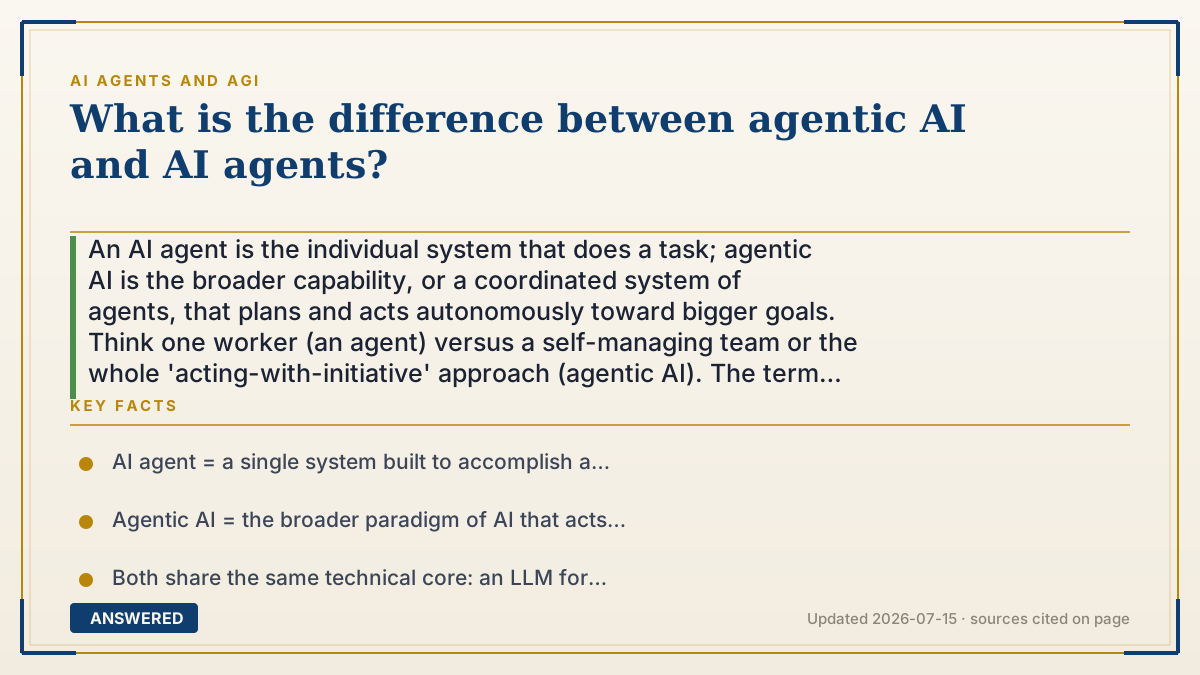
An AI agent is the individual system that does a task; agentic AI is the broader capability, or a coordinated system of agents, that plans and acts autonomously toward bigger goals. Think one worker (an agent) versus a self-managing team or the whole 'acting-with-initiative' approach (agentic AI). The terms overlap and are often used loosely.
Why — the first-principles explanation
These two phrases point at the same idea from different zoom levels, which is why they're easy to confuse.
AI agent is a countable noun, a specific system. It's a language model wired to tools and a loop, built to accomplish a defined task: a support agent, a coding agent, a scheduling agent. You can point at one and say 'that's an agent.'
Agentic AI is an adjective-plus-noun describing a style or paradigm: AI that behaves agentically, with initiative, planning, and adaptation. It's used two ways. Broadly, it names the whole category of systems that act rather than just answer, of which any single AI agent is an example. More specifically, some vendors use 'agentic AI' for higher-order setups where multiple agents coordinate, orchestrating sub-agents, sharing memory, and managing a workflow end to end, versus a single agent doing one job.
The technical foundation is identical: an LLM for reasoning, tools for action, and a feedback loop. The difference is scope and framing. 'AI agent' emphasizes the unit; 'agentic AI' emphasizes the capability and often the coordination of many units toward a larger objective.
Because there's no strict industry standard, treat these as a spectrum, not a hard boundary. When precision matters, ask what someone means: a single task-doer, a team of coordinated agents, or just the general 'AI that acts' concept.
An example that makes it click
Picture a kitchen. A single line cook who grills the burgers is an AI agent, one worker with one job and the tools to do it. The whole self-running kitchen, where a head chef coordinates the grill cook, the fry cook, and the plater to get a full dinner service out the door, is agentic AI: many agents planning and adapting together toward a bigger goal.
You could also use 'agentic' just to describe the kitchen's style, everyone acts on their own initiative instead of waiting for step-by-step orders. That's why the words overlap: one names the cook, the other names the way the whole kitchen operates.
Key facts
- AI agent = a single system built to accomplish a specific task (a countable unit).
- Agentic AI = the broader paradigm of AI that acts autonomously, and often a coordinated system of multiple agents.
- Both share the same technical core: an LLM for reasoning, tools for action, and a perceive-act-observe loop.
- The distinction is scope and framing (unit vs capability/orchestration), not a strict technical standard.
- The terms overlap and are frequently used interchangeably, so clarifying intent matters in practice.
Choosing an AI tool for work?
The answer above explains the concept; this next step helps you choose by job, limits and current terms.
▶ The 60-second explainer (script)
What's the difference between agentic AI and AI agents? They're the same idea at different zoom levels. An AI agent is a single system, one language model wired to tools and a loop, built to do a specific task, like a support agent or a coding agent. You can point at it and say, that's an agent. Agentic AI is broader. It's the whole style of AI that acts with initiative and adapts, and it often refers to several agents coordinating toward a bigger goal, one orchestrating the others. Think of a kitchen: a single line cook is an AI agent, the whole self-running kitchen with a head chef directing everyone is agentic AI. Under the hood they share the same recipe, a model that reasons, tools that act, and a loop that adapts. The difference is scope, one names the unit, the other names the capability. And honestly, people use the terms interchangeably, so when it matters, just ask what they mean.
What authoritative sources say
People also ask
Are agentic AI and AI agents the same thing?
They overlap heavily. An AI agent is a single system; agentic AI is the broader paradigm of autonomous, acting AI, often multiple agents working together. People use the terms loosely.
Which is bigger in scope?
Agentic AI. It's the umbrella concept and often implies orchestration of several agents, whereas an AI agent is one unit doing one task.
Do they use different technology?
No. Both rest on the same core, a language model for reasoning, tools for action, and a feedback loop. The difference is framing and scale, not the underlying build.
Which term should I use?
Use 'AI agent' for a specific system and 'agentic AI' for the general capability or a coordinated multi-agent setup. When precision matters, clarify which you mean.