What is the difference between AI and AGI?
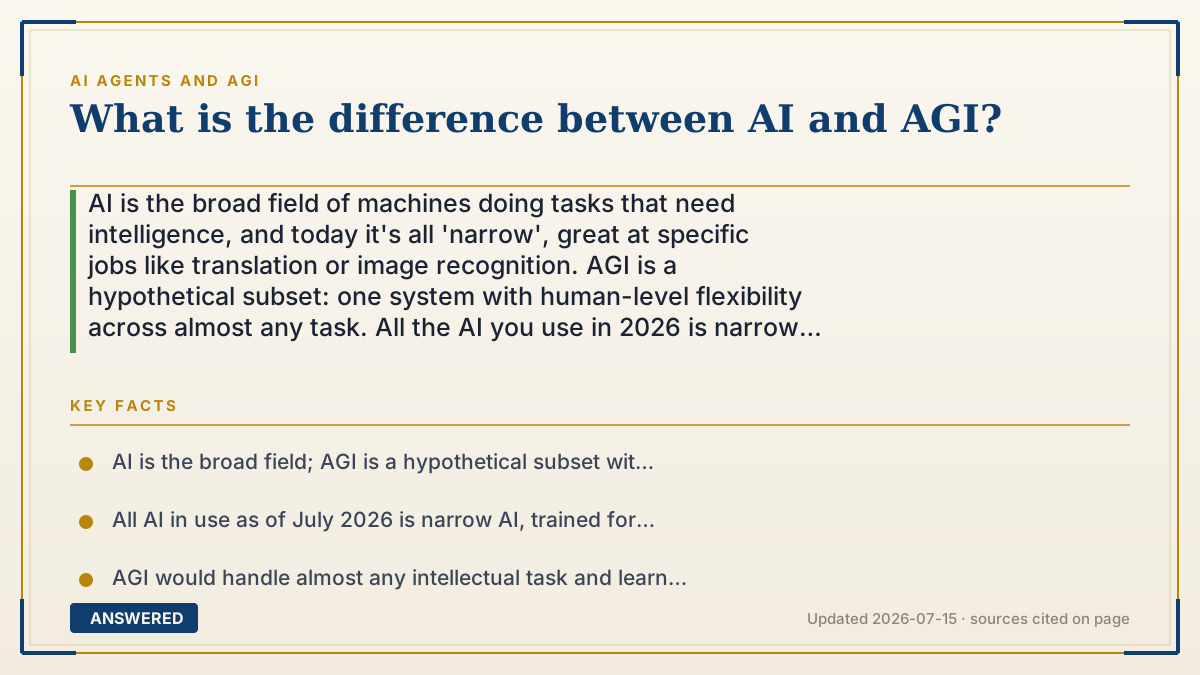
AI is the broad field of machines doing tasks that need intelligence, and today it's all 'narrow', great at specific jobs like translation or image recognition. AGI is a hypothetical subset: one system with human-level flexibility across almost any task. All the AI you use in 2026 is narrow AI; AGI does not exist yet.
Why — the first-principles explanation
The simplest way to see it: AGI is a special kind of AI, not a different thing. AI is the umbrella; AGI is a spot near the far end of it that we haven't reached.
AI (artificial intelligence) just means machines performing tasks that would normally require human intelligence. Everything from a spam filter to a chess engine to ChatGPT counts. The defining feature of today's AI is that it's narrow: each system is trained for a particular purpose. A translation model translates; it can't drive a car. A chess engine crushes grandmasters but can't write an email. Even a chatbot that seems to do many things is really one system trained to predict text; it fails outside that pattern.
AGI (artificial general intelligence) is the hypothetical next level: a single system that matches human flexibility across almost any intellectual task, including ones it wasn't specifically trained for. It would learn new skills on the fly, carry knowledge from one area to another, and adapt to novel situations, the way a person handles a job they've never done before.
Why does the distinction matter? Because headlines often blur them. When people ask if 'AI' will take over, they usually mean AGI. In reality, today's narrow AI is powerful but bounded, and no system has crossed into generality. On the 2026 ARC-AGI-3 test of on-the-fly learning, top models scored under 1% while humans scored 100%, a vivid reminder that broad, human-like generality is still missing.
An example that makes it click
Think of transportation. 'Vehicles' is the big category, like AI. Within it you have bicycles, forklifts, and race cars, each brilliant at one thing but useless outside its lane. A forklift lifts pallets but can't take you across town; a race car is fast but can't climb stairs. That's narrow AI: specialized and excellent, but bounded.
AGI would be like a magical all-terrain vehicle that could instantly become whatever you need, bike, boat, plane, or truck, and handle any road, even ones it's never seen. We have lots of amazing specialized 'vehicles' today. The shape-shifting do-anything one doesn't exist yet. AI is the whole garage; AGI is the vehicle we haven't built.
Key facts
- AI is the broad field; AGI is a hypothetical subset with human-level general capability.
- All AI in use as of July 2026 is narrow AI, trained for specific tasks.
- AGI would handle almost any intellectual task and learn new skills without task-specific retraining.
- No system has demonstrated AGI; frontier models scored under 1% on interactive ARC-AGI-3 in 2026 versus 100% for humans.
- 'Narrow AI' and 'weak AI' mean today's task-specific systems; 'strong AI' is another term sometimes used for AGI.
▶ The 60-second explainer (script)
What's the difference between AI and AGI? Here's the key: AGI is a special kind of AI, not a separate thing. AI is the umbrella term, machines doing tasks that need intelligence. But everything we have today is narrow AI: each system is trained for one job. A translation model translates but can't drive. A chess engine wins games but can't write your email. Even a chatbot is really one system predicting text, and it stumbles outside that. AGI, artificial general intelligence, is the hypothetical next level: one system with human-like flexibility across almost any task, even ones it wasn't trained for, learning new skills on the fly. It doesn't exist yet. On a 2026 test of on-the-fly learning, top models scored under one percent while humans scored one hundred. So when a headline asks if 'AI' will take over, it usually means AGI, and that's still science fiction. Today's AI is powerful, but bounded.
What authoritative sources say
People also ask
Is ChatGPT AI or AGI?
It's AI, specifically narrow AI. It seems general because it was trained on broad data, but it remains a text-prediction system and isn't human-level general like AGI would be.
What does 'narrow AI' mean?
Narrow AI (also called weak AI) is trained for specific tasks, like translation, recommendations, or image recognition. It performs well in its lane but can't flexibly handle new domains.
Is AGI the same as 'strong AI'?
Roughly yes. 'Strong AI' is an older term often used for human-level general intelligence, which is what AGI describes, versus today's 'weak' or narrow AI.
When will AI become AGI?
Unknown. Estimates in 2026 range from the 2030s to mid-century, and there's no agreed definition of when the line is crossed.
The same question, asked other ways
- What is the difference between artificial intelligence and artificial general intelligence?