When will AGI arrive?
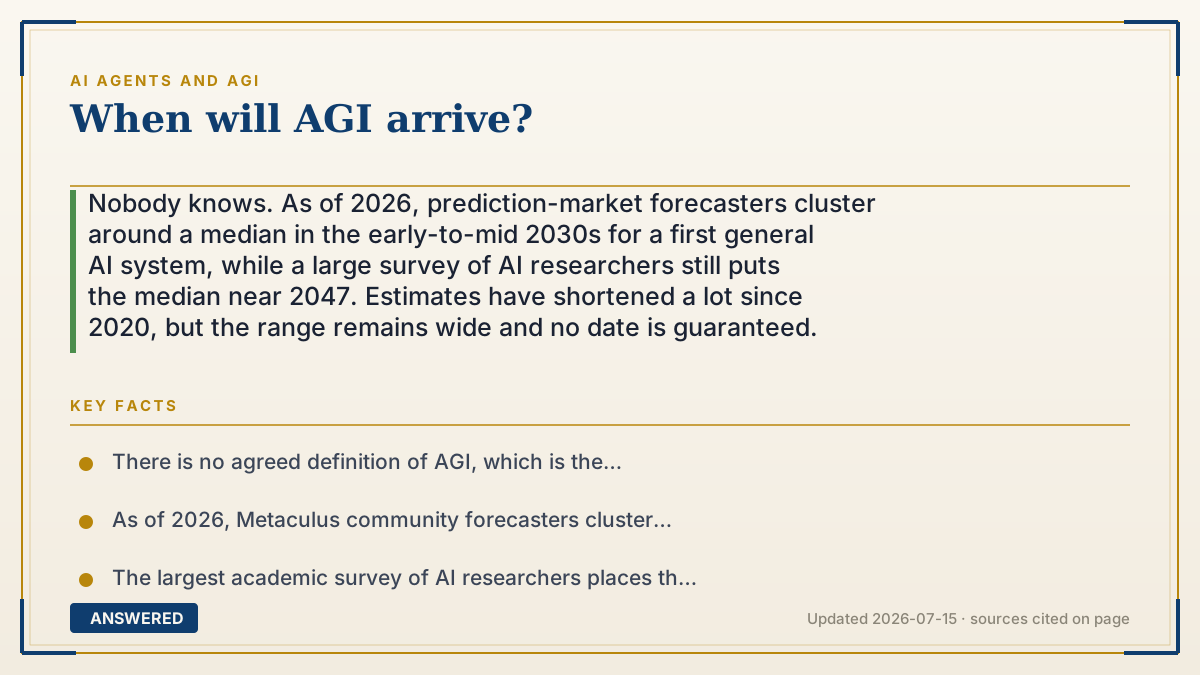
Nobody knows. As of 2026, prediction-market forecasters cluster around a median in the early-to-mid 2030s for a first general AI system, while a large survey of AI researchers still puts the median near 2047. Estimates have shortened a lot since 2020, but the range remains wide and no date is guaranteed.
Why — the first-principles explanation
'When will AGI arrive' has no reliable answer, and understanding why is more useful than any single date.
First, there's no agreed definition of AGI. If your bar is 'beats humans on most benchmarks,' that could feel close. If it's 'learns any new task as flexibly as a person, including ones it's never seen,' that's much further off. Two honest experts using different bars will name dates decades apart.
Second, forecasting a technology breakthrough is inherently hard. We can measure how fast benchmark scores rise, but we can't measure how many hard, unsolved problems remain between here and true generality. Rapid progress on visible metrics doesn't guarantee the invisible barriers, on-the-fly learning, long-horizon memory, reliable reasoning, will fall on schedule.
What we can say: aggregated forecasts have compressed sharply. Around 2020, many surveys pointed to roughly 50 years out. By 2026, Metaculus community forecasters cluster in the early-to-mid 2030s for a first publicly announced general system, and even the more conservative academic survey of thousands of AI researchers dropped toward the mid-2040s. That's a real trend, but trends can stall.
The grounded takeaway: treat AGI timing as a wide probability range, not a countdown. Anyone offering a confident single date, whether 2027 or 2060, is expressing an opinion, not a measurement. And the interactive ARC-AGI-3 result (models under 1%, humans 100% in 2026) is a reminder that big gaps remain regardless of the optimism.
An example that makes it click
Predicting AGI is like predicting when a big earthquake will hit a known fault line. Scientists can see pressure building, so they're confident it will eventually happen, but pinning the year is nearly impossible. They give ranges and probabilities, not a date on the calendar.
AGI is the same. The 'pressure', rising capabilities, is clearly building, which is why forecasts have moved from 'about 50 years out' in 2020 to 'maybe the 2030s' by 2026. But just as with earthquakes, the honest scientists say 'sometime in this window, with these odds,' not 'next Tuesday.' Anyone naming an exact year is guessing.
Key facts
- There is no agreed definition of AGI, which is the biggest reason timeline estimates vary by decades.
- As of 2026, Metaculus community forecasters cluster around a median in the early-to-mid 2030s for a first general AI system.
- The largest academic survey of AI researchers places the median for high-level machine intelligence near 2047.
- Around 2020, many expert forecasts pointed to roughly 50 years out, so estimates have compressed significantly.
- Interactive ARC-AGI-3 (2026) showed frontier models under 1% versus 100% for humans, underscoring large remaining gaps.
▶ The 60-second explainer (script)
When will AGI arrive? The honest answer is nobody knows, and here's why that's the right answer. First, there's no agreed definition of AGI, so experts are aiming at different targets and naming dates decades apart. Second, we can measure how fast benchmark scores climb, but not how many hard, unsolved problems still stand between us and true general intelligence. What we can say is that forecasts have compressed fast. Back in 2020, many surveys said roughly 50 years out. By 2026, prediction-market forecasters cluster in the early-to-mid 2030s, while a big researcher survey still says around 2047. It's like predicting an earthquake on a known fault: you can see pressure building and give a probability window, but not an exact year. So treat AGI timing as a wide range, not a countdown. Anyone giving you one confident date is guessing.
What authoritative sources say
People also ask
Will AGI arrive by 2030?
Possibly, but far from certain. Some forecasters put meaningful odds on the early 2030s, while others expect the 2040s or later. No date is guaranteed.
Why can't experts agree on a date?
Because AGI has no standard definition and breakthrough timing is inherently unpredictable. Rising benchmark scores don't reveal how many hard problems remain.
Have predictions changed recently?
Yes. Estimates have compressed from around 50 years out in 2020 to medians in the 2030s-2040s by 2026, driven by rapid AI progress.
Should I trust a specific AGI date I saw online?
Be skeptical. A single confident year is an opinion, not a measurement. The responsible framing is a probability range across roughly the 2030s to mid-century.
The same question, asked other ways
- What do experts predict about AGI timelines?
- Will AGI be created in our lifetime?