Where does AI get its information?
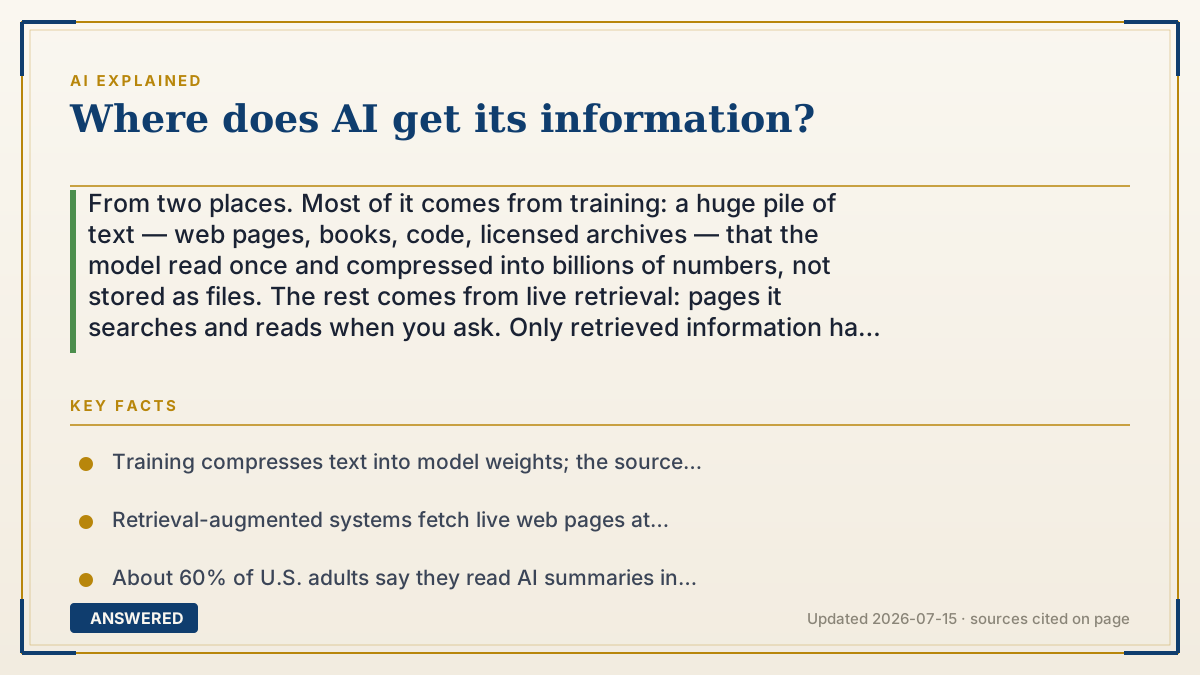
From two places. Most of it comes from training: a huge pile of text — web pages, books, code, licensed archives — that the model read once and compressed into billions of numbers, not stored as files. The rest comes from live retrieval: pages it searches and reads when you ask. Only retrieved information has a source you can click.
Why — the first-principles explanation
The key thing almost every explanation gets wrong: a language model does not have a database. It is not looking anything up. During training it read an enormous amount of text and repeatedly adjusted billions of internal numbers to get better at one narrow task — predicting the next word. That process is lossy and one-way. The text is not filed; it is dissolved into weights, the way a stock is not a pile of vegetables. You cannot open a model and find the Wikipedia article it "knows."
This single fact explains nearly all model behavior. It explains why models hallucinate: when the training soup contains something faint or contradictory, the machinery still produces confident fluent text, because producing confident fluent text is the only thing it does. There's no "I don't have that file" error, because there are no files. It explains why models can't cite themselves — a citation would have to point at a source, and no source survived training. So the model generates what a citation looks like, which is why fake URLs feel so real. And it explains the knowledge cutoff: training ended on a date, so anything after it never entered the soup.
The second source patches exactly these holes. Retrieval means the system runs a search when you ask, fetches actual pages, pastes their text into the prompt, and answers from that. Now there's a real source, fetched at a real moment, with a link. This is what powers AI summaries in search — about 60% of U.S. adults say they read them. It fixes recency and citation, but not truth: retrieval tells you where the answer came from, not whether that page is right.
A third source people forget: you. Whatever you paste into the chat — your document, your spreadsheet, your email thread — becomes information the model uses for that answer. Tools like Microsoft 365 Copilot industrialize this, connecting the model to your organization's own files through the Microsoft Graph. That's why a corporate copilot can summarize your actual quarter and a public chatbot can't.
Finally, one source that isn't text at all. Human raters compare model answers and pick the better one, and that preference data shapes behavior. Reading teaches the model what people write. Only human feedback teaches it what people want.
An example that makes it click
Think about how you know French pastry. You read cookbooks for years. Today you can make a croissant — but you can't name which page taught you to fold the dough. The knowledge is in your hands, not on a shelf. If someone demands a citation, you'd have to invent one. That's training data.
Now someone asks what the bakery down the street charges. You don't guess — you pull out your phone and check. That's retrieval, and you can hand them the phone.
And if they hand you their grandmother's recipe card and ask you to fix it, you're now working from information that was never yours at all. That's your uploaded document.
Key facts
- Training compresses text into model weights; the source documents are not stored and cannot be retrieved from the model, which is why models cannot cite their own training data.
- Retrieval-augmented systems fetch live web pages at question time and answer from that text — this produces genuine, clickable sources.
- About 60% of U.S. adults say they read AI summaries in search engines, which are generated from retrieved pages — Pew Research Center, 5,119 adults, February 17–23, 2026.
- Microsoft 365 Copilot obtains organization-specific information by connecting large language models to a user's data through the Microsoft Graph, not through training.
- Human preference data collected by rater platforms — such as Outlier, operated by Scale AI, where contributors rank AI outputs and improve model responses — is a separate information source that shapes model behavior after training.
- APA style treats AI output as an algorithm's output rather than a personal communication, listing the developer as author, precisely because there is no underlying retrievable document.
▶ The 60-second explainer (script)
AI gets its information from two very different places, and almost every explanation skips the part that matters. Here it is: a language model does not have a database. It isn't looking anything up. During training it read an enormous pile of text — web pages, books, code, licensed archives — and adjusted billions of numbers to get better at predicting the next word. That's lossy and one-way. The text isn't filed away. It's dissolved into weights, the way a stock isn't a pile of vegetables. You can't open a model and find the article it knows. That one fact explains everything. It's why models hallucinate: there's no "file not found" error, because there are no files — just machinery that always produces confident, fluent text. It's why they invent citations: no source survived training, so the model generates what a citation looks like. And it's why there's a knowledge cutoff — training ended on a date. The second source patches those holes. Retrieval: the system searches, fetches real pages, and answers from them. Now there's a link you can click. That's what powers AI summaries in search, which Pew says about 60% of Americans read. But retrieval only tells you where the answer came from — not whether that page is right. Third source people forget: you. Anything you paste in becomes information for that answer. And one that isn't text at all — human raters picking better answers. Reading teaches a model what people write. Only feedback teaches it what people want. Rule of thumb: if you can't click it, the AI is remembering, not sourcing.
What authoritative sources say
People also ask
Does AI just search Google for answers?
Only sometimes. If the assistant shows links, it searched and read real pages. If it doesn't, it's answering from training — compressed patterns, not a lookup. Many assistants do both and don't always tell you which.
Was my website used to train AI?
If it was publicly accessible and not blocked, quite possibly — large models train on broad web crawls. There's no reliable way to confirm from the outside, because training doesn't keep a file list. You can block future crawling via robots.txt, though that doesn't undo past training.
Why does AI make up sources?
Because no real source exists to retrieve. Training dissolved the text into weights, so when asked for a citation the model generates text that resembles a citation. It isn't lying — it has no mechanism to know the difference.
What is a knowledge cutoff?
The date training data ends. Anything after it never entered the model. Assistants with live search can cover the gap by retrieving current pages, which is why the same model can seem current in one product and outdated in another.
Is information from AI reliable?
Treat unlinked claims as a starting point, not evidence. Claims with a working link to a government agency, a peer-reviewed study, or an official vendor doc are checkable — so check them. The link is the difference.