Why is Character.AI now rated 18+?
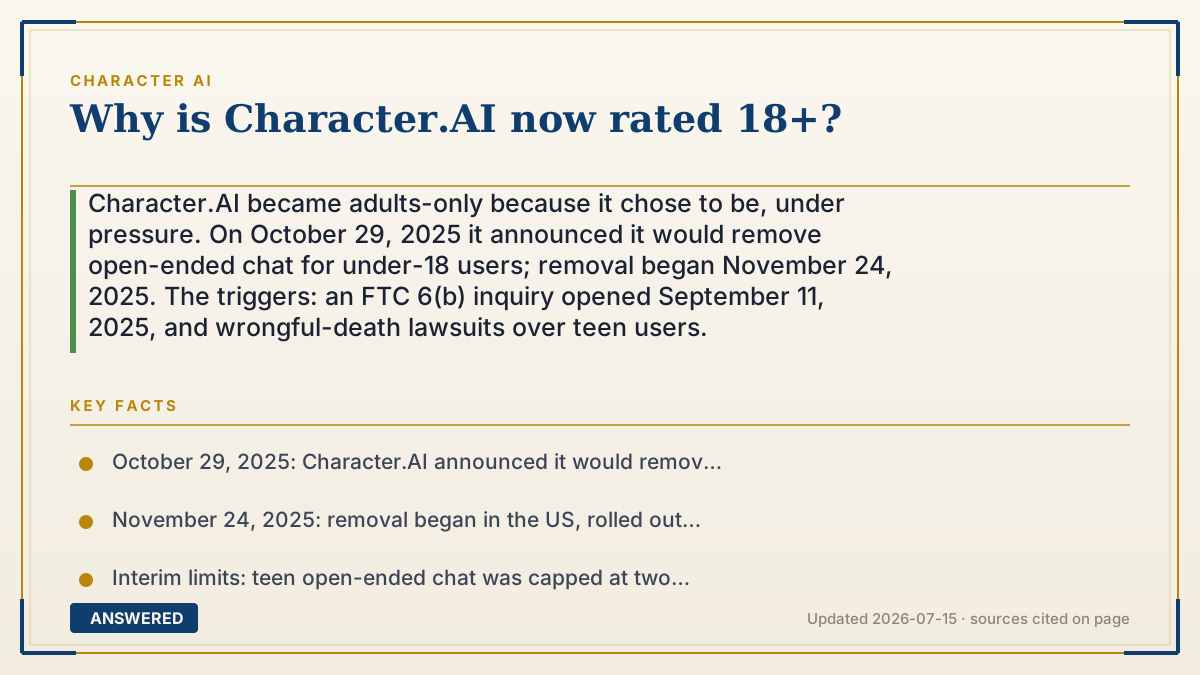
Character.AI became adults-only because it chose to be, under pressure. On October 29, 2025 it announced it would remove open-ended chat for under-18 users; removal began November 24, 2025. The triggers: an FTC 6(b) inquiry opened September 11, 2025, and wrongful-death lawsuits over teen users.
Why — the first-principles explanation
The word "now" in this question is doing real work — this was a reversal. Character.AI spent years as a platform whose core users were teenagers. Cutting them off was not a routine policy tweak; it was the company amputating a large share of its own audience. Companies don't do that for fun. They do it when the alternative is worse.
Three forces converged in 2025. First, litigation with teeth. Megan Garcia sued in October 2024 after her 14-year-old son, Sewell Setzer III, died by suicide in February 2024 following months of chatting with a Character.AI character. On May 21, 2025, Judge Anne Conway refused to dismiss on First Amendment grounds and treated the chatbot as a product rather than protected speech. That single ruling changed the company's exposure from "we publish words" to "we manufacture a thing that can be defectively designed." Product-liability law is a far more dangerous neighborhood.
Second, the regulator showed up. On September 11, 2025 the FTC issued 6(b) orders to seven companies — Alphabet, Character Technologies, Instagram, Meta, OpenAI, Snap and X.AI — demanding detail on how they test chatbot harms to kids and limit minors' use. Six weeks later, Character.AI announced the ban. That sequence is not a coincidence.
Third, the mechanism is genuinely hard to fix. A filter can block explicit words, but the risk with companion AI isn't only explicit content — it's a system optimized to keep a lonely teenager talking, indefinitely, in a relationship that feels reciprocal and isn't. You can't patch that with a keyword list, because the engagement is the product. Faced with a problem it couldn't filter its way out of, Character.AI removed the population most at risk instead.
The rollout was gradual: two hours of teen chat per day from late October 2025, then one hour daily in the US, then removal starting Monday November 24 to a first group, with a second group weeks later. Enforcement required age assurance — an in-house model plus third-party checks including Persona — which is why adults now get selfie prompts. The company also pledged to fund an independent AI Safety Lab nonprofit.
An example that makes it click
Imagine a trampoline park that's wildly popular with 12-year-olds. Then a child is badly hurt, a judge rules the trampoline is a product and not a form of expression, and the safety regulator sends a letter asking exactly how you test for injuries.
You could add more padding. But if the injuries come from the bouncing itself — the whole point of the park — padding won't save you. So you put up a sign: 18 and over. You just lost most of your customers, and you did it because the lawyers ran the numbers. That's what happened here, almost exactly.
Key facts
- October 29, 2025: Character.AI announced it would remove the ability for under-18 users to engage in open-ended chat, no later than November 25, 2025.
- November 24, 2025: removal began in the US, rolled out to a first group of under-18 users, with a second group deprecated weeks later.
- Interim limits: teen open-ended chat was capped at two hours per day from late October 2025, then reduced to one hour daily in the US.
- September 11, 2025: the FTC issued 6(b) orders to seven companies including Character Technologies, seeking data on chatbot safety testing and limits on use by minors.
- May 21, 2025: Judge Anne Conway declined to dismiss Garcia v. Character Technologies on First Amendment grounds and treated Character.AI as a product, not a service.
- January 7, 2026: unsealed filings disclosed mediated settlements in five cases across Florida, Colorado, New York and Texas, on undisclosed terms.
- Character.AI pledged to establish and fund an independent AI Safety Lab nonprofit, and partnered with Koko and ThroughLine on a helpline network of 1,500 services across 170 countries.
Open the official product site and confirm the current access, plans and terms.
▶ The 60-second explainer (script)
Character.AI went eighteen-plus, and the word people miss is why now. This was a reversal. Teenagers were a huge share of that platform. Cutting them off was the company cutting off its own audience — nobody does that voluntarily. Three things happened. One: a mother sued in twenty twenty-four after her fourteen-year-old son died by suicide following months of chatting with a Character.AI bot. In May twenty twenty-five, a federal judge refused to throw the case out on free-speech grounds and said the chatbot counts as a product. That flipped the company from publishing words to manufacturing a thing that can be defectively designed. Much scarier legal territory. Two: on September eleventh, twenty twenty-five, the FTC ordered seven companies, Character Technologies included, to explain how they test for harm to kids. Six weeks later, the ban was announced. Not a coincidence. Three: the problem isn't fixable with a filter. The risk isn't just spicy words — it's a system built to keep a lonely kid talking forever. You can't keyword-block engagement, because engagement is the product. So on October twenty-ninth they announced it, and on November twenty-fourth open-ended chat for US under-eighteens started disappearing. That's also why adults now get hit with selfie age checks — you can't enforce eighteen-plus without knowing who's eighteen.
What authoritative sources say
People also ask
Did the government force Character.AI to go 18+?
No. No US law or regulator ordered it. The company chose it under litigation and FTC scrutiny — the FTC's 6(b) inquiry compels information but does not mandate product changes.
Can under-18 users still use Character.AI at all?
Not for open-ended chat in the US. Character.AI said it would preserve other creative features for teens, but the core back-and-forth conversation was removed starting November 24, 2025.
Is this permanent?
Character.AI has framed it as a deliberate, conservative change rather than a temporary measure. Nothing announced as of 2026-07 suggests a reversal.
Why do adults have to verify their age now?
Because an 18+ rule is unenforceable without knowing who's 18. Age assurance uses an in-house model first, then routes uncertain accounts to Persona for a selfie check.
The same question, asked other ways
- Why is Character.AI rated 18+?
- What is the age rating for Character AI?