Can AI make better music than humans?
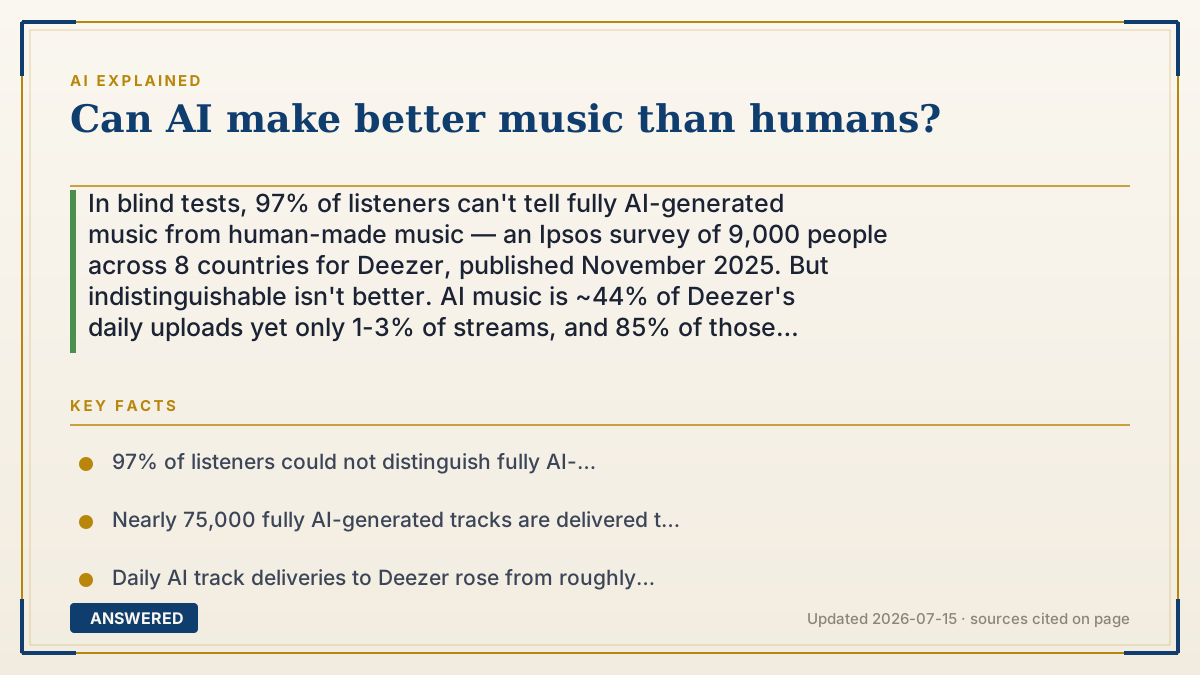
In blind tests, 97% of listeners can't tell fully AI-generated music from human-made music — an Ipsos survey of 9,000 people across 8 countries for Deezer, published November 2025. But indistinguishable isn't better. AI music is ~44% of Deezer's daily uploads yet only 1-3% of streams, and 85% of those streams were flagged as fraudulent.
Why — the first-principles explanation
"Better" hides two different questions, and the data answers them very differently.
The first is can it fool you? Yes, overwhelmingly. That Ipsos study found 97% of listeners couldn't reliably separate AI tracks from human ones in blind testing. This shouldn't be surprising once you see the mechanism. Music is unusually learnable: it's built from a small vocabulary of scales, chord progressions, and rhythms, repeated across millions of recorded examples with strong statistical regularities. A model trained on that corpus can produce a competent pop song the way it produces a competent paragraph — by predicting what plausibly comes next. And for most listening — background music, playlists, a café, a workout — competent is the entire requirement. You are not auditing the song. You are letting it fill space.
The second question is do people choose it? Here the picture inverts. On Deezer, roughly 75,000 fully AI-generated tracks arrive every day, about 44% of all uploads, over 2 million a month as of April 2026. Those tracks earn 1-3% of total streams. That is a staggering gap: near-half of the supply, a rounding error of the demand. And of the streams AI tracks do get, Deezer detected up to 85% as fraudulent — bot farms streaming tracks to harvest royalties, not people listening. Strip the fraud and real human demand for AI music is close to invisible.
Why the gap? Because generation is now free and attention isn't. A model can produce a plausible song for pennies, so supply explodes toward infinity. But the reason someone plays a song twice is usually not acoustic quality — it's that it means something: who made it, what happened to them, what it soundtracked in your life. Models are excellent at the sound and have nothing to offer on the meaning. That's not a temporary capability gap you can train away; it's a category difference.
The honest framing, then: AI can already make music most people can't distinguish from human music, and can do it at a volume no human industry can match. It has not shown it can make music people seek out. And listeners themselves want the line drawn — 80% in that same survey said fully AI-generated music should be clearly labeled.
An example that makes it click
Think about supermarket bread versus the loaf from the bakery down the street. Put both in a blind taste test with your eyes closed and most people, most of the time, can't reliably say which is which. The supermarket loaf is engineered to be perfectly adequate — and adequate is genuinely all you need for toast on a Tuesday.
But notice what happens on Saturday. You walk past the supermarket and go to the bakery, and pay four times as much, and you can't fully explain why. Part of it is the smell and the crust. A bigger part is that a person made it, at 4 a.m., and you know which person. That's not in the flour.
AI music is the supermarket loaf, produced at 75,000 loaves a day. Nobody can taste the difference. Almost nobody goes out of their way for it.
Key facts
- 97% of listeners could not distinguish fully AI-generated music from human-made music in blind testing — Ipsos survey of 9,000 people across 8 countries, commissioned by Deezer, published November 2025.
- Nearly 75,000 fully AI-generated tracks are delivered to Deezer daily, about 44% of total daily uploads and over 2 million per month, as of April 2026.
- Daily AI track deliveries to Deezer rose from roughly 10,000 in January 2025 to 75,000 by April 2026 — a 7.5x increase in about one year.
- AI-generated music accounts for only 1-3% of total streams on Deezer, despite being ~44% of uploads.
- Up to 85% of streams of fully AI-generated tracks on Deezer were detected as fraudulent and demonetized.
- 80% of surveyed listeners said 100% AI-generated music should be clearly labeled, and 52% said AI songs should not appear in main charts alongside human-made music.
▶ The 60-second explainer (script)
Can AI make better music than humans? The data says something more interesting than yes or no. Start here: in blind tests, 97% of listeners could not tell fully AI-generated music from human-made music. That's an Ipsos survey of nine thousand people across eight countries, done for Deezer and published in November 2025. So on the question of can it fool you — yes, overwhelmingly. And that makes sense. Music is unusually learnable. It's built from a small vocabulary of scales, chords, and rhythms, repeated across millions of recordings with strong statistical patterns. A model can generate a competent pop song the same way it generates a competent paragraph — by predicting what plausibly comes next. And for most listening, competent is the whole requirement. You're not auditing the song. You're filling space. But now flip to the second question: do people actually choose it? On Deezer, about 75,000 fully AI-generated tracks arrive every single day — roughly 44% of all uploads, over two million a month, as of April 2026. Those tracks earn one to three percent of total streams. Nearly half the supply, a rounding error of the demand. And of the streams they do get, Deezer detected up to 85% as fraudulent — bot farms harvesting royalties, not people listening. Strip that out and real demand is close to invisible. Here's why. Generation is free now; attention isn't. But the reason you play a song twice usually isn't acoustic quality — it's that it means something. Who made it, what happened to them. Models are excellent at the sound and have nothing to say about the meaning. So: AI can already make music you can't distinguish, at a volume no human industry can match. It hasn't shown it can make music people seek out.
What authoritative sources say
People also ask
Can people really not tell AI music apart?
Mostly not. In blind testing for Deezer's Ipsos survey of 9,000 people across 8 countries, 97% could not reliably distinguish fully AI-generated tracks from human-made ones.
If nobody can tell, why is AI music barely streamed?
Because 'indistinguishable' isn't the same as 'sought out.' AI music is ~44% of Deezer's daily uploads but 1-3% of streams — and up to 85% of those streams were flagged as fraudulent bot activity.
What is AI music stream fraud?
Uploading mass-generated tracks and using bot farms to stream them, harvesting royalty payouts from the pool. Deezer says it detects this and demonetizes those streams.
Do listeners want AI music labeled?
Yes — 80% of those surveyed said 100% AI-generated music should be clearly labeled, 73% want to know if a service is recommending it, and 52% said it shouldn't appear in main charts.
Will AI music get better than human music eventually?
It's already acoustically competent enough to fool nearly everyone. The gap isn't sound quality — it's that people choose music for what it means and who made it, which isn't something a generator competes on.