How to make AI music?
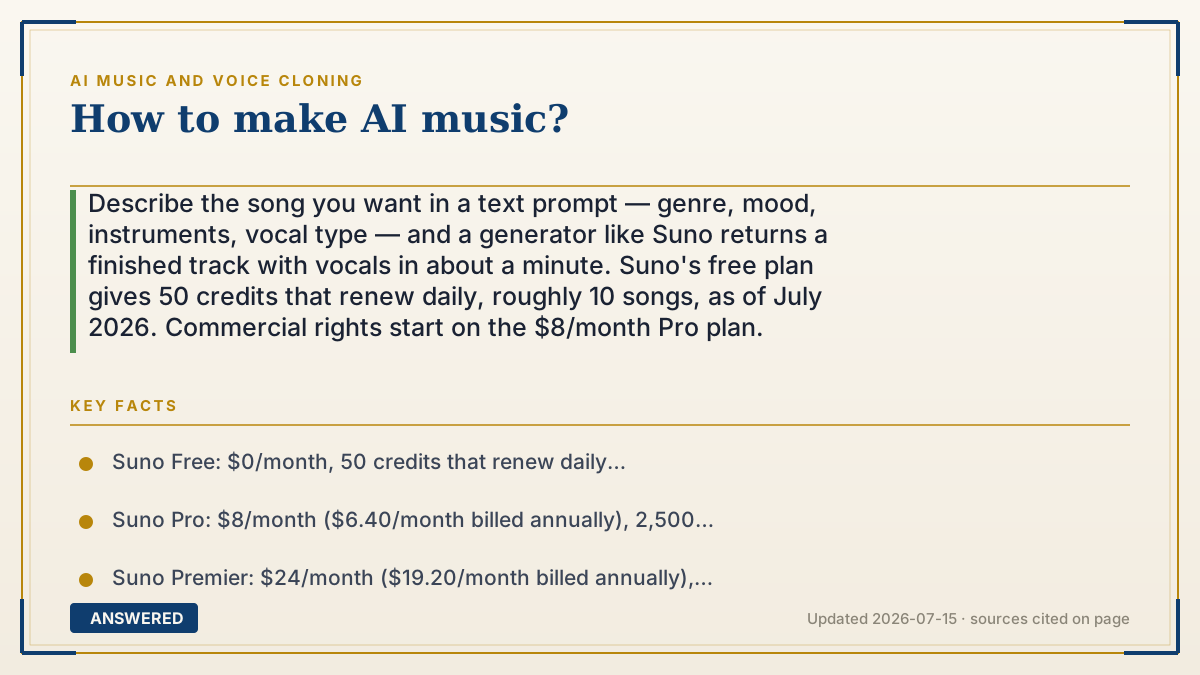
Describe the song you want in a text prompt — genre, mood, instruments, vocal type — and a generator like Suno returns a finished track with vocals in about a minute. Suno's free plan gives 50 credits that renew daily, roughly 10 songs, as of July 2026. Commercial rights start on the $8/month Pro plan.
Why — the first-principles explanation
The mechanics are almost insultingly simple, and that's the point. You type a sentence describing a song. The model returns a complete master — vocals, lyrics, drums, bass, mix — in about a minute. There's no DAW, no instrument, no theory. The model was trained on an enormous corpus of recorded music and learned what plausibly comes next in audio, the same way a language model learned what comes next in text. Your prompt isn't an instruction so much as a steering wheel: it narrows the model to a region of everything it has heard. That's why prompts describing sound — "gritty 70s soul, Rhodes piano, tape saturation, female lead, raspy" — work far better than prompts describing feelings — "an emotional song about loss." Feelings don't narrow anything. Every song is about loss.
Which leads to the thing that separates people who make good AI music from people who make slop: the model regresses to the average of its training data unless you push it off center. Ask for "a pop song" and you get the statistical middle of all pop — competent, forgettable, exactly what everyone else asking for a pop song gets. Specificity is the only lever you have. Name the decade, the instrument, the recording texture, the vocal grain. Write your own lyrics instead of letting it generate them, because lyrics are where the model is weakest and where a human is free.
Here's the part almost no tutorial admits: the real work is curation, not generation. Generation is nearly free — Suno's free tier is 50 credits renewing daily, about ten songs a day for nothing, and $8/month buys 2,500 credits. That means your job isn't producing a song, it's rejecting ninety of them. People who release listenable AI music generate in volume, throw away the vast majority, then edit — regenerating verses, changing tempo, splicing the good eight bars from take 31 into take 12. The generator is a slot machine; the skill is knowing when to stop pulling.
Last, the boring part that costs people money: rights are a licensing question, not a technical one. On Suno, free-tier songs cannot be used commercially — you can make them, but you can't sell them, monetize a video with them, or distribute them. Commercial use begins at Pro, and applies to songs newly created while subscribed. Credits also don't roll over from day to day or month to month. And if you're thinking of uploading at scale: platforms are actively countering that. Deezer runs an AI detector and reports that up to 85% of streams on fully AI-generated tracks were fraudulent bot activity, which it demonetizes. The floor for making music collapsed. The floor for getting paid didn't.
An example that makes it click
It's like ordering coffee from a barista who has memorized every drink ever made but has no idea what you like. Say "a coffee" and you get the world's most average coffee — technically fine, instantly forgettable. Say "a small flat white, oat milk, one shot, a bit under-extracted so it's sweet," and suddenly you're getting somewhere.
And because each cup costs about nothing, the winning move isn't ordering better once. It's ordering thirty, pouring twenty-nine down the sink, and keeping the one that's actually good. That sounds wasteful. It's the whole job.
How to do it
- Pick a generator. Suno is the most widely used; open suno.com and make a free account — no credit card needed for the free tier.
- Write a sound-first prompt, not a feelings-first one. Name the genre, decade, lead instrument, vocal type and recording texture — e.g. "1970s Memphis soul, Rhodes piano, live drums, tape saturation, raspy female lead."
- Write your own lyrics and paste them in rather than letting the model invent them. Lyrics are the model's weakest area and your cheapest advantage.
- Generate several takes at once. On the free plan you get 50 credits renewing daily — about 10 songs — with up to 4 generations running concurrently.
- Listen ruthlessly and throw most of it away. Expect to keep roughly one in ten. Curation is the actual skill, not prompting.
- Edit the keeper instead of restarting: regenerate a weak verse, extend the outro, adjust tempo, or splice the best section from another take.
- Check your rights before you publish. Free-tier Suno songs are not licensed for commercial use — that starts on Pro ($8/month, 2,500 credits, as of 2026-07) and covers songs newly created while subscribed.
- If you plan to distribute, expect platform scrutiny: Deezer runs an AI detector, and Apple Music applies transparency tags.
Key facts
- Suno Free: $0/month, 50 credits that renew daily (roughly 10 songs), up to 4 concurrent generations, access to the v4.5-all model, and no commercial use — as listed on Suno's pricing page, 2026-07.
- Suno Pro: $8/month ($6.40/month billed annually), 2,500 credits monthly, 10 concurrent generations, and commercial use allowed for newly created songs — as of 2026-07.
- Suno Premier: $24/month ($19.20/month billed annually), 10,000 credits monthly, commercial use allowed — as of 2026-07.
- A single song costs roughly 5 credits, and subscription credits do not carry over from day to day or month to month.
- Generation is not the bottleneck: Deezer receives almost 75,000 AI-generated tracks a day, about 44% of all new uploads — meaning the scarce resource is attention, not output.
- Distribution is policed: Deezer offers a free AI detector and Apple Music applies transparency tags to AI-generated tracks.
▶ The 60-second explainer (script)
How do you make AI music? You type a sentence describing a song, and a generator like Suno hands you a finished track — vocals, lyrics, drums, mix — in about a minute. No instrument, no software, no theory. Free account, no credit card: Suno's free tier gives you fifty credits that renew every day, which is about ten songs. Now here's what actually separates decent AI music from slop. First: prompt for sound, not for feelings. "An emotional song about loss" narrows nothing — every song is about loss. "Nineteen-seventies Memphis soul, Rhodes piano, live drums, tape saturation, raspy female lead" narrows everything. The model was trained on a huge pile of recorded music and predicts what plausibly comes next. Your prompt is a steering wheel. Vague prompt, and it drifts straight to the statistical middle of all pop — which is exactly what everyone else gets. Second, and this is the one nobody says out loud: the real work is curation, not generation. Generating is basically free. So your job isn't making a song — it's rejecting ninety of them. People who release listenable AI music generate in volume, bin almost all of it, then edit: regenerate the weak verse, splice the good eight bars from take thirty-one into take twelve. The generator's a slot machine. The skill is knowing when to stop pulling. Third, the boring part that costs money. On the free plan you can make songs but you cannot sell them. Commercial rights start at Pro — eight dollars a month, twenty-five hundred credits, as of July 2026. And don't dream about uploading at scale: Deezer already gets seventy-five thousand AI tracks a day and runs a detector. Making music got free. Getting heard didn't.
What authoritative sources say
People also ask
Can I make AI music for free?
Yes. Suno's free plan costs $0 and gives 50 credits that renew daily — about 10 songs a day, as of July 2026. But free-tier songs are not licensed for commercial use.
Can I sell songs I made with AI?
On Suno, only with a paid plan. Commercial use starts at Pro ($8/month as of 2026-07) and applies to songs newly created while you're subscribed — not to tracks you made earlier on the free tier.
Why does my AI music sound generic?
Because vague prompts land on the average of the training data. Name the decade, lead instrument, vocal grain and recording texture, and write your own lyrics — lyrics are where the model is weakest.
How long does one song take?
About a minute to generate. The time cost isn't generation — it's listening through takes and discarding most of them, which is where the actual quality comes from.
Will streaming platforms accept AI tracks?
Generally yes, but with scrutiny. Deezer runs an AI detector and Apple Music applies transparency tags. Deezer already receives about 75,000 AI tracks daily, so standing out is the real problem.
Do unused credits roll over?
No. Suno's included subscription credits don't carry over from day to day or month to month. Separately purchased top-up credits don't expire but need an active subscription to use.