Can an AI caseworker policy assistant help mitigate errors?
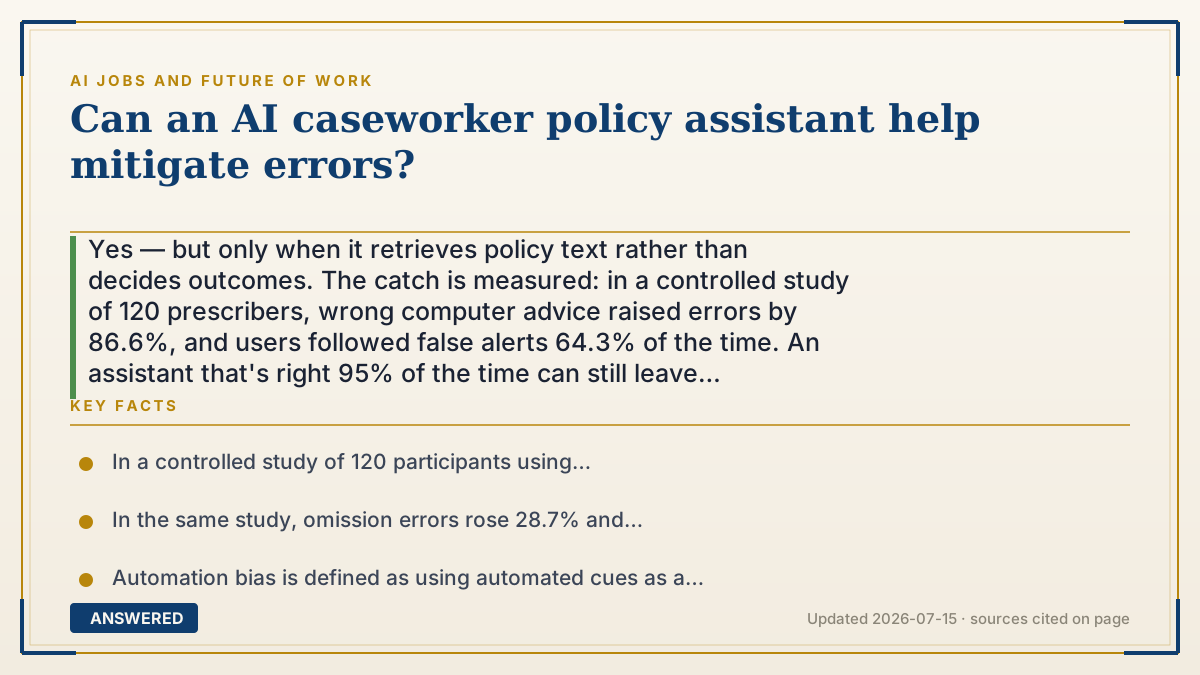
Yes — but only when it retrieves policy text rather than decides outcomes. The catch is measured: in a controlled study of 120 prescribers, wrong computer advice raised errors by 86.6%, and users followed false alerts 64.3% of the time. An assistant that's right 95% of the time can still leave caseworkers worse off than no assistant.
Why — the first-principles explanation
Caseworker errors have a specific cause, and it isn't stupidity. Benefits policy is enormous, cross-referenced, and constantly amended. A worker with a 90-second window has to recall which of 400 pages applies to a household with a disabled dependent and irregular income. The failure mode is almost always retrieval failure — the right rule existed and nobody found it in time. That is a search problem, and search is exactly what language models are good at. Point one at the actual policy manual, and it can surface the governing paragraph in seconds. Real error reduction, real mechanism.
But every decision-support tool introduces a second error channel that often gets ignored. It's called automation bias: the tendency to use the machine's output as a substitute for your own vigilance rather than a supplement to it. It produces two distinct failures. Omission — you miss a problem because the system didn't flag it, and silence felt like an all-clear. Commission — the system flags something wrong and you go along with it. Both are cases where the human stopped being a check and became a rubber stamp.
The size of this effect is not speculative. In a controlled experiment with 120 participants using simulated prescribing software, incorrect computer advice increased errors by 86.6% — omission errors up 28.7%, commission errors up 56.9%. When shown a false positive alert, participants complied with it 64.3% of the time. Note what this means: the tool was correct most of the time, and its rare wrong answers were followed anyway, because being right most of the time is exactly what teaches people to stop checking. Reliability breeds the complacency that makes the failures dangerous.
So the design question isn't "is the AI accurate?" It's "does the AI's failure get caught?" An assistant that says "§ 273.9(d)(6)(ii) appears to govern this — here's the text, you decide" keeps the human's judgment engaged and fails safely. An assistant that says "Deny. Confidence: 94%" replaces judgment, and its errors sail straight through to a family that loses benefits. Same model, same accuracy, opposite safety profile. Retrieval helps. Recommendation is where people get hurt.
An example that makes it click
Think about spellcheck versus autocorrect. Spellcheck underlines a word in red and lets you look. You stay the decider, and when it's wrong about a name, nothing bad happens — you just ignore it. Autocorrect silently changes the word. It's right most of the time, which is precisely why you stopped proofreading, which is why the embarrassing text got sent.
A policy assistant is the same fork in the road. "Here's the rule that seems to apply, here's the actual text" is spellcheck — it finds what the caseworker couldn't find in time, and its mistakes are visible. "Approve this claim" is autocorrect. It's right often enough to train the caseworker to stop reading, and then one day it's wrong about a household that needed the money.
How to do it
- Scope it to retrieval, not judgment: the assistant finds and quotes governing policy text; the caseworker decides.
- Ground it in the actual policy corpus (regulations, manuals, current amendments) rather than the model's memory, so answers can be traced to a source.
- Require a citation to a specific section with every output, and make the underlying text one click away — unverifiable output should be treated as no output.
- Keep accountability with the named human decision-maker; research shows people who feel accountable for a decision scrutinize it more and show less automation bias.
- Deliberately test the failure case: measure what caseworkers do when the assistant is wrong, not just how often it's right.
- Log overrides. If the override rate falls to near zero, that's evidence of rubber-stamping, not evidence of a good tool.
Key facts
- In a controlled study of 120 participants using simulated e-prescribing, incorrect clinical decision support increased errors by 86.6% (Lyell et al., BMC Medical Informatics and Decision Making, 2017).
- In the same study, omission errors rose 28.7% and commission errors rose 56.9%; participants complied with false positive alerts 64.3% of the time.
- Automation bias is defined as using automated cues as a heuristic replacement for vigilant information seeking and processing (Mosier & Skitka, 1996).
- Automation bias has two failure modes: omission (missing a problem because no alert fired) and commission (following an incorrect recommendation).
- Research indicates users who feel accountable for their decisions examine them more thoroughly, which reduces automation bias — accountability is a design lever, not a slogan.
- Physicians were more likely to accept decision-support advice when less confident in their own judgment — meaning the tool's influence is largest exactly where the human is weakest.
▶ The 60-second explainer (script)
Can an AI policy assistant help caseworkers make fewer errors? Yes — but only one kind of assistant, and the difference matters enormously. Start with why caseworkers make errors. It's almost never ignorance. It's that benefits policy is thousands of pages, constantly amended, and they've got ninety seconds. The right rule existed. Nobody found it. That's a search problem, and search is what these models are genuinely good at. So an assistant that instantly surfaces the governing paragraph? Real help. Here's the trap. Every decision-support tool creates a new error channel called automation bias — people start using the machine's answer instead of their own vigilance. And we know how big this is. In a controlled study of a hundred and twenty prescribers, when the computer gave wrong advice, errors jumped eighty-seven percent. People followed false alerts sixty-four percent of the time. Read that again. The tool was usually right. That's the problem. Being usually right is what teaches you to stop checking. So the question isn't accuracy. It's whether the mistake gets caught. 'Here's section 273.9, here's the text, you decide' — that keeps the human awake and fails safely. 'Deny, ninety-four percent confidence' — that replaces the human, and the error goes straight through to a family. Same model. Opposite outcome. Build the first one.
What authoritative sources say
People also ask
Is the assistant safe if it's 95% accurate?
Accuracy isn't the safety property. The prescribing study's tool was usually right too — the harm came from the rare wrong answers being followed, because high reliability trains people to stop verifying.
What's the single most important design rule?
Make it cite the actual policy text for every answer. An assistant whose output can be checked in one click fails safely; one that produces an unverifiable verdict does not.
Doesn't a human reviewer solve the problem?
Only if the human is genuinely reviewing. Automation bias means a nominal human check often becomes a rubber stamp — especially when the reviewer is unsure, which is when the tool's pull is strongest.
How do I know if my team is rubber-stamping?
Watch the override rate. If caseworkers almost never disagree with the assistant, that is not proof it's excellent — it's a warning sign that independent judgment has stopped.
Should AI ever decide a benefits case?
Denying benefits is a consequential decision affecting people's income, and the evidence on automation bias argues for keeping a named, accountable human as the decider. Check your agency's rules and applicable law before deploying anything.