Can AI resume screening tools detect AI-written resumes?
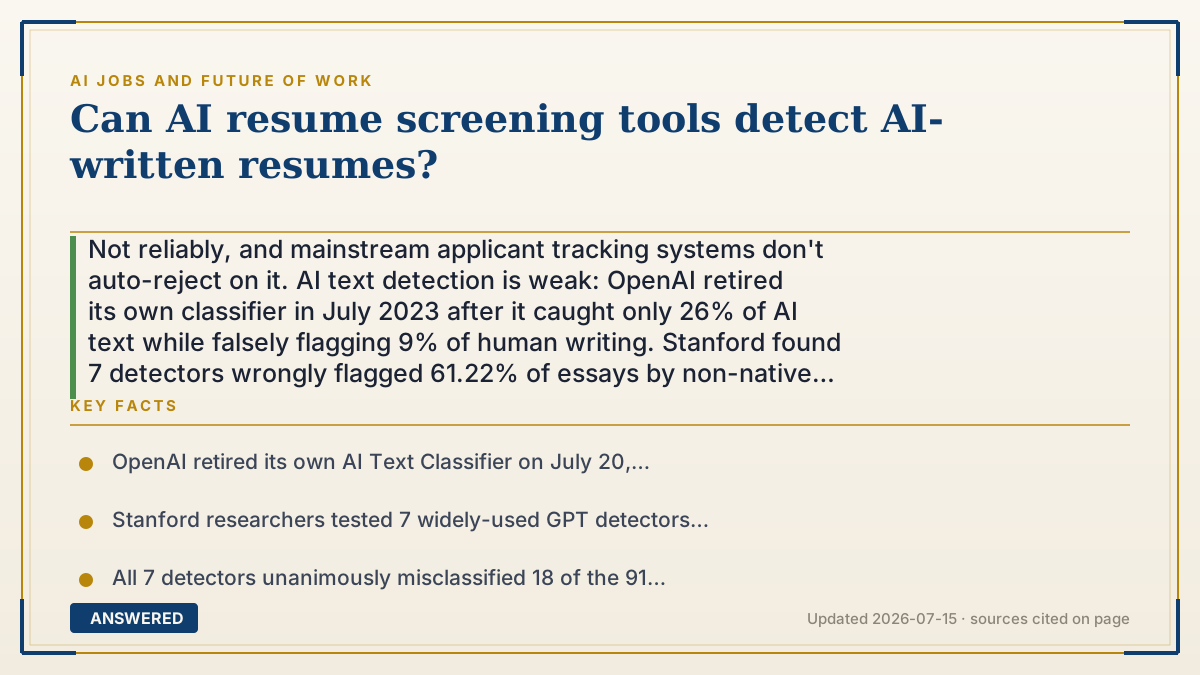
Not reliably, and mainstream applicant tracking systems don't auto-reject on it. AI text detection is weak: OpenAI retired its own classifier in July 2023 after it caught only 26% of AI text while falsely flagging 9% of human writing. Stanford found 7 detectors wrongly flagged 61.22% of essays by non-native English writers.
Why — the first-principles explanation
Detection fails for a reason that's baked into the math. Detectors mostly measure perplexity — how surprising the word choices are. AI text is low-perplexity by construction, because the model literally picks high-probability words. The problem is that plenty of human writing is also low-perplexity: people writing in a second language, people using a formal register, and — critically — anyone writing a résumé, which is the most templated, cliché-saturated document in professional life. "Results-driven professional with a proven track record" is exactly what a detector sees as machine-made, and humans have been writing that sentence since long before ChatGPT existed.
Stanford researchers quantified the damage. Testing seven widely-used GPT detectors on 91 TOEFL essays written by real humans, the detectors misclassified 61.22% as AI-generated on average — while scoring near-perfect on US 8th-grade essays. All seven detectors unanimously flagged 18 of those 91 essays, and 89 of 91 were flagged by at least one. That's not a tunable margin of error; that's a systematic bias against non-native English writers.
The same study showed detection collapses from the other side too. Prompting the AI to "elevate the text by employing literary language" dropped detection rates from as high as 100% to as low as 13%. So the tool fails in both directions at once: it flags innocent humans and misses anyone who added one extra prompt. A test that's both easy to trip and easy to evade isn't a test.
The economics finish the argument. A large employer might receive 250,000 applications a year. Even a genuinely good 1% false-positive rate rejects 2,500 real candidates — and since the errors land disproportionately on non-native English speakers, that's discrimination exposure under laws like NYC's Local Law 144. This is why no major ATS auto-rejects for AI authorship: the liability is real and the accuracy isn't. Recruiters do notice AI writing — but they notice it as humans, by its blandness, not because a detector flagged it.
An example that makes it click
Imagine screening job applicants by rejecting anyone wearing a navy suit, on the theory that con artists wear navy suits. You'd catch some con artists. You'd also reject every honest accountant in the building — and any con artist who read the memo would simply wear brown.
That's an AI detector. "Sounds polished and predictable" is the navy suit. It's evidence of nothing, because that's how résumés have always been written, and because one extra prompt changes the outfit. Stanford's numbers make it concrete: 61 out of every 100 real human essays by non-native speakers got tagged as robots, while AI text that had been told to write with flair sailed straight through.
Key facts
- OpenAI retired its own AI Text Classifier on July 20, 2023 due to a 'low rate of accuracy'; it correctly identified only 26% of AI-written text while falsely labeling 9% of human writing as AI-generated.
- Stanford researchers tested 7 widely-used GPT detectors on 91 human-written TOEFL essays: average false-positive rate was 61.22%, versus near-perfect accuracy on 88 US 8th-grade essays (Liang et al., Patterns, 2023).
- All 7 detectors unanimously misclassified 18 of the 91 TOEFL essays (19.78%) as AI-authored, and 89 of 91 (97.80%) were flagged by at least one detector.
- Simply prompting the AI to 'elevate the provided text by employing literary language' cut detection rates from up to 100% down to as low as 13%.
- Rewriting non-native essays to improve word choice dropped the false-positive rate from 61.22% to 11.77% — the detectors were measuring vocabulary, not authorship.
- Conversely, simplifying US 8th-grade essays to mimic non-native writing raised their false-flag rate from 5.19% to 56.65%.
▶ The 60-second explainer (script)
Can AI resume screening tools detect an AI-written resume? Not reliably — and the major applicant tracking systems don't auto-reject based on it. Here's why the technology doesn't work. Detectors mostly measure perplexity: how surprising your word choices are. AI text is unsurprising by design, because the model picks high-probability words. But so is a lot of human writing — especially people writing in a second language, and especially resumes, which are the most templated documents in professional life. 'Results-driven professional with a proven track record' looks machine-made to a detector. Humans have written that sentence for decades. Stanford put numbers on it. Seven popular detectors, ninety-one real human essays by non-native English writers: sixty-one percent got wrongly flagged as AI. On American eighth-grade essays, the same detectors were near-perfect. That's not a rounding error, that's a systematic bias. And it fails the other way too. Prompt the AI to 'elevate the text with literary language' and detection fell from a hundred percent to thirteen. So it flags innocent people and misses anyone who added one prompt. OpenAI knew this — they shut down their own detector in July 2023. It caught twenty-six percent of AI text and falsely accused nine percent of humans. Here's what's actually true: recruiters do notice AI writing. Not because a detector caught you — because it's boring. Specific numbers and real stories are what read as human.
What authoritative sources say
People also ask
Will an ATS like Workday or Greenhouse auto-reject my resume for AI?
Mainstream applicant tracking systems don't natively detect or auto-reject on AI authorship. The false-positive math makes it commercially and legally reckless at application volumes in the hundreds of thousands.
Can a human recruiter tell I used AI?
Often, yes — but by reading, not by detecting. AI resumes tend to be fluent, generic, and free of specifics. Concrete numbers, named systems, and real anecdotes are what distinguish a human draft.
Is it against the rules to use AI on my resume?
Generally no — most employers treat it like a grammar checker. What gets people fired is inaccuracy, so the real risk is AI inserting skills, metrics, or credentials you don't actually have.
Why do detectors flag non-native English speakers so heavily?
Because they measure vocabulary predictability, not authorship. Stanford showed that simply improving word choice in the same essays dropped the false-positive rate from 61.22% to 11.77%.
What's the safe way to use AI on a resume?
Use it to restructure and tighten your own facts, then verify every line is literally true. Add the specifics a model can't know — real numbers, real systems, real outcomes — which also happens to be what makes it read as human.