Do AI platforms speak to each other?
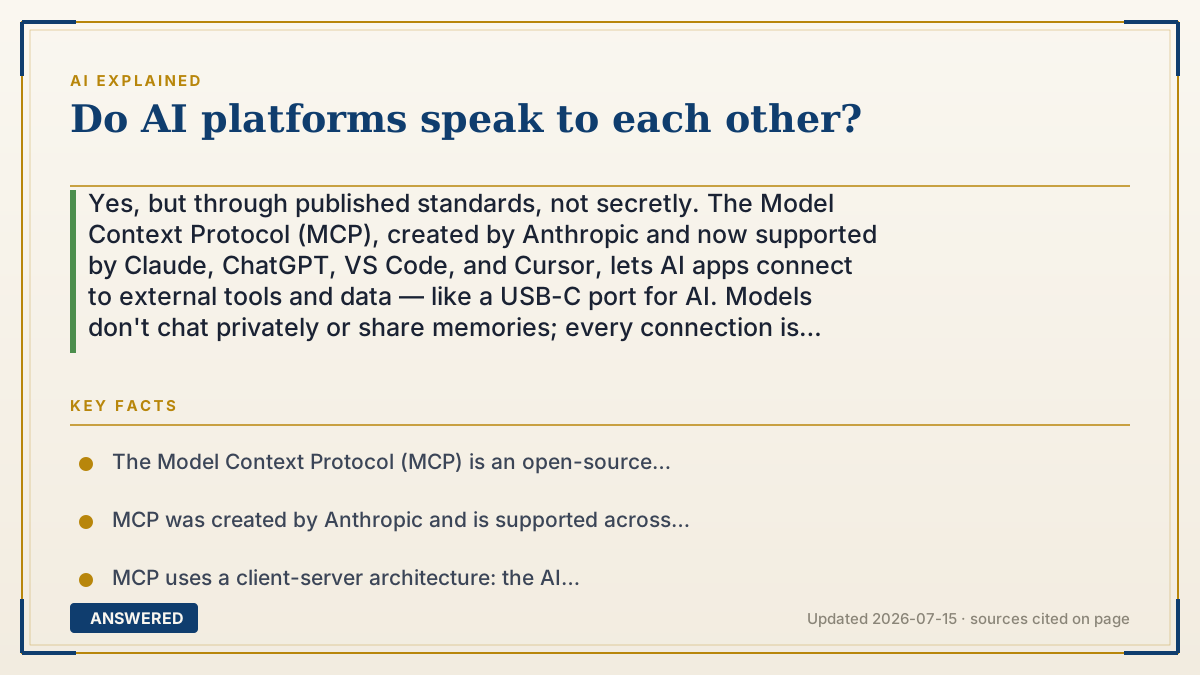
Yes, but through published standards, not secretly. The Model Context Protocol (MCP), created by Anthropic and now supported by Claude, ChatGPT, VS Code, and Cursor, lets AI apps connect to external tools and data — like a USB-C port for AI. Models don't chat privately or share memories; every connection is code someone wrote and configured.
Why — the first-principles explanation
The question usually carries a quiet worry: are these systems talking behind our backs, comparing notes, pooling what they know about me? The answer is no, and the reason is architectural rather than a matter of trust.
A language model is not a running entity. It's a function: text goes in, text comes out, and then nothing persists. It has no network connection, no background process, no way to initiate anything. Between your messages, the model isn't waiting — it isn't anywhere. So a model cannot phone another model any more than a calculator can phone another calculator. Every connection you've heard about is software wrapped around the model, written by developers, doing an explicit thing.
What those wrappers do has become standardized, and that's the real story. Before 2024, every AI-to-tool connection was custom: if you wanted Claude to read your Google Drive, someone wrote Claude-to-Drive glue code. Ten models times ten tools meant a hundred integrations. MCP — the Model Context Protocol, an open standard introduced by Anthropic — collapsed that. The official description is that it's "like a USB-C port for AI applications": build one server for your data or tool, and any MCP-compatible AI can use it. That's why adoption spread across competitors. Claude and ChatGPT both support it; so do developer tools like Visual Studio Code and Cursor. Rivals agreeing on a plug shape is unusual and tells you the pain was real.
So what does "speaking" actually look like? It's a client-server exchange in the open. Your AI app is the client. An MCP server sits in front of your calendar, your database, or a search engine and advertises what it can do. The model asks for a tool, the server runs it, the result comes back as text the model reads. It's the same pattern as any API call — the novelty is that the caller decides in plain language rather than hard-coded logic.
The honest boundaries: models don't share memory or training data across companies. Two AI apps only interact if a human configured them to. And the risk isn't secret collusion — it's the opposite. It's that you gave an assistant access to your Drive, forgot, and it's doing exactly what you authorized. The permission you granted is the whole story.
An example that makes it click
Think about the electrical outlet in your wall. A lamp, a laptop charger, and a kettle all plug into the same three holes and work. That doesn't mean the lamp is talking to the kettle, or that they compare notes about your evening. They just agree on a plug shape.
MCP is that plug shape for AI. Before it, every appliance came with its own weird proprietary socket — you needed a different adapter for each device in each room. Now Claude, ChatGPT, VS Code, and Cursor all fit the same outlet, and your calendar or your database can be wired up once and used by any of them.
And notice: the outlet only does something when you plug something in. The wall isn't reaching out to your kettle.
Key facts
- The Model Context Protocol (MCP) is an open-source standard for connecting AI applications to external systems, described officially as 'like a USB-C port for AI applications.'
- MCP was created by Anthropic and is supported across competing products, including Claude and ChatGPT, plus developer tools Visual Studio Code, Cursor, and MCPJam (as of 2026-07).
- MCP uses a client-server architecture: the AI application is the client, and an MCP server exposes data sources (files, databases), tools (search, calculators), and workflows (specialized prompts).
- The protocol is open, published, and documented publicly — connections are configured by developers and users, not initiated by models themselves.
- Language models are stateless functions with no network access of their own; any external connection is performed by the surrounding application code.
- Real-world MCP uses include an agent reading your Google Calendar and Notion, Claude Code building a web app from a Figma design, and models driving Blender to create 3D designs.
▶ The 60-second explainer (script)
Do AI platforms speak to each other? Yes — but not the way the question usually implies. There's no back channel where models compare notes about you. Here's why that's architecturally impossible, not just unlikely. A language model isn't a running entity. It's a function: text goes in, text comes out, and then nothing persists. It has no network connection, no background process, no way to start anything on its own. Between your messages, the model isn't waiting somewhere — it isn't anywhere. A model can't phone another model any more than a calculator can phone another calculator. So every connection you've heard about is software wrapped around the model, written by developers, doing an explicit thing. What's changed is that those wrappers got standardized. Before 2024, every AI-to-tool link was custom glue code. Ten models times ten tools meant a hundred integrations. Then came MCP — the Model Context Protocol, an open standard from Anthropic. Its own docs describe it as a USB-C port for AI applications. Build one server for your data, and any compatible AI can use it. And that's why it spread across rivals: Claude and ChatGPT both support it, so do VS Code and Cursor. Competitors agreeing on a plug shape tells you the pain was real. Think of a wall outlet. A lamp, a charger, and a kettle all fit the same three holes. That doesn't mean the lamp talks to the kettle. They just agree on a plug. And the outlet only does something when you plug something in. So the honest boundaries: models don't share memory or training data across companies, and two AI apps only interact if a human wired them together. The real risk isn't secret collusion. It's the opposite — you granted an assistant access to your Drive, forgot about it, and it's doing exactly what you authorized.
What authoritative sources say
People also ask
Can ChatGPT and Claude talk to each other directly?
Not on their own. Both support MCP, so a developer can wire them into the same tools or even into each other — but that's configured software, not the models choosing to communicate.
Do AI companies share my conversations with each other?
No. Models don't share memory or training data across companies. Your data moves between services only if you or a developer explicitly connected them.
What is MCP in plain English?
An open standard for plugging AI apps into your data and tools — its own docs call it 'a USB-C port for AI applications.' Build one connector, and any compatible assistant can use it.
Should I worry about AI systems coordinating behind my back?
That's not the realistic risk. Models are stateless and can't initiate anything. The practical concern is access you granted and forgot — an assistant with standing permission to your files or email.
Why did competing AI companies agree on one protocol?
Because custom integrations don't scale — ten models times ten tools is a hundred pieces of glue code. A shared plug shape means each tool gets built once and works everywhere.