Do college admissions check for AI?
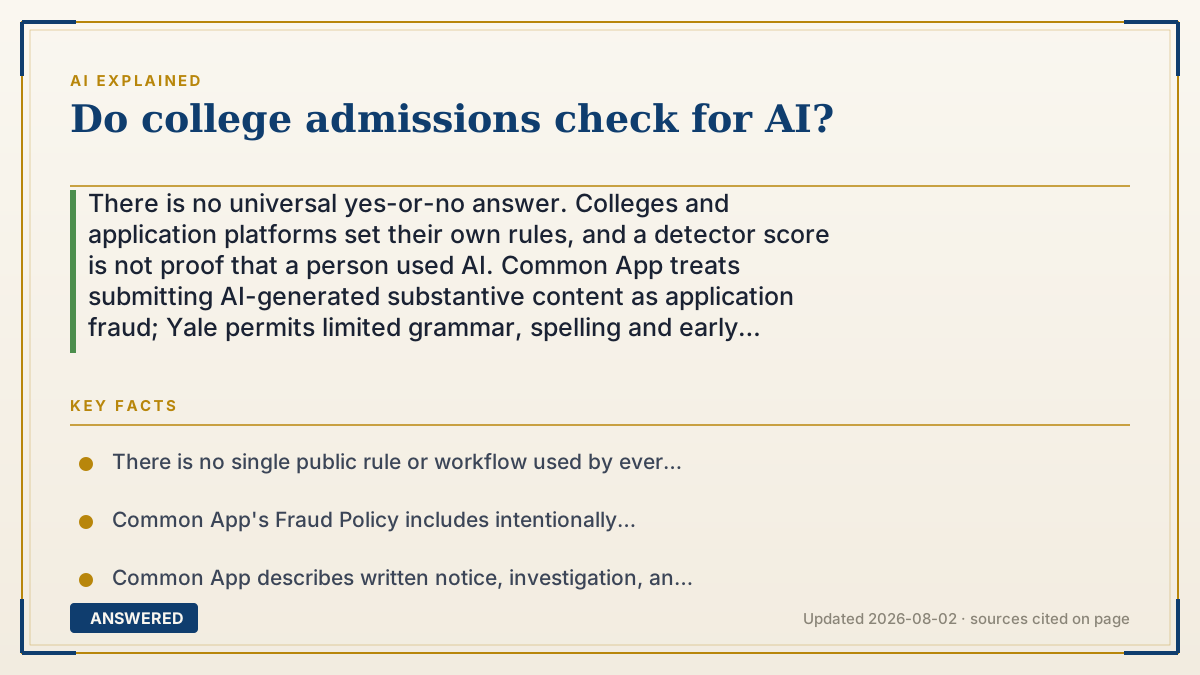
There is no universal yes-or-no answer. Colleges and application platforms set their own rules, and a detector score is not proof that a person used AI. Common App treats submitting AI-generated substantive content as application fraud; Yale permits limited grammar, spelling and early brainstorming help, while Brown says applicants may not use AI for application content beyond basic proofreading. Read the current policy for every school and platform on your list.
Why — the first-principles explanation
“Do colleges check for AI?” combines two different questions: what a school permits and how a school investigates a concern. The first is a policy question. The second is an evidence and process question. Neither has one answer for every college, application cycle or type of submission.
The safest starting point is authorship. Common App's current fraud policy says that intentionally misrepresenting the substantive content or output of an AI platform as your own original work can be fraud. It also describes a notice, investigation, appeal and possible account consequences. That is different from saying every essay is automatically scanned. A member college may have its own internal review or reporting procedure, and Common App says members are not required to report every alleged instance to Common App.
AI detectors are a weak standalone test of authorship. They infer statistical patterns in text; they do not observe who typed the words or verify a draft history. In a Stanford study of seven detectors, 61.22% of 91 human-written TOEFL essays by non-native English students were classified as AI-generated, while the same detectors were near-perfect on essays by U.S.-born eighth-graders. The sample is old and limited, so it is not a current error rate for every product. It is strong evidence for one practical rule: a score should trigger careful human review, not serve as a verdict.
Schools may instead look at the whole application and the applicable policy: whether the writing is your own, whether claims can be verified, whether the voice and experiences are coherent across submissions, and whether a counselor or member reports a concern. Brown publicly describes randomly verifying a small sample of credentials after admission, while Yale explains that its readers want the applicant's perspective and character. Those are examples, not a universal admissions protocol.
Allowed assistance also varies. Yale's policy allows grammar or spelling review and general advice or topic suggestions at the start of writing, but treats substantive generated application content as fraud. Brown says AI is not permitted in application content, while allowing basic spelling and grammar review. A different school can draw a different line. If a rule is unclear, ask the admissions office in writing, save the answer and follow the stricter interpretation until you have clarity. Never submit generated prose as your own, and do not assume a detector's “human” result makes a policy violation safe.
An example that makes it click
Suppose a university allows spelling review but not generated sentences. You brainstorm a story, write the draft yourself, ask a teacher to comment on clarity, and use a proofreading tool only to identify a misspelling. You keep the draft and revision history, then submit the words you chose and can explain the experiences in an interview. That process follows the published boundary. If another university bans AI assistance in application content, the same proofreading step may not be allowed there. The school policy—not a detector score—is the deciding rule.
How to do it
- List every school, application platform and scholarship that will receive your words. Treat a university's admissions policy, the Common App policy and any program-specific instruction as separate documents.
- Read the policy for the current application cycle from the official admissions site. Record exactly what it says about brainstorming, grammar, translation, editing, generated text, recommendation materials, portfolios and disclosures.
- If the wording is ambiguous, email or call the admissions office before using the tool. Quote the exact proposed use, ask for a written answer and save the response with the date and cycle.
- Write the substantive content yourself. Use your own experiences, observations and decisions; do not paste a generated paragraph into an essay and merely change a few words.
- Keep normal evidence of your process: notes, outlines, dated drafts, document history and feedback from permitted people. Preserve it honestly; never manufacture a writing trail after the fact.
- Use only assistance the policy permits. A grammar or spelling review is not automatically allowed everywhere, and “suggest a better sentence” is more substantive than correcting a typo.
- Check every supporting item separately. Essays, short answers, activity descriptions, portfolios, recommendation letters, translations and application forms can have different authorship rules.
- Do not use an AI detector as a pre-submission certificate or rewrite your voice to evade one. A false negative does not make generated work yours, and a false positive does not prove misconduct.
- If a school raises a concern, ask for the applicable rule and the evidence, respond truthfully, provide contemporaneous process records and use the stated appeal or review channel. Do not delete or alter records.
- Before submitting, reread the certification and save a copy of the final application. Confirm that every factual statement and every substantive sentence is accurate, honestly presented and compliant with that recipient's current policy.
Key facts
- There is no single public rule or workflow used by every college to check AI in applications; policies, cycles, programs and application platforms differ.
- Common App's Fraud Policy includes intentionally misrepresenting the substantive content or output of an artificial intelligence platform as one's own original work.
- Common App describes written notice, investigation, an opportunity to appeal and possible suspension, termination or disclosure to colleges on a user's My Colleges list after a fraud determination.
- Common App says member colleges are not required to report every alleged instance of fraud to Common App and may use their own internal protocols.
- Yale's published AI policy permits grammar or spelling review and general advice or topic suggestions at the start of writing, but treats substantive generated application content as fraud.
- Brown's published policy says AI is not permitted in application content, while allowing basic spelling and grammar review; its admissions office also describes random credential verification for a small sample of matriculating students.
- A Stanford study tested seven detectors on 91 human-written TOEFL essays by non-native English students and found 61.22% classified as AI-generated; this limited 2023 study is not a universal current detector benchmark.
- The Stanford study found 18 of 91 TOEFL essays unanimously flagged and 89 of 91 flagged by at least one detector, while detectors were near-perfect on the study's U.S.-born eighth-grade sample.
- Detector output is a probabilistic signal about text patterns, not direct evidence of who authored a document; a human review and the applicable policy are necessary for a fair decision.
- Keeping genuine drafts and revision history can help explain authorship, but it cannot override a school rule or make false information truthful.
Follow the policy, preserve authorship and verify the evidence
Separate a school's permitted AI assistance from its investigation process, then use the current official rule, honest drafts and a fair review path—not a detector score—as your decision framework.
▶ The 60-second explainer (script)
Do college admissions check for AI? There is no universal yes or no. Separate the rule from the investigation. Common App says intentionally submitting the substantive output of an AI platform as your own original work can be application fraud, with notice, review, appeal and possible account consequences. But that does not mean every essay is automatically scanned. Schools can have their own procedures. AI detectors are not authorship proof: a Stanford study found seven detectors misclassified 61.22 percent of 91 human-written TOEFL essays by non-native English students, while performing near-perfectly on the study's U.S.-born eighth-grade sample. Policies also differ. Yale permits limited grammar, spelling and early brainstorming help; Brown says AI is not permitted in application content beyond basic proofreading. Read every current policy, ask the admissions office when wording is unclear, write the substantive content yourself, keep honest drafts and never treat a detector's human score as permission.
What authoritative sources say
People also ask
Do colleges run every application essay through an AI detector?
There is no reliable public evidence that every college does this, and schools do not share one universal workflow. Some may use software or other review methods, while published policies focus on authorship and truthful certification. Check the specific school and application platform.
Can an AI detector prove that I used ChatGPT?
No. A detector estimates patterns in text; it does not observe who wrote the words. Stanford's limited study found substantial false positives for human TOEFL essays. A score can prompt questions, but it should not be treated as conclusive authorship proof.
Can I use AI to fix grammar in a college essay?
Only if the recipient's current policy allows it. Yale permits grammar or spelling review under its policy, while Brown allows basic proofreading but prohibits AI use in application content. Other schools may be stricter, so ask before using the tool.
Can I use AI to brainstorm an essay topic?
Some schools allow general advice or topic suggestions at the beginning, and some may not. Yale explicitly lists this as permitted in its policy. Do not turn generated ideas or sentences into substantive application content without confirming the recipient's rule.
What counts as AI-generated application content?
The definition depends on the policy, but it generally includes substantive words, ideas, expressions or experiences produced by an AI system and submitted as if they were yours. Read the exact policy rather than relying on a percentage of “AI assistance.”
What happens if Common App determines fraud?
The current policy describes written notice, an investigation, a chance to appeal and a final determination. Possible actions include temporary or permanent suspension, account termination and disclosure of the finding to colleges on the user's My Colleges list.
Will colleges compare my essay with my other writing?
A reader may consider the application as a whole, but practices differ and no applicant should assume a particular comparison test. Write in your own voice, keep honest drafts and make sure you can explain the experiences and claims in every submission.
Are international or multilingual students more likely to be falsely flagged?
A Stanford study found a serious false-positive pattern for the non-native English TOEFL essays in its sample. It does not predict every current detector, but it is a reason not to treat a detector score as a verdict and to require fair human review.
Should I run my essay through an AI detector before submitting?
Not as a compliance test. A “human” result cannot authorize prohibited assistance, and a high score can pressure you to distort your authentic voice. Follow the policy, keep your real writing process and ask the admissions office if you are unsure.
What should I do if a college accuses me of using AI?
Stay truthful and follow the notice or appeal procedure. Ask which policy applies and what evidence is being considered, provide genuine contemporaneous drafts or revision history, explain permitted assistance accurately and seek help from a counselor or advisor. Do not fabricate or delete records.
How can I use AI safely while applying to college?
Start with the strictest applicable rule: write substantive content yourself, use only explicitly permitted proofreading or planning help, avoid uploading sensitive documents, save the policy and your drafts, and ask the school before using a borderline feature.
The same question, asked other ways
- Do colleges check for AI in application essays?