How can I tell if something was written by AI?
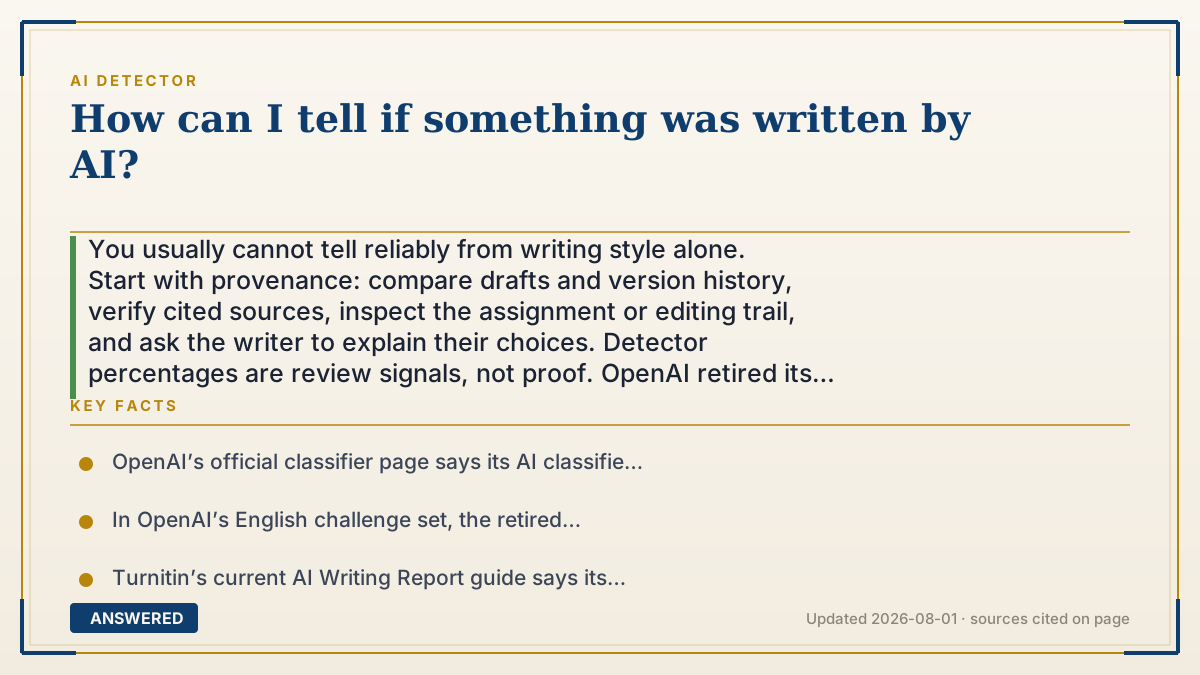
You usually cannot tell reliably from writing style alone. Start with provenance: compare drafts and version history, verify cited sources, inspect the assignment or editing trail, and ask the writer to explain their choices. Detector percentages are review signals, not proof. OpenAI retired its classifier for low accuracy, and Turnitin says its report should not be the sole basis for adverse action.
Why — the first-principles explanation
A text does not contain a universal, reliable “AI-written” stamp. A detector estimates how closely a sample resembles patterns in a model- and dataset-dependent test; it does not identify the author or prove how the text was produced. Human writing can be formulaic, translated, edited or constrained by a rubric, while AI output can be revised, paraphrased or mixed with human writing.
A stronger review starts with an evidence chain. Find the earliest draft, outline, notes, source files and version history. Check whether cited sources exist and support the claims. Compare the submitted text with the writer’s earlier work only as context, not as a style verdict. Ask the writer to explain the argument, evidence and revision choices, and record the tool, model, language, text length and date if a detector was used. Keep the original file and follow the applicable school, workplace or publishing policy.
Detectors can be useful for triage, but their limits are material. OpenAI says its own classifier was removed on July 20, 2023 because of low accuracy and says such a classifier should not be a primary decision tool. Turnitin’s current guide says its AI Writing Report may misidentify human, AI-generated and AI-paraphrased text and should not alone trigger adverse action. Stanford researchers found substantial false flags against essays by non-native English writers. The practical answer is therefore not “look for seven tells”; it is “assemble converging, policy-compliant evidence and let the person respond.”
An example that makes it click
Suppose a paper receives an 82% detector score. That number does not show who wrote it or whether an authorized editing tool was used. Preserve the document, inspect its version history, verify the citations, ask the writer to walk through the reasoning and apply the written policy. If the history is incomplete, the correct result may be “insufficient evidence,” not a confident accusation.
How to do it
- State the decision and stakes: casual curiosity, editorial review, school discipline, employment or a legal/reputational claim require different safeguards.
- Preserve the original file and collect drafts, notes, source documents, version history and any disclosure of AI assistance before uploading text to another service.
- Verify the content: open citations, check quotations, compare claims with primary sources and look for invented references or unexplained factual changes.
- Ask the writer to explain the thesis, evidence, revisions and process. Treat the conversation as one piece of evidence, not a performance test.
- If you run a detector, record its name, model/version, language, text length and date. Treat its percentage as a weak review signal; do not compare scores across tools as if they were the same scale.
- Apply the relevant written policy and privacy rules. Tell the person what evidence is being considered, give them a chance to respond and document the reviewer’s reasoning.
- Do not make a disciplinary, hiring, publishing or reputational decision from a detector score alone. If the evidence conflicts, escalate to a qualified human reviewer or record that the result is inconclusive.
Key facts
- OpenAI’s official classifier page says its AI classifier was removed on July 20, 2023 because of low accuracy and should not be used as a primary decision-making tool.
- In OpenAI’s English challenge set, the retired classifier correctly identified 26% of AI-written text and incorrectly labeled human-written text as AI-written 9% of the time; performance varied with length, language and editing.
- Turnitin’s current AI Writing Report guide says its model may misidentify human-written, AI-generated and AI-paraphrased text, so the report should not be the sole basis for adverse action against a student.
- Turnitin says its 0–19% range has a higher incidence of false positives and is marked with an asterisk in new reports; its model release notes also say updates do not retroactively change existing reports.
- Stanford HAI summarizes a study in which seven detectors flagged 61.22% of TOEFL essays by non-native English writers as AI-generated, and at least one detector flagged 89 of 91 essays.
- Washington State University’s February 2026 policy page says it does not endorse an AI detector as the sole support for an academic-misconduct case and highlights privacy, intellectual-property and fairness risks.
- C2PA explains that Content Credentials can provide signed, tamper-evident provenance for supported documents and media; a missing credential does not prove human authorship and a valid credential does not prove every claim in the content.
Use an evidence chain, not a detector verdict
For school, work and publishing decisions, verify provenance and policy before comparing tools or uploading someone’s text.
▶ The 60-second explainer (script)
Can you tell if text was written by AI? Usually not from style alone. Start with provenance: preserve the original, compare drafts and version history, verify citations and ask the writer to explain the argument and revisions. Detector percentages are triage, not proof. OpenAI retired its own classifier because its accuracy was too low. Turnitin says its current report may misidentify human, AI-generated and AI-paraphrased text and should not be the sole basis for adverse action. Stanford research also found serious false flags against non-native English writers. In school, work or publishing, follow the written policy, protect the person’s data, let them respond and combine independent evidence. If the evidence conflicts, the defensible answer is inconclusive—not a confident accusation based on one score.
What authoritative sources say
People also ask
Can an AI detector prove that a person used AI?
No. It returns a model- and dataset-dependent estimate. OpenAI retired its own classifier for low accuracy, and Turnitin says its report may misidentify text and should not be the sole basis for adverse action.
What are reliable signs that text was written by AI?
There are no reliable style signs that work across authors, languages and models. Invented citations, missing drafts or an inability to explain the work can justify closer review, but each is a prompt for evidence—not proof of AI use.
Should a teacher accuse a student based on a detector score?
No. Follow the institution’s written policy, preserve the original, review drafts and sources, speak with the student and document converging evidence. WSU’s policy explicitly rejects using an AI detector as the sole support for a misconduct case.
Does a low detector score prove the writing is human?
No. A low score only means that particular model did not flag the sample. It does not establish authorship, especially after editing, paraphrasing, translation or changes in length and language.
Can version history prove who wrote a document?
Version history is useful corroborating evidence, especially when it shows a plausible drafting process and source work. It can be incomplete, edited or shared, so interpret it alongside the document, policy and the writer’s explanation.
What should I do if someone falsely says my writing is AI-generated?
Keep the original file, drafts, notes, sources and version history. Ask which tool and version produced the allegation, request the written policy and respond with your process. Ask for human review and an appeal path; a percentage alone is not proof.
Is uploading student or confidential work to a detector safe?
Check approved-tools, retention, intellectual-property and data-protection rules before uploading. Use the minimum necessary text and an approved workflow; WSU specifically warns about privacy and intellectual-property risks.
The same question, asked other ways
- How can you tell if something was written by AI?
- How to tell if something was written by AI?
- How do you know if something was written by AI?
- How to tell if something is AI written?
- How to tell if an essay was written by AI?
- How can you tell if an essay was written by AI?
- How can you tell if AI wrote something?
- How to tell if a student used AI?