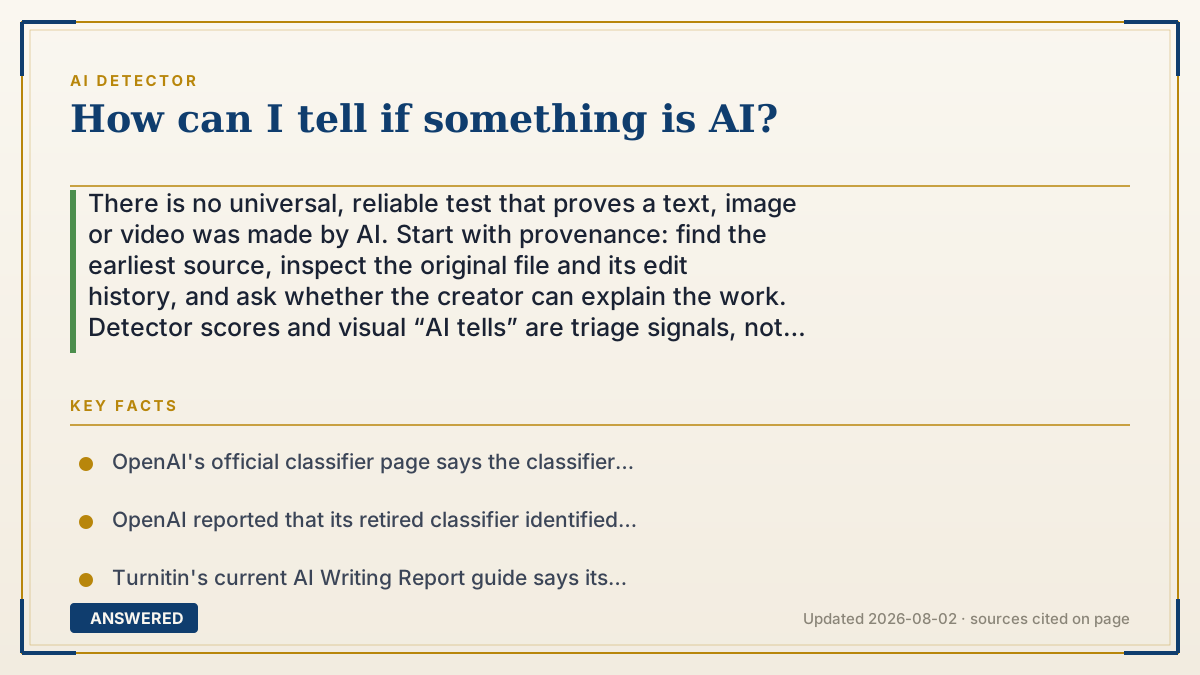
How can I tell if something is AI?
There is no universal, reliable test that proves a text, image or video was made by AI. Start with provenance: find the earliest source, inspect the original file and its edit history, and ask whether the creator can explain the work. Detector scores and visual “AI tells” are triage signals, not proof of authorship, intent or misconduct. For school, hiring or reputation decisions, preserve evidence, follow the written policy and require human review.
Why — the first-principles explanation
A detector does not observe authorship. It compares a sample with patterns learned from particular data and returns a model-dependent estimate. Human writing can be formulaic, translated, edited, constrained by a rubric or produced by several collaborators. AI output can be paraphrased, mixed with human writing or transformed by a platform. Short text, language, genre, model generation and editing can all change the result, so a percentage is not a universal probability of AI use.
The stronger question is “what evidence connects this file to its claimed origin?” For text, look for dated drafts, outlines, source notes, version history, citations and a conversation in which the creator can explain the argument. For images, video, audio and documents, find the earliest publication, inspect the original file and look for Content Credentials or other provenance metadata. C2PA describes Content Credentials as cryptographically signed, tamper-evident records of declared creation and edit events. They can strengthen a chain of evidence, but they do not prove every caption, identity or ingredient, and metadata can be removed or separated from the asset.
Use an AI detector only as triage. OpenAI retired its own classifier in July 2023 because of low accuracy and said it should not be a primary decision-making tool. In its English challenge set, that classifier identified 26% of AI-written text and falsely labeled human text 9% of the time; those are historical results for one classifier and test set, not a universal accuracy rate. Turnitin likewise says its current AI Writing Report may misidentify human, AI-generated and AI-paraphrased text and should not be the sole basis for adverse action against a student.
Vendor updates do not turn a detector into an authorship oracle. Turnitin's 2026 model notes describe improvements and language-specific behavior, and say older reports may need resubmission to reflect a new model. Its reports separate AI-writing detection from similarity, and scores below 20% are not surfaced as a precise percentage in the current presentation because false positives are possible. Record the tool, version, language, sample length and date if a detector is used; never compare percentages from different products as if they share a scale.
Fairness matters. One published evaluation found that seven GPT detectors flagged 61.22% of TOEFL essays by non-native English writers as AI-generated. That result describes one study, population and detector set; it is a warning about language and evaluation bias, not a general false-positive rate for every tool. Constrained writing, disability, translation and editing can all look unusual without proving misconduct.
For a school or workplace concern, the decision process is more important than the score. State the applicable AI policy before the assignment or task, preserve the original, give the person a chance to explain, review drafts and sources, and combine independent evidence. Washington State University's guidance recommends clear policy, proactive teaching and additional evidence rather than relying on AI detection alone. For hiring, discipline, publication or reputational claims, involve the responsible human reviewer and document an appeal or correction path.
Protect the data while investigating. Check whether the institution has approved a detector, what it retains, who can see the submission and whether the work may be used for model improvement. Upload the minimum necessary content and do not put confidential, student or client material into an unapproved service. A tool that is convenient for triage can still create privacy, intellectual-property and procedural risk.
A defensible conclusion is usually graded, not binary: verified provenance, strong converging evidence, unresolved or insufficient evidence. “No credential” does not mean human; “high detector score” does not mean AI; “AI-assisted” does not automatically mean cheating or deception. Use the least harmful explanation that fits the evidence, apply the written policy consistently and leave room for the evidence to be corrected.
An example that makes it click
A detector reports 82% AI on a student's essay, but there is no version history. That number is a reason to review, not a verdict. Ask for the outline, drafts, source notes and a short explanation of the argument; verify the citations and apply the institution's written policy. Now imagine a photograph with a valid Content Credential showing capture and edits by a trusted implementation. That provenance is useful, but it still does not prove the caption or identity of every person in the scene. In both cases, the evidence chain is more informative than a style guess.
How to do it
- Classify the medium: text, image, video, audio, document or account. No single detector works equally well across all of them.
- Find provenance before running a detector: locate the earliest publication, inspect the original file, compare versions and ask for drafts, source files or edit history where appropriate.
- For text, verify checkable claims, citations, quotations and unexplained changes in voice. These are review prompts, not proof of AI use.
- For media and documents, inspect Content Credentials or other provenance metadata and verify the signer or credential chain when a validator is available. Missing metadata proves nothing because it can be stripped or lost.
- If you use a detector, record the product, model or report version, language, text length, settings and date. Treat the score as a weak signal and do not compare percentages across tools.
- For a school or workplace concern, read the written AI and privacy policy, preserve the original, let the person respond and combine drafts, sources, version history and conversation evidence.
- Do not publish an accusation or make a disciplinary, employment, admissions or reputational decision from an automated percentage. Ask a qualified reviewer to assess converging evidence.
- Document the result as verified provenance, strong evidence, unresolved or insufficient evidence. Record what would change the conclusion and provide a correction or appeal path.
- Delete or restrict investigation copies according to the approved retention policy. Never upload sensitive work to an unapproved detector merely to obtain a quick score.
Key facts
- OpenAI's official classifier page says the classifier was removed on July 20, 2023 because of low accuracy and should not be used as a primary decision-making tool.
- OpenAI reported that its retired classifier identified 26% of AI-written text in an English challenge set and falsely labeled human text as AI-written 9% of the time; those results were not a universal accuracy guarantee.
- Turnitin's current AI Writing Report guide says its model may misidentify human-written, AI-generated and AI-paraphrased text, so it should not be the sole basis for adverse action against a student.
- Turnitin's 2026 model notes describe language-specific updates, improved recall and the need to resubmit older work to obtain a score from a newer model; scores below 20% are not surfaced as a precise percentage in the current presentation.
- A published evaluation of seven GPT detectors found that 61.22% of TOEFL essays by non-native English writers were flagged as AI-generated; this is one study and population, not a universal detector error rate.
- C2PA Content Credentials are cryptographically signed, tamper-evident provenance records, but validation does not prove every claim or complete ingredient chain and credentials can be removed or separated.
- A detector score is a model output conditioned on its training data, language, genre, length and editing; it is not a calibrated, cross-tool probability of authorship.
- A fair high-stakes review needs written policy, original evidence, an opportunity to respond, qualified human judgment and a correction or appeal path.
Choose your next step
Compare current options, limits and terms before you decide.
▶ The 60-second explainer (script)
Can a tool tell you for sure whether something is AI? No. Start with provenance: find the earliest source, inspect the original file and its edit history, and ask whether the creator can explain the work. Content Credentials can provide a signed, tamper-evident history when an implementation creates them, but they do not prove every caption or ingredient. AI detectors are triage signals. OpenAI retired its classifier for low accuracy, and Turnitin says its report should not be the sole basis for adverse action against a student. Preserve evidence, follow the written policy, give the person a chance to respond and require human review for school, hiring or reputational decisions.
What authoritative sources say
People also ask
Is there a tool that can tell me for sure whether text was written by AI?
No. A detector returns a model- and dataset-dependent estimate, not proof of authorship. OpenAI retired its classifier for low accuracy, and current vendor guidance still requires human judgment and additional evidence.
How can I tell if an image or video is AI-generated?
Check the earliest source, creator history, original file and any Content Credentials. Visual glitches can be clues, but they are not reliable proof: synthetic media can avoid them and real media can be edited or compressed.
Do Content Credentials prove that a file is real?
They provide a signed, tamper-evident record of declared creation and edit events from a trusted implementation. Verify the signer and chain; a credential does not prove every caption, identity or ingredient, and missing credentials do not prove human creation.
Can I accuse a student based on an AI detector score?
No. Turnitin says its report may misidentify text and should not be the sole basis for adverse action. Follow the institution's policy, preserve the original, review drafts and sources, speak with the student and document converging evidence.
What should I do if someone falsely says my work is AI-generated?
Keep the original file, version history, notes, sources and drafts. Ask which tool and version produced the allegation, request the written policy and respond with your process. A score alone is not proof; ask for human review and an appeal path.
Are AI detectors fair for non-native English writers?
Fairness varies by tool, language, genre and evaluation set. Research has documented detector bias against non-native English writing. Do not treat a detector percentage as evidence of intent or authorship, especially in a high-stakes decision.
Are AI detectors safe for confidential or student work?
Check the institution's approved-tools and privacy rules before uploading anything. A third-party detector can create retention, intellectual-property or regulated-data risks. Use the minimum data necessary and prefer an approved workflow.
Does AI-assisted work automatically mean cheating?
No. The answer depends on the task, the written policy, the assistance used and the evidence. State the policy clearly, preserve process evidence and evaluate the work with a qualified human rather than inferring intent from a score.